Prime Minister Kamla Persad-Bissessar and Chief Secretary Farley Augustine recently celebrated the granting of an export licence to the Studley Park Quarry in Tobago, marking a significant milestone for the island’s economic autonomy. The licence, issued on November 4 at the Tobago House of Assembly Legislature in Scarborough, has been hailed as a tangible step towards reducing Tobago’s reliance on external economic support. However, questions linger about the quarry’s ability to capitalize on this opportunity and generate meaningful foreign exchange earnings. Critics argue that outdated equipment and low productivity could hinder the quarry’s ability to meet export demands consistently. Additionally, the regional market for construction materials is highly competitive, with established players dominating in terms of product quality, pricing, shipping reliability, and marketing reach. Without urgent modernization and strategic improvements, the licence may remain a symbolic gesture rather than a catalyst for economic growth. The success of this initiative now rests on the Tobago House of Assembly’s ability to address these challenges and transform potential into tangible results.
分类: business
-

Ansa Merchant Bank profit rises 40%
ANSA Merchant Bank Ltd (AMBL) has announced a remarkable 40% increase in profit before tax for the nine months ending September 30, 2025, reaching $180.9 million, up from $129.4 million in the same period last year. Chairman A Norman Sabga hailed the results as a testament to the bank’s robust financial performance, with group assets growing by 2.98% and earnings per share rising to $1.78 from $1.39 in 2024. The bank’s diversified operations, including banking, insurance, and mutual funds, all contributed to this impressive growth. In the banking sector, pre-tax profit rose by 12.2% to $85.8 million, while the insurance segment saw a 45% increase to $129.4 million, driven by improved underwriting and higher investment income. The mutual funds business also performed well, generating $16.4 million in pre-tax profit, up from $15.5 million in 2024. Net operating income for the period stood at $456.4 million, compared to $415.9 million the previous year, with operating profit at $180.9 million after $275.5 million in expenses. Profit attributable to shareholders surged by 33% to $152.5 million after tax. Total assets grew to $10.22 billion, with shareholders’ equity increasing to $2.74 billion and total liabilities at $7.48 billion. The group also reported net cash from operating activities of $279.8 million and held $538.9 million in cash and cash equivalents at the end of the period. Sabga attributed the strong performance to steady growth in the loan portfolio, expansion of private-wealth management services, and improved premium income in insurance operations. He expressed confidence in the bank’s continued success and commitment to delivering value to shareholders and customers.
-

Regional agricultural officials reach consensus to enhance technical collaboration, facilitate innovative technologies to mitigate risks to food safety
Agricultural ministers from across the Americas gathered in Brasília to forge a united front against pests and diseases threatening regional food security. The meeting, hosted by the Brazilian government in collaboration with the Inter-American Institute for Cooperation on Agriculture (IICA), focused on enhancing technical cooperation, improving information sharing, and expanding access to advanced technologies. Key threats addressed included the New World screwworm, African swine fever, and other transboundary plant and animal diseases, which pose significant risks to farmers and rural communities. Participants pledged support for the Agricultural Health and Food Security Initiative of the Americas, a platform aimed at coordinating collective efforts in this critical area. Delegates from Argentina and the United States emphasized the importance of science-based decision-making in trade and agricultural production, noting that IICA Member States are the world’s largest net exporters of food. They stressed that maintaining a competitive, secure, and healthy agricultural system is vital for prosperity, public health, and regional development.
-

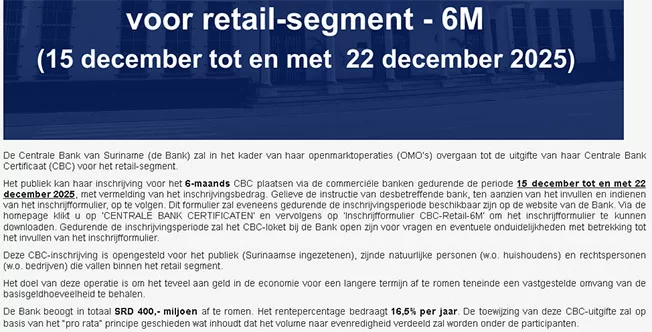
Alarm bij Deviezencommissie over gelduitvoer via stichtingen
The Foreign Exchange Commission of Suriname has raised alarms over a significant surge in foreign currency outflows through local foundations, prompting stricter regulatory measures. Chairman Arun Sankatsing revealed that tens of millions in foreign currency are being transferred abroad without proper accountability. In response, the Commission has intensified its scrutiny of fund origins, aligning with the 1947 Foreign Exchange Regulation and international anti-money laundering (AML) and counter-terrorism financing (CFT) standards. The Commission emphasized that foundations must comply with these regulations and provide transparent documentation of their financial sources. Sankatsing clarified that these enhanced controls are not new but a reinforcement of existing laws and international obligations. However, notaries representing these foundations have expressed concerns, citing delays in transaction processing and increased administrative burdens due to the stringent verification requirements. The Commission maintains that these measures are essential to safeguard Suriname’s financial integrity and comply with AML/CFT laws. The surge in foreign currency outflows, particularly through foundations, has been labeled a high-risk category under international standards, necessitating additional documentation to mitigate risks and protect monetary stability. The Commission’s actions come ahead of Suriname’s evaluation at the upcoming CFATF meeting in Barbados, where compliance with AML/CFT regulations will be assessed. Sankatsing stressed that cooperation from all stakeholders is crucial to address these challenges effectively.
-

Bedrijven zetten stap naar datagedreven toekomst
Suriname is positioning itself at the forefront of a data-driven future, as highlighted during the leadership seminar ‘Data as a Compass,’ organized by Consulytic. The event brought together executives, policymakers, and entrepreneurs to explore how data can serve as a guiding force for economic growth and decision-making. The seminar was inspired by the book ‘Data as a Compass’ by Dutch data strategist Rob van den Wijngaard, who was specially invited to Suriname for the occasion. Minister Andrew Basaron of Economic Affairs, Entrepreneurship, and Technological Innovation (EZOTI) opened the event, emphasizing that Suriname stands at a critical economic juncture. He stressed that with anticipated developments in the oil and gas sector, businesses must prepare for scaling, international competition, and more efficient decision-making. ‘Data-driven operations are no longer optional but a necessity,’ he stated. Van den Wijngaard, in his presentation, argued that the shift to data-driven practices begins not with technology but with people. ‘The success of data-driven organizations is not determined by the volume of data or the quality of software,’ he said. ‘It starts with leaders who demonstrate vision and guide their teams on a journey of learning and improvement.’ He expressed optimism about Suriname’s potential, citing motivation, curiosity, and a willingness to build a strong, future-oriented economy. The seminar also included masterclasses for EZOTI ministry officials and executives from leading companies, focusing on data-driven leadership, collaboration, and the role of data in modern business operations. Bibi Mustapha, Operations Manager at Consulytic, noted that the event marks the beginning of a broader movement. ‘The world is changing rapidly. Surinamese organizations have the opportunity not just to catch up but to lead. We are guiding businesses and government institutions through this transition—not just with technology but with knowledge, leadership, and sustainable collaboration,’ she said. Van den Wijngaard concluded with optimism, stating, ‘Something beautiful is coming to Suriname. The energy is palpable. This is a country ready to grow.’
-

Indocafe launches first national sustainable coffee certification
Santo Domingo – In a significant move to enhance the competitiveness and sustainability of its coffee sector, the Dominican Coffee Institute (Indocafe) has unveiled two groundbreaking initiatives: the Sustainable Coffee Farm Certification Program (SCF) and the Integrated Coffee Information and Services System (Siisec). These programs aim to position the Dominican Republic as a leader in sustainable coffee production while addressing global market demands. The SCF, developed under the Biodiversity in Productive Landscapes Project (BPP), marks a historic achievement as the first national certification for sustainable coffee farms in the Dominican Republic and the broader Caribbean region. This certification underscores the potential to harmonize agricultural productivity with biodiversity conservation and sustainable economic development. Meanwhile, Siisec is designed to improve traceability and quality assurance, particularly for exports to the European Union. During the launch event, the National Office of Industrial Property (ONAPI) officially awarded Indocafe the ‘Sustainable Coffee Farm’ accreditation mark, and the United Nations Development Programme (UNDP) presented the first promotional kit to producer Alfredo Díaz. Indocafe’s Executive Director, Leónidas Batista Díaz, highlighted the transformative impact of these initiatives, emphasizing their role in fostering a more resilient and globally competitive coffee industry.
-

BTL Must Pay Severance to All Retirees; Pension Doesn’t Replace Legal Rights
In a groundbreaking decision, the Caribbean Court of Justice (CCJ) has ruled that Belize Telemedia Limited (BTL) must pay severance benefits to all former employees, regardless of their retirement status. This landmark case, decided on November 5, 2025, marks a significant victory for ten retirees who argued that severance pay is a legal right under the Labour Act, even after receiving pension benefits. The CCJ’s ruling overturns BTL’s long-standing practice of substituting severance with pension benefits, a policy the company had implemented since the 1990s. Senior Counsel Eamon Courtenay, who represented the retirees, explained that the case involved three categories of employees: those who resigned, those who retired voluntarily, and those who reached the mandatory retirement age of fifty-five. Initially, the Court of Appeal had ruled that only those who resigned were entitled to severance, but the CCJ’s unanimous decision extends this right to all retirees. The court emphasized that severance is a statutory entitlement that cannot be waived or replaced by pension benefits. This ruling sets a precedent for labor rights in the Caribbean and ensures that employees are fairly compensated upon leaving their jobs.
-

Court Reinforces Workers’ Rights Under Labor Act
In a landmark ruling on November 5, 2025, the Caribbean Court of Justice (CCJ) reinforced the rights of workers under Belize’s Labor Act, emphasizing that severance pay cannot be replaced by pension benefits. The case centered on Belize Telecommunications Limited (BTL), which had ceased paying severance to employees since 1994-95, arguing that its pension scheme fulfilled the obligation. The court, however, ruled that severance is a distinct entitlement earned through service, not contributions, and must be paid regardless of pension arrangements. This decision underscores the Labor Act’s role as social justice legislation aimed at protecting workers, not employers’ financial interests. BTL is now required to compensate affected employees, with costs awarded to the appellants. Eamon Courtenay, SC, a prominent attorney, highlighted that pension plans must account for severance benefits, ensuring workers receive both entitlements. This ruling sets a precedent for labor rights in Belize and reaffirms the importance of severance as a fundamental worker protection.
-

BTL Employees Owed Severance Despite Pension Plans
In a landmark development, Belize Telemedia Limited (BTL) employees, both current and former, may now be entitled to severance pay despite their participation in pension schemes that previously excluded such benefits. Senior Counsel Eamon Courtenay highlighted the significant challenge this poses for BTL and other companies, as they must retroactively assess years of service and calculate severance entitlements for employees upon retirement or resignation. This ruling extends to former employees who only received pension benefits, potentially allowing them to claim severance pay retroactively. The judgment, which could have a ripple effect across Belize, raises critical questions about how companies will adapt and what this means for workers nationwide. Courtenay emphasized that companies with pension schemes lacking severance provisions must now accrue severance benefits from the start of employment, ensuring compliance with the Caribbean Court of Justice’s (CCJ) decision. This development underscores a pivotal shift in employee rights and corporate obligations in Belize.