作者: admin

  • Barbadians remember, reflect as Sir Garfield Sobers lies in state

    Barbadians remember, reflect as Sir Garfield Sobers lies in state

    On a solemn Monday in Barbados, thousands of locals lined the sidewalks surrounding the country’s historic Parliament Buildings, turning the heart of the capital into a space of collective mourning and celebration for one of the nation’s most beloved figures: National Hero Sir Garfield Sobers. The cricket icon, who passed away at 88 just weeks short of his 90th birthday, was lying in state in the House of Assembly chamber, drawing a steady stream of mourners who waited for hours to walk past his casket and leave tributes in official condolence books.

    While the Barbadian government arranged for condolence registers to be placed at dozens of locations across the island — from the central General Post Office in Bridgetown to the David Thompson Health and Social Services Complex in St. John — the Parliament Buildings emerged as the primary gathering spot for residents seeking to say a personal final goodbye. For many in the long, patient queues, the moment carried deep personal meaning beyond the national mourning.

    Anthony Beckles, a lifelong Barbadian who grew up connected to the Sobers family, shared that his mother and Sir Garfield’s sister were close childhood friends. “I have known Sir Garry my entire life,” he told reporters on site. “He was a great, great person, a truly tremendous man. He did so much good not just for Barbados, but for the entire world. May his soul rest in peace, and may he rise in glory.”

    Many other attendees had never had the chance to meet the cricketing legend in person, but still said they felt a moral calling to honor the man who put their small island nation on the global map through his unmatched talent and quiet humility. Marcia Ashby, who joined the queue to sign the condolence book, left a simple, heartfelt message: “We love you, Sir Garry.” She explained her presence saying, “Even though I never met him, I had to come because of who he was — he was so humble and so kind.”

    For Jane Boyce, a resident of Josey Hill in St. Lucy, the day brought back warm memories of her late father, who counted Sir Garfield as his personal hero. “Growing up as a child, I heard my dad talk about Sir Garry Sobers constantly,” she recalled. “I’m so thankful I got to meet him before he passed. He was such a pleasant, decent man. So long, farewell until we meet again. Fly with the angels, fly high, my friend. May he rest in peace and rise in glory.”

    Other mourners framed their grief through the lens of faith, acknowledging the national loss while giving thanks for Sobers’ decades of impact. Bentley Webster, who had already signed a condolence book at Grantley Adams International Airport a day before visiting Parliament, called the cricketer’s passing “a great loss.” He added, “But as Christians, we know we are only here for a little while. I thank God for the life and the legacy he leaves behind. I just bless God for him.”

    Christine Austin described the experience of seeing the National Hero lying in state as a deeply moving, almost visceral moment. “I got goosebumps all over,” she said. “He looks just like he’s sleeping. What the country is doing for him is so wonderful. May he rest in peace.”

    Throughout the day, the atmosphere around Parliament remained one of quiet, reflective emotion, with most attendees sharing a mix of profound national pride and gentle sadness. Gail Skinner, one of the mourners, voiced a common regret: that Sir Garfield did not live to mark his 90th birthday, which would have come just weeks after his death. “It’s a very solemn occasion,” she said. “I’m sorry he didn’t make it to 90, but I am so proud that he is our hero.”

    Skinner drew a comparison between Sir Garfield’s global cultural impact and that of another iconic Caribbean legend: Jamaica’s Bob Marley. “That’s what Sir Garfield Sobers did for us,” she explained. “People know Barbados all over the world because of Sir Garry Sobers. He will be in our history books forever. There will never be another cricketing hero like Sir Garfield.”

    Condolence books have been open to the public across the island since the previous Wednesday, giving both Barbadians and visiting tourists the chance to record their personal memories and messages of tribute for the National Hero. As of Monday, condolence registers still remained available at additional locations including the iconic Kensington Oval cricket ground, Holetown Post Office, and the Cricket Legends Museum, though activity at those sites paled in comparison to the steady stream of mourners at Parliament. Additional books will remain open during regular business hours at Government Headquarters, Bay Primary School, Weymouth Sports Club, and the St. Andrew Post Office for those unable to visit the capital.

    Sir Garfield Sobers, who died at the age of 89, will be honored with an official State Service of Thanksgiving this Wednesday, a national ceremony that will celebrate a life that inspired generations of Barbadians and earned the respect and admiration of the entire global cricketing community.

  • City traffic disruptions expected for Sobers’ state funeral

    City traffic disruptions expected for Sobers’ state funeral

    Barbados is preparing to lay to rest one of its most revered national figures, National Hero the Right Excellent Sir Garfield Sobers, and law enforcement officials are urging both commuters and local business owners to make advance preparations for significant traffic disruptions on the day of the state funeral, Wednesday.

    Acting Inspector Ryan Brathwaite, communications officer for the Barbados Police Service, shared detailed logistical plans in an interview with Barbados TODAY, calling on the public to remain patient and cooperative throughout the day of memorial events. “Bear with us and be cooperative,” Brathwaite emphasized, as he outlined the phased road closure schedule that will roll out across multiple areas of the island starting early Wednesday morning.

    From 6 a.m. to 2 p.m., multiple major thoroughfares in central Bridgetown will be closed to all traffic. These include Lower Bay Street, River Road, Bridge Road, St Michael’s Row, both Upper and Lower Broad Street, Cowell Street, Fontabelle, and President Kennedy Drive. The ceremonial funeral procession is scheduled to depart its starting point at approximately 8:45 a.m., meaning some routes will see full traffic prohibition while others will face extended delays. Brathwaite confirmed that roadways will be reopened incrementally as the procession moves toward its final destination, and asked the public to follow all directions from on-duty police officers deployed along the route.

    Addressing local business owners operating in and around Bridgetown, Brathwaite offered an apology for the unavoidable inconvenience the traffic disruptions will cause, and issued a key recommendation for planned deliveries: “To all the businesses in and around Bridgetown, I want to sincerely apologise for any inconvenience that this disruption may cause you on the day, and to encourage those businesses who are having deliveries to please try to have those deliveries done on Tuesday.”

    After the official service, the cortege will depart Kensington Oval and travel a second route that will require additional temporary road closures between 1 p.m. and 5 p.m. The procession will turn right onto the Mighty Grynner Highway, continue along University Hill through Warrens, turn left at the JTC Ramsay (also known as Bussa) roundabout onto Mapp Hill, pass through South District, Watts Village, Boarded Hall, and Lower Greys, before ending at Skeene’s Hill. Like the morning closures, these roads will be reopened gradually once the cortege has cleared each section.

    Additional closures will be in place around the Coral Ridge area: the road network spanning from the Coral Ridge roundabout to Newton roundabout, from the Ridge roundabout to Searles, from the Ridge roundabout to Yorkshire, and from the Ridge roundabout back to St. David’s will all be off-limits to civilian traffic during the procession’s movement through the area.

    The police force already held a full rehearsal of the procession route from Parliament to Kensington Oval this past Sunday, which required barricading multiple downtown streets and forced motorists to seek alternate routing. Following that test run, Brathwaite noted that police teams are now refining their operational plans to cut down on unnecessary disruption, with the goal of tightening protocols to minimize inconvenience for residents and businesses as much as possible ahead of Wednesday’s official event.

  • Oppositie legt Guyanees parlement stil na veerbootramp

    Oppositie legt Guyanees parlement stil na veerbootramp

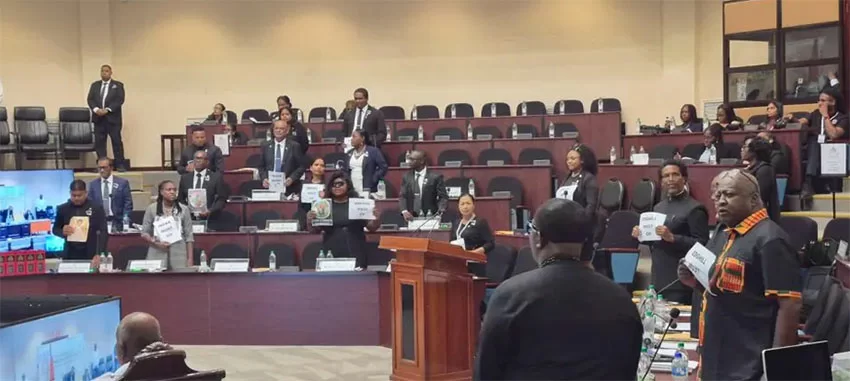
    Escalating political tensions have rocked Guyana this week, after opposition lawmakers repeatedly disrupted a National Assembly sitting on Monday to protest the government’s handling of the deadly MV Barima maritime disaster. The opposition bloc is demanding the immediate resignation of Public Works Minister Juan Edghill and former minister Deodat Indar, accusing the incumbent administration of failing to take adequate political responsibility for what has been called the worst maritime tragedy in the country’s recent history.

    Before the parliamentary sitting got underway, opposition politicians and allied activists gathered for a public demonstration outside the National Assembly building. Holding large banners and chanting unified slogans, protesters called for accountability for victims of the disaster and justice for their surviving family members, reiterating their demand that the officials they blame for lax regulatory oversight of the country’s ferry service step down.

    The demonstration spilled directly into the parliamentary chamber once proceedings began. After National Assembly Speaker Manzoor Nadir opened the sitting and a minute’s silence was held to honor the disaster’s victims, opposition lawmakers launched a noisy demonstration, shouting protest slogans and striking their parliamentary desks to disrupt proceedings. The sitting was temporarily suspended as a result of the unrest, before adjournment organizers were able to resume proceedings at a later time.

    Prime Minister Mark Phillips delivered an official update on ongoing search and rescue operations during the sitting, confirming that 30 people remain unaccounted for following the disaster and that search and recovery efforts are continuing at full capacity. Phillips also noted that the administration is moving forward with plans for an independent investigation into the causes of the incident. President Irfaan Ali reaffirmed on Monday that the Guyanese public is entitled to full transparency about what caused the disaster, confirming that an independent inquiry commission will examine whether negligence, operational errors, or other regulatory failures contributed to the tragedy.

    For the opposition, however, the government’s commitment to an independent probe does not go far enough. Opposition leaders are demanding that the inquiry not only operate independently, but also receive a formal mandate approved by a full vote of parliament. They are also pushing for immediate political consequences for the implicated officials before the inquiry’s final report is completed. Despite ongoing disruptions from the opposition, the government’s parliamentary majority pushed ahead with the scheduled legislative agenda. By the end of the sitting, lawmakers approved an additional government spending package totaling 54.9 billion Guyanese dollars. Opposition lawmakers refused to participate in the related debate and continued their protest throughout the vote, meaning the budget proposals passed without any substantive input from the opposition bloc.

    Monday’s events underscore how the MV Barima disaster has quickly evolved from a national human tragedy into a major political flashpoint that threatens to destabilize President Ali’s administration. As search teams continue to comb waterways for missing victims, political pressure on the Ali government is growing steadily, with opponents demanding full accountability for the government’s pre-disaster oversight of the state-owned ferry service and the safety of the country’s public water transport systems.

  • Griffith, Niles Advance in Commonwealth 100m

    Griffith, Niles Advance in Commonwealth 100m

    The 2014 Commonwealth Games hosted in Scotland have wrapped up the first round of sprint and swimming events, with mixed results for Team Barbados across multiple competitions. In the men’s 100-meter sprint discipline, young Barbadian sprinter Kuron Griffith delivered a solid performance in Heat 7, crossing the finish line in 10.24 seconds to claim third place. The result earned him a coveted spot in the upcoming second round of the tournament. Unfortunately, Griffith’s teammate Julian Forde could not replicate that success. Competing in his own qualifying heat, Forde posted a time of 10.58 seconds to finish fifth, a result that left him just outside the qualification cut-off and ended his 100m campaign in the opening round.

    On the women’s side of the 100m sprint, Barbados also earned a second-round berth thanks to sprinter Kishawna Niles. Nimes held her own against a deep field of competitors in Heat 8, clocking an 11.52-second run to secure second place in her heat and punch her ticket to the next stage of the competition.

    Over in the swimming pool, the Barbadian team faced early eliminations in two qualifying events. In the men’s 200-meter butterfly, Victor Ashby competed in Heat 3 and posted a time of 2 minutes 17.94 seconds, finishing seventh in the heat. That time was not fast enough to advance him to the subsequent rounds. Similarly, in the women’s 50-meter breaststroke, Adara Stoddard placed fifth in Heat 2 with a time of 34.35 seconds, which also saw her miss the mark for qualification and exit the competition in the opening stage.

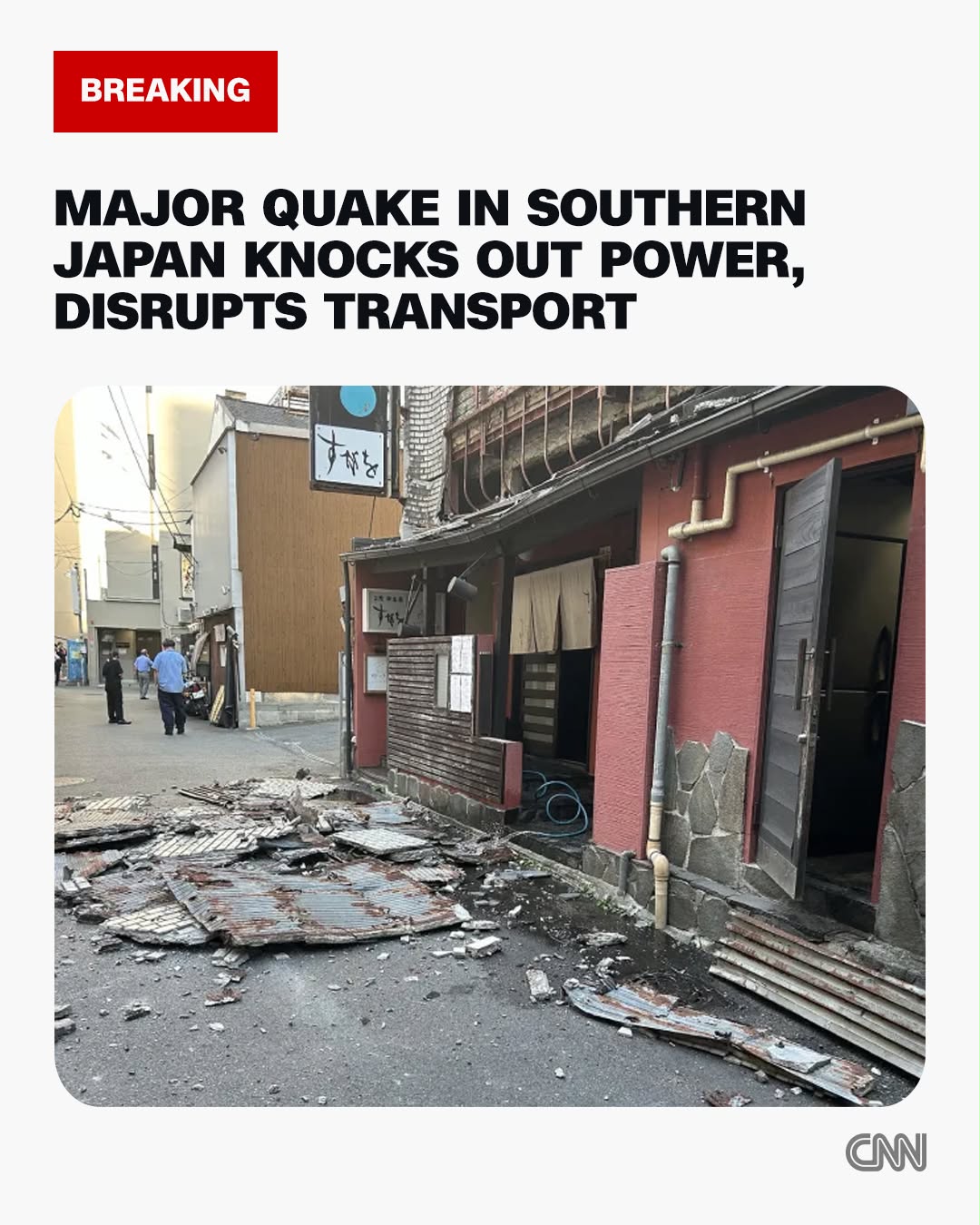
  • 7.1-magnitude earthquake strikes southern Japan, damaging buildings and bridges, and knocking out power to thousands of homes

    7.1-magnitude earthquake strikes southern Japan, damaging buildings and bridges, and knocking out power to thousands of homes

    On Tuesday, a powerful 7.1-magnitude earthquake struck Japan’s southern Kumamoto Prefecture, leaving a trail of destruction across the Kyushu region that has injured at least 50 people, cut power to tens of thousands of households, and damaged critical infrastructure. In the hours after the tremor, assessments of full casualty and damage counts are still ongoing, according to Japanese Prime Minister Sanae Takaichi, who addressed reporters from her Tokyo office Wednesday.

    “We have already confirmed multiple injuries,” Takaichi told reporters. “Power outages and small blazes have broken out in several communities, alongside damage to roads and bridges, and multiple reports of partial building collapses.”

    Public broadcaster NHK was first to report that a local hospital had recorded more than 50 quake-related injuries, while Japan’s leading financial newspaper Nikkei added that several passengers on a high-speed bullet train traveling through the region at the time of the tremor were also hurt. Visual footage from the disaster zone shows collapsed exterior walls on commercial buildings in central Kumamoto City, and multiple damaged structures across the prefecture. Among the damaged sites is an Aeon Co. shopping mall, where NHK reported a small explosion; the company has not yet issued a public statement on the incident. Multiple other structures have been recorded as partially collapsed or engulfed in small fires in local broadcaster footage.

    Critical transport networks have been heavily impacted by the tremor: large cracks have opened on major arterial roads including a key elevated highway, a freight train derailed shortly after the quake hit, and all regional rail services—including Kyushu Shinkansen high-speed routes—have been suspended indefinitely while infrastructure inspections are carried out. Kumamoto Airport closed its main runway immediately after the quake, prompting airlines to divert incoming flights and cancel dozens of scheduled services.

    Major global manufacturers with production facilities in the affected region have moved quickly to evacuate staff as a safety precaution. Taiwan Semiconductor Manufacturing Company (TSMC), the world’s largest contract chip manufacturer, confirmed it had evacuated all personnel from its Kumamoto-area plant. Leading Japanese electronics giant Sony and photographic material firm Fujifilm also evacuated staff from their local facilities, with Sony noting that teams are still conducting full assessments of potential facility damage.

    Japan’s Disaster Management Agency announced that more than 150,000 residents across high-risk areas have been ordered to relocate to designated emergency evacuation centers as of Wednesday morning. Officials from the Japan Meteorological Agency (JMA) have issued urgent warnings to residents in areas that experienced the strongest shaking: the agency warned that aftershocks of similar or greater intensity could strike the region over the next seven days, and residents also face elevated risks of deadly landslides in hilly areas already weakened by the initial tremor.

    Japan sits along the Pacific Ring of Fire, the geologically active zone that produces roughly 20% of all global earthquakes of magnitude 6.0 or higher, making it one of the most earthquake-prone countries on Earth. In response to Tuesday’s tremor, Japanese authorities issued emergency earthquake alerts across seven southern Kyushu prefectures: Kumamoto, Nagasaki, Kagoshima, Fukuoka, Saga, Oita, and Miyazaki. The JMA initially issued a tsunami warning for a potential 1-meter wave, but canceled the warning within hours after no abnormal sea level changes were recorded.

    As of Wednesday, Kyushu Electric Power reported that roughly 40,000 households across the region remain without power. Major Japanese telecom providers KDDI and NTT Docomo have also reported widespread mobile service disruptions, caused by downed transmission lines and outage-related power cuts at network infrastructure sites. Japan’s Nuclear Regulation Authority has confirmed that no abnormalities have been detected at any nuclear power facilities operating in the Kyushu region, easing fears of a major radiological incident.

    The earthquake marks a devastating repeat of a 2016 catastrophic quake that hit the same region: that disaster killed 275 people, injured more than 2,700, and destroyed thousands of structures, including large sections of Kumamoto Castle, a iconic national historic site and top tourist destination that was still undergoing restoration work. Castle officials confirmed Tuesday that additional portions of the castle’s historic stone walls collapsed during the latest tremor.

    This is a developing breaking news story, and updates will be issued as more damage and casualty information becomes available.

  • DOMINICA: Family Continues Search for Missing Teen Jerbia Paul

    DOMINICA: Family Continues Search for Missing Teen Jerbia Paul

    Weeks after a 16-year-old girl went missing on the Caribbean island of Dominica, her loved ones are stepping up public appeals for information as fear for her safety grows steadily. Jerbia Paul was last spotted by members of the public on Friday, July 24, 2026, in the Georgetown district of Glanvilles, the location where she was documented to have been seen before her disappearance.

    Since her disappearance was officially reported, both local law enforcement officers and Paul’s immediate family members have launched coordinated ground searches across the area surrounding her last confirmed location. Despite these exhaustive efforts, investigators and relatives have not turned up any concrete clues that would reveal where the teenager is currently located.

    To help generate new leads from the public, Paul’s family has released a detailed physical description of the teen to help members of the public recognize her. She stands approximately 5 feet 3 inches tall, was wearing a dark blue short-sleeved shirt at the time she was last seen, and her hair was styled in a voluminous puff that matches widely shared photos being circulated online.

    Relatives have launched a grassroots outreach campaign, sharing Paul’s missing person information across social media platforms and posting printed flyers throughout neighboring communities in an effort to reach as many people as possible. They stress that even the smallest piece of information, which might seem unimportant to the person holding it, could make a critical difference in moving the police investigation forward and helping locate Jerbia.

    As the search enters its second week, Paul’s family is holding onto cautious hope that she will be returned home safely, and is urging anyone who may have seen a person matching her description in recent days to share that information immediately with local police authorities. They also ask that community members continue sharing the missing person appeal to expand its reach to more potential witnesses.

  • APUA: Several Communities Still Without Electricity Amid Ongoing Grid Repairs

    APUA: Several Communities Still Without Electricity Amid Ongoing Grid Repairs

    July 28, 2026 — Multiple communities across the region remain without temporary power service as utility crews work to resolve ongoing faults in the local electricity transmission network, according to an official update from power authorities.

    Four separate feeders are currently offline, leaving thousands of residential and commercial customers in the dark. The Belmont #2 feeder serves a wide swath of affected areas, including all of All Saints Road east of the main substation, plus the communities of Bellview, Bayview, Herberts, Clarks Hill Renfrew, St. Clair’s Estate, Freemans Village, Sea View Farm, Lightfoot and Ferris Farm. Outages on the Belmont #4 feeder have cut power to Big Creek, Ebenezer, Jennings, Hermitage and the popular coastal area of Jolly Harbour. On the Swetes #4 feeder, outages extend across All Saints Village, Clarkes Hill, Matthews Road, Jonas Road, Cedar Hill, the Mount Joy Service Station, Vernons, Parham and Cochrane Corner. Finally, the North Feeder, which serves northern coastal and residential areas, remains offline, impacting customers in Friars Hill Road North, McKinnon’s, Halcyon, Blue Waters, Marble Hill, Paradise View, Sandals North, Langfords, Weatherills and Mount Pleasant South.

    Notably, the North Feeder had been successfully restored to service earlier in the outage event. However, utility officials made the decision to temporarily cut power to the area once again, citing the need to manage strained capacity on the only operational transmission line currently available. Officials explained that the existing in-service line does not have enough capacity to meet the full electricity demand of all connected customers across all affected zones, and keeping the North Feeder energized raised an unacceptable risk of a total systemic collapse that would extend outages to even more communities.

    At present, utility engineering and field crews are working around the clock to conduct detailed network assessments to pinpoint the location of the remaining root fault that has triggered the widespread outages. Once the fault is accurately identified, crews will immediately begin implementing targeted repairs. Only after those repairs are completed will authorities be able to proceed with full restoration of power to all affected communities.

    In the statement, utility officials expressed their regret for the extended disruption to daily life for impacted residents and businesses, and extended gratitude to customers for their continued patience as restoration work progresses.

  • DC Ilahibaks wil achterstanden in Paramaribo Midden wegwerken

    DC Ilahibaks wil achterstanden in Paramaribo Midden wegwerken

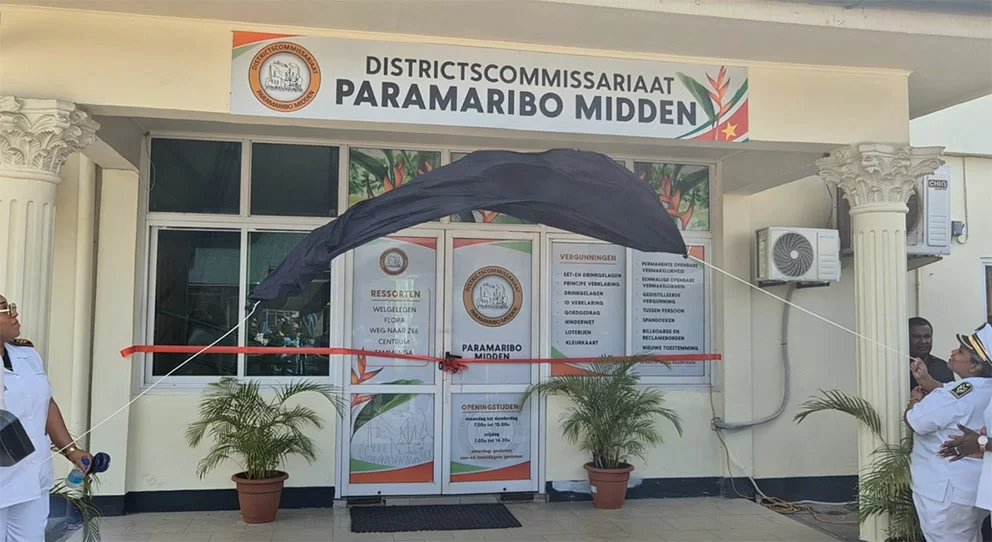
    After months of operating out of a shared temporary space, the newly created Paramaribo Midden district commissioner’s office in Suriname has officially moved into its own permanent headquarters, with district chief Ruchsana Ilahibaks announcing that resolving long-standing public complaints and clearing backlogged work will be the office’s top priority in the coming months.

    The Paramaribo Midden district was created in September 2025 as the third administrative district for Suriname’s capital city, joining the previously existing Paramaribo North and Paramaribo South districts. Prior to this relocation, Ilahibaks and her 52-member staff had been working out of the Paramaribo North district commissioner’s office, a arrangement that limited the team’s ability to address the growing volume of public needs across its service area. On Monday, the team officially moved into the new facility, located on the grounds of Openbaar Groen at the intersection of Johannes Mungrastraat and Kernkampweg, made available with support from Stephen Tsang, Minister of Public Works and Spatial Planning.

    Before the facility’s formal opening, Ilahibaks and her staff gathered for a joint prayer, standing hand-in-hand to affirm their commitment to centering community service in all their work. “The community is always welcome here,” Ilahibaks emphasized.

    The new Paramaribo Midden district covers five key resort areas: Welgelegen, Flora, Tammenga, Weg naar Zee and Centrum. It also takes on administrative responsibility for four of the capital’s major markets: the Central Market, Vreedzaam Market, Kwakoe Market and Haitian Market. Ilahibaks noted that the creation of a third district for Paramarame fills a clear, long-unmet public need, as the existing two districts were stretched too thin to address the volume of resident requests and infrastructure concerns across the capital. “There are countless complaints and pending requests, and a huge amount of work remains to be put in order,” she said, confirming that these backlogged cases will move to the top of the new office’s agenda.

    While the office now has its own dedicated physical space, it still lacks all the resources required to fully carry out its mandate. To close this gap, Ilahibaks said the Paramaribo Midden office will maintain close collaboration with the Ministry of Public Works and Spatial Planning, particularly for infrastructure work on tertiary roads and road verges.

    Across Suriname’s 10 national districts, there are now 21 district commissioner positions in total. The largest concentration of posts is in Sipaliwini, which has five district commissioners appointed to serve the district’s large territory and geographically dispersed population.

  • Scorching heat grips T&T hot spell continues today

    Scorching heat grips T&T hot spell continues today

    Residents of Trinidad and Tobago are bracing for another day of sweltering conditions, with the Trinidad and Tobago Meteorological Service (TTMS) forecasting peak temperatures of 32°C (90°F) at its Piarco monitoring station and up to 31°C (88°F) in Crown Point on Tobago.

    The latest heat wave follows a particularly stifling day yesterday, when weekend projections had Piarco temperatures soaring as high as 33°C. While scattered brief showers moved through the islands overnight into Wednesday, they did little to alleviate the prolonged heat buildup. Though no official heat warning has been issued by public health or meteorological authorities, local residents took to social media Tuesday to describe midday through early afternoon conditions as among the most intense they had ever experienced. By late Tuesday evening, some residents shared that while personal home thermometers and weather apps showed official readings hovering at or below 28°C, the combination of high heat and oppressive humidity made conditions feel far hotter than the recorded temperature. Multiple people reported experiencing heat-related symptoms including nausea and dizziness, highlighting the hidden health risk of humid heat waves.

    In its daily forecast, the TTMS outlined that Wednesday will be mostly sunny and hazy across both islands, with isolated partly cloudy periods and light showers possible in a small number of regions through the morning. Precipitation is expected to become more widespread through the afternoon, evening and overnight, with a moderate 40% chance of isolated heavy showers and thunderstorm activity. The service has warned that intense downpours could bring localized street flooding and sudden gusty winds, adding secondary hazards to the day’s conditions. Compounding the air quality concerns, a relatively mild plume of Saharan dust is currently circulating across the region, prompting officials to urge targeted precautions for sensitive groups.

    This current heat event aligns with long-term seasonal projections the TTMS released earlier this year for the 2026 dry and wet seasons. The agency forecast that maximum day and night temperatures would land above the long-term average across the country, with the most pronounced warming expected in northern regions. In its May 2026 outlook for the May to July period, the TTMS specifically noted that above-average temperatures would be most intense in densely developed urban areas, where built infrastructure traps heat and amplifies uncomfortable conditions. During peak heat bursts, projections indicate daytime temperatures could climb above 34°C across Trinidad and exceed 33°C on Tobago. The service emphasized that these extreme temperatures will not be continuous, but will arrive in short, intense bursts that require advance preparation for local communities. Agricultural stakeholders have also received targeted guidance, with officials advising farmers and livestock owners to monitor for heat stress in grazing animals, young seedlings and recently transplanted crops.

    To help residents protect themselves from heat-related illness, Trinidad and Tobago’s Ministry of Health has published clear public guidance on heat safety on its official website. “Very hot temperatures can be dangerous to your health,” the ministry noted, outlining key steps residents can take to stay cool and healthy during the prolonged warm period. Core recommendations include drinking ample water throughout the day to stay hydrated, while avoiding caffeinated beverages and alcohol, which can increase dehydration risk. The ministry also advises wearing loose, lightweight, light-colored clothing that reflects rather than absorbs heat, and skipping strenuous physical activity during the hottest peak hours of the day. For people working outdoors, frequent rest breaks in shaded or cool areas are strongly recommended. The public guidance also emphasizes community support, urging residents to check on vulnerable neighbors, family members and friends who do not have access to air conditioning, as extreme heat poses the greatest risk to these groups. Additional tips include cooling homes overnight by opening windows when outdoor air is cooler, staying in air-conditioned spaces as much as possible during peak heat, and wearing broad-spectrum sunscreen to protect against intense UV radiation for anyone spending time outdoors.

  • T&T STILL VULNERABLE

    T&T STILL VULNERABLE

    As Trinidad and Tobago paused this week to commemorate the 36th anniversary of the 1990 attempted coup, a fiery exchange has erupted over the current administration’s handling of critical national security infrastructure, with a former top security official accusing the sitting homeland security minister of misappropriating a landmark intelligence facility.

    Gary Griffith, who previously led the Ministry of National Security, used a public Facebook post to anchor his criticism in the firsthand lessons he learned during the 1990 uprising. As one of the youngest active-duty soldiers deployed during the crisis, Griffith saw firsthand the systemic failures that allowed the coup attempt to catch state authorities off guard: within the first 48 hours of the insurgency, dozens of law enforcement officials abandoned their posts, leaving frontline personnel to defend critical state infrastructure without support or coordination.

    In the aftermath of the failed coup, a government-appointed Commission of Enquiry was convened to unpack what went wrong. The commission ultimately identified deep structural flaws in national security operations and laid out 34 concrete recommendations designed to prevent a similar crisis from unfolding again. Griffith argues that for more than a decade after the commission released its findings, successive governments largely ignored the report entirely—a failure he says is only possible in a state with weak democratic accountability, what he calls a “banana republic.”

    During his own tenure leading the national security ministry, Griffith prioritized implementing the commission’s recommendations, carrying out 13 of the 34 proposals before leaving office. The flagship recommendation from the commission was the creation of a dedicated National Operations Centre (NOC), a step directly prompted by the 1990 failure of separate intelligence agencies to share critical threat information with one another.

    Griffith explained that this intelligence sharing gap left law enforcement completely unprepared for the 1990 insurgency: with no coordinated predictive intelligence, the state was forced into reactive damage control rather than launching a pre-emptive strike to stop the uprising before it began. Built at a cost of $500 million, the NOC Griffith established was designed as a cutting-edge, high-technology hub that would enable real-time intelligence gathering and cross-agency collaboration. Its core mandate was to bring all branches of the national intelligence community together to aggregate, analyze, and act on threat information, stopping national security risks before they escalated into crisis.

    During Griffith’s time in office, the NOC delivered tangible results, he says: in 2014, Trinidad and Tobago recorded the largest single drop in serious crime in 31 years, a reduction achieved without implementing a disruptive national state of emergency.

    Today, however, Griffith accuses the current administration and its Homeland Security Minister Roger Alexander of fundamentally altering the NOC’s core mandate, stripping it of its critical intelligence role and reducing it to a basic police dispatch center that duplicates the work already done by the existing E 999 emergency dispatch service. “Sadly, the present administration, through a Minister of Homeland Security whose knowledge is limited primarily to policing, has reduced this highly advanced system to a dispatch centre working alongside E 999, even though E 999 already has its own dispatch centre,” Griffith said. “The National Operations Centre was not built to duplicate E 999.”

    Griffith’s final warning is stark: the failure to fully implement all 34 of the 1990 Commission of Enquiry’s recommendations, paired with the gutting of the NOC’s intelligence function, has left Trinidad and Tobago just as vulnerable to a major security crisis as it was three and a half decades ago. “Poor intelligence gathering was the principal weakness in 1990,” he noted. “The failure to implement the remaining recommendations of the Commission of Enquiry, combined with the failure to utilise the National Operations Centre as intended, has left this country exposed. Thirty-six years later, we are not one step closer to ensuring that what happened in 1990 will never happen again.”