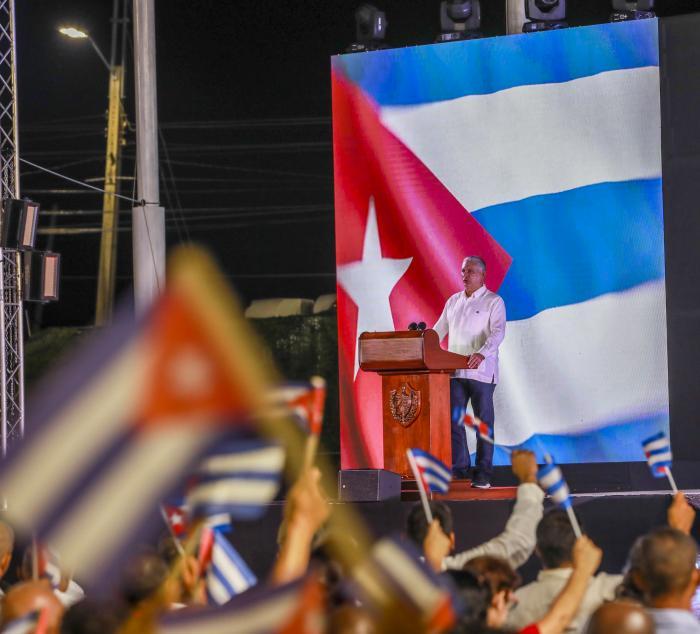
On July 26, 2026, a date marking the 73rd anniversary of the 1953 assault on the Moncada and Carlos Manuel de Céspedes barracks — Cuba’s National Rebellion Day — Miguel Mario Díaz-Canel Bermúdez, First Secretary of the Central Committee of the Communist Party of Cuba and President of the Republic, took the stage at the main commemoration in Pinar del Río. The gathering fell in the “Year of the Centennial of Commander-in-Chief Fidel Castro Ruz,” carrying extra symbolic weight for Cuba’s revolutionary movement. Opening the event, Díaz-Canel shared a pre-recorded message from retired Army General Raúl Castro Ruz, the historic leader of the Cuban Revolution, who conveyed warm affection and recognition to the people of Pinar del Río for their tireless dedication to the revolutionary cause and the honor of hosting this year’s national ceremony.
Framing Cuba’s current struggle as a “new Moncada,” Díaz-Canel drew a direct parallel between the 1953 rebels’ risky charge against the Batista dictatorship’s barracks and today’s generation’s fight against what he called a genocidal foreign policy designed to suffocate the Cuban people and seize control of the island. He recalled that while critics dismiss the 1953 assault as a failure, that small spark of rebellion ignited the broader movement that ultimately brought the Cuban Revolution to triumph in 1959, echoing Fidel Castro’s core lesson that victory can emerge even from the greatest setbacks. He paid tribute to the legacy of Fidel, who famously declared in his historic self-defense trial that being Cuban carries an unnegotiable duty, and that abandoning that duty is an act of treason. Díaz-Canel also paused to honor the late revolutionary commander Ramiro Valdés Menéndez, a hero of the 1953 Moncada assault who passed earlier this year, marking the first National Rebellion Day since 1959 without his presence, calling for eternal glory to all who took part in the 1953 uprising.
Díaz-Canel explained that Pinar del Río was chosen to host the main ceremony not only for its measurable political, economic and social gains, but because those victories stand as a testament to everyday Cuban heroism amid profound national hardship. He highlighted a striking local statistic: an infant mortality rate of 4.8 per 1,000 live births and a full year of zero maternal deaths, achieved despite widespread power outages and acute shortages of critical goods — results he called the definition of revolutionary heroism. The province has exceeded national expectations in advancing the Cuban government’s Economic and Social Program, meeting economic plan targets and balancing the state budget, growing export earnings, cutting the number of unprofitable state enterprises, and boosting domestic food production through collaborative work with small producers, while streamlining the process of granting land usufruct rights, a top national priority. He also celebrated Pinar del Río’s iconic tobacco industry, a globally recognized symbol of the region and a key export earner, as well as the food sector’s growing successful partnerships with non-state economic actors. The local Hermanos Saíz Montes de Oca University was highlighted for its commitment to tying scientific research and innovation directly to regional development, offering a model for other Cuban institutions. Despite widespread adversity, Díaz-Canel noted that Pinar del Río, a region with deep cultural roots and home to leading Cuban literary and artistic figures, has kept its cultural flame alive, protecting national heritage, expanding community cultural access, and delivering strong arts education outcomes as part of a collective effort to defend Cuban identity.
Turning to the international context, Díaz-Canel issued a fierce condemnation of what he described as escalating aggression from Cuba’s historic adversaries, noting that as right-wing and far-right forces gain influence across Latin America, the United States has ramped up unilateral sanctions targeting Cuban companies, public officials, and even private or foreign entities that trade with or invest in the island. He singled out the latest round of U.S. sanctions, which target Cuban public health officials and medical services, calling the move a new low in infamy. He compared U.S. State Department officials, who draft sanctions lists and invent pretexts for coercion, to medieval authors of repressive military edicts and Nazi propagandists during World War II, arguing that Washington acts as if the entire world is its colony, dictating terms under threat of punishment. Díaz-Canel argued that the U.S. has declared a global war on left-wing movements and positioned Cuba as a primary target, claiming that U.S. leaders scapegoat Cuba to distract from domestic inequality that has sparked protests from working-class and impoverished communities, while criminalizing legitimate dissent to sustain their harmful policy toward the island.
“Cuba is no threat to the United States or any nation on Earth,” Díaz-Canel emphasized. He pointed to Cuba’s decades-long history of global solidarity: sending doctors and teachers to regions where other powers send weapons, training thousands of young professionals from low-income nations around the world even amid its own hardship. Just this academic year, he noted, Cuban universities graduated 30,185 new professionals, including 735 from 62 foreign nations — among them 23 new Palestinian doctors and 5 American doctors. He argued that the true threat to regional and global security is not Cuba, but the U.S. policy of aggression that causes famine, mass impoverishment, uncontrolled migration, widespread instability, and tens of thousands of preventable deaths across the globe. He stressed that Cuba is the current victim of this campaign of economic suffocation, which is designed to provoke social unrest and install a government loyal to U.S. imperial interests, and explicitly denounced the six-decade U.S. blockade as a coldly calculated act of genocide.
Díaz-Canel laid out the devastating human cost of the intensifying blockade, detailing that the U.S.-imposed energy and financial siege has caused prolonged national blackouts that often last more than 24 hours, shut down industrial production, and left tens of thousands of workers out of work. He shared grim national statistics that tell the story of widespread suffering: preventable deaths from a lack of medications that Cuba once produced and distributed freely or at low subsidized prices; more than 100,000 surgeries delayed or canceled due to unreliable power and a lack of fuel for backup generators; more than 118,000 cancer patients, including 1,200 children, who are forced to use less effective second- and third-line treatments because they cannot access first-line care; and a national rise in infant mortality to 9.3 per 1,000 live births, up from 4 to 5 in previous years. Behind every number, he said, is a child who died as a direct result of the blockade and its genocidal intent. He noted that the United Nations General Assembly has repeatedly condemned the U.S. unilateral coercive measures as violations of international law, arguing that it is illegal and criminal to torment an entire people simply to force them to overthrow their government. The latest U.S. slanderous report claiming Cuban subversion, he said, is nothing more than a mediocre propaganda pamphlet designed to build support for potential military aggression, and he held all those who design, implement, and tolerate the blockade accountable for the suffering and deaths of the Cuban people.
Issuing a global appeal to the international community, Díaz-Canel warned that silence in the face of aggression against Cuba weakens international law and erodes the principle of national non-interference, clearing the way for future aggression against other sovereign nations. He drew a direct parallel to the ongoing crisis in Gaza, noting that global solidarity for the Palestinian people came too late for more than 70,000 Palestinians, including 21,000 children, killed by what he called a Zionist genocide that has turned the strip into mountains of rubble. “Defending Cuba from the cruelty of its executioners is not something that can wait,” he declared. He argued that defending Cuba’s right to sovereignty is a global fight against 21st-century colonialism, white supremacy, xenophobia, and hegemony, stressing that no nation is superior or inferior, and the old world order of emperors and subjects can never be restored.
Díaz-Canel expressed profound gratitude to the global solidarity movement that has stood with Cuba despite U.S. pressure, including social movements across Latin America and the Caribbean, human rights organizations that have denounced the blockade at the United Nations and other global forums, parliamentary groups that work to end illegal sanctions, European civil society organizations that maintain ties with Cuban institutions, anti-imperialist and pacifist movements, and blocs of Global South nations that share the belief that national sovereignty is non-negotiable. He specifically thanked all governments that voted for the annual Cuban resolution condemning the blockade and the energy blockade at the UN General Assembly, despite heavy U.S. pressure, and recognized the international solidarity groups present at the ceremony, including Pastors for Peace, Carlota’s Warriors from New York, the Australian Association for Solidarity with Cuba, the José Martí Cultural Association of Miami, and the Marcapasos project. “Your presence is living proof that we are not alone,” he said, noting that defending Cuba at a time of maximum pressure is an act of courage that exposes the hypocrisy of powers that claim to defend human rights but stay silent in the face of genocide.
Reaffirming that Cuba will never surrender, Díaz-Canel said that Cubans respond to the blockade’s suffocation with ingenuity, creativity, and the unyielding joy that defines the Cuban people, even in hard times. He echoed Raúl Castro’s 2024 call that unity is Cuba’s most important strategic weapon, stressing that unity does not mean uniformity — it means all Cubans, regardless of differences in approach, share the core goal of building a sovereign, independent, socialist, dignified, and prosperous Cuba that leaves no one behind. He noted that any fracture of national unity has always derailed the Cuban revolution in the past, making unity an non-negotiable priority.
While praising the heroism and creativity of the Cuban people, Díaz-Canel stressed that individual effort alone cannot break the blockade, making ongoing national economic and social transformation a top strategic priority. He explained that Cuba is pursuing a process of macroeconomic restructuring, strengthening all forms of productive management, motivating workers and farmers, and opening pathways for responsible investment, always guided by the sacred principle that change cannot come at the cost of social justice. He noted that the revolutionary legacy of the Moncada assault demands that Cubans not fear change, but any transformation must always be rooted in the pursuit of the highest possible level of social justice, and that all economic and political decisions will remain in Cuban hands, with no foreign power allowed to dictate the island’s future.
He noted that 2026, as the centennial of Fidel Castro Ruz’s birth, holds global significance, with revolutionary activists and friends from every continent set to travel to Cuba to take part in a colloquium and other events celebrating Fidel’s legacy. These events will offer a space to analyze Fidel’s extraordinary ideological contributions, assess Cuba’s current place in the world at one of the most difficult moments in its revolutionary history, and renew commitment to the revolutionary principles Fidel left to the Cuban people. Díaz-Canel called on all Cubans to honor Fidel’s centennial not just with words, but with action: through work, unity, dignity, and urgent determination to implement the transformations the current moment demands.
Turning directly to Cuba’s young people, Díaz-Canel called them the present and the future of the revolution, noting that they are the heirs to the courage of the 1953 Moncada generation, and the first generation of Fidel’s centennial. He called on young Cubans to lead the current transformation from every neighborhood and every corner of the island, working to build change for the common good, just as previous generations fought for a better future for young Cubans.
Closing the address, Díaz-Canel cited Cuban independence hero José Martí, who once said that a people’s greatest strength is faith in its own power. He issued a national call to action: no waiting, no lamenting, no settling for hardship, but thinking like a sovereign nation, pursuing new alternatives with creativity and boldness, protecting every scarce resource, increasing production, substituting imports, and developing national potential. He called on every Cuban, at their workplace, in their fields, in their schools, and in their neighborhoods, to see themselves as protagonists of the national transformation needed to overcome the current crisis. He ended with a message of hope, noting that just as the 1953 rebels faced overwhelming odds with courage and optimism, today’s Cubans are also conquerors of the impossible. Reaffirming Cuba’s commitment to the homeland, the revolution, and socialism, he closed with the iconic revolutionary slogans: “Long live July 26th! Long live the National Rebellion! Long live Cuba, sovereign and independent! Long live international solidarity with Cuba! Socialism or Death! Fatherland or Death! We will prevail!”