
作者: admin

  • BEC begins employer education drive ahead of wage bill rollout

    BEC begins employer education drive ahead of wage bill rollout

    As Barbados moves closer to approving the long-awaited Protection of Wages Bill, the Barbados Employers Confederation (BEC) has launched a large-scale outreach campaign to prepare local business owners for the upcoming regulatory changes to wage management practices.

    The first of BEC’s public education events was held Thursday at the Lloyd Erskine Sandiford Centre, designed to walk employers through the fine print of the new legislation and help them align existing payroll operations with the upcoming legal requirements. Speaking to attendees at the session, BEC Executive Director Sheena Mayers-Granville explained that the event was structured to give employers an open forum to clarify uncertainties and map out their new obligations under the law.

    With parliamentary debate on the bill wrapping up earlier this month, this information session marks the organization’s first public effort to sensitize the business community to the Bill’s provisions. “This is our chance to help employers start reviewing the terms of the legislation now, so they can implement any necessary changes to their operations long before the law goes into effect to stay compliant,” Mayers-Granville noted.

    The Protection of Wages Bill introduces sweeping new regulatory standards for wage payments, authorized deductions, and pay cycles – three core areas of payroll management that BEC emphasizes will require close attention from employers once the law is enacted. Previously, most of these processes were governed exclusively by individual employment contracts negotiated between employers and workers, but the new framework will bring standardized, government-mandated regulation to these areas for the first time.

    “Before, there was no formal regulation of pay cycles; those terms were left entirely to the employment contract. Now, the new legislation will set clear rules for pay cycles, and we’ve also been walking employers through what the new rules mean for wage deductions,” Mayers-Granville explained.

    One of the most common points of confusion for participating employers has been the one-third cap on wage deductions, a provision that already exists under the outdated 1950s-era wage legislation but has long been plagued by inconsistent application. Mayers-Granville pointed out that for decades, employers and financial institutions alike have debated whether the cap applies to gross or net earnings, and how the rule should be implemented for court-ordered or worker-requested deductions for major financial commitments like mortgages and car loans.

    Unlike the vague existing rules, the new Protection of Wages Bill includes explicit, detailed guidance on how to apply the one-third deduction cap, eliminating the ambiguity that has created compliance risks for employers for generations. Moving forward, BEC will maintain its ongoing support for local businesses through the transition period.

    Mayers-Granville confirmed that BEC will continue rolling out educational resources, detailed guidance, and personalized advice for member businesses over the coming months, with regular updates to help employers prepare before the law comes into force. The organization acknowledges that the shift to the new regulatory framework will require a period of adjustment for local businesses, and BEC has committed to standing by employers throughout the transition to answer questions, resolve uncertainties, and ensure all businesses can adapt smoothly to the new compliance requirements.

  • Guyanese Man Deported After Completing 18-Year Sentence for Rape in Antigua

    Guyanese Man Deported After Completing 18-Year Sentence for Rape in Antigua

    In a routine operation following the completion of a major custodial sentence, a 54-year-old Guyanese citizen convicted of rape has been deported back to his home country after serving 18 years behind bars in Antigua and Barbuda.

    Eustace Barry, the offender, walked out of His Majesty’s Prison on Wednesday, marking the end of the sentence handed down years prior by the country’s High Court. Immediately after his release, local immigration officials took custody of Barry in accordance with the nation’s established immigration protocols for non-citizen offenders, and arranged for his prompt removal to Guyana.

    Under Antigua and Barbuda’s immigration regulations, foreign nationals who have completed felony prison sentences are not eligible to remain within the country’s borders, making deportation a mandatory step in this case.

    Local crime advocacy platform True Crimes Antigua has announced that Barry will be added to its specially created “Predator Awareness” list. This public-facing initiative was launched specifically to increase community awareness of individuals who have been convicted of sexual offenses, giving the public access to information to help them make informed safety decisions.

    The organization says it will continue adding details of other convicted sex offenders to the list as part of its ongoing public education campaign. In a public post addressing Barry’s departure, True Crimes Antigua underscored a critical reality of sexual violence: even after an offender completes their sentence and leaves the jurisdiction, the harm inflicted on survivors persists for years, often decades. The advocacy group emphasized that sexual violence leaves enduring emotional, psychological, and physical scars that impact survivors long after the legal process concludes. It also renewed its call for sustained, expanded support services for victims of sexual abuse, increased public education on prevention, and collective action to reduce incidents of sexual violence across the region.

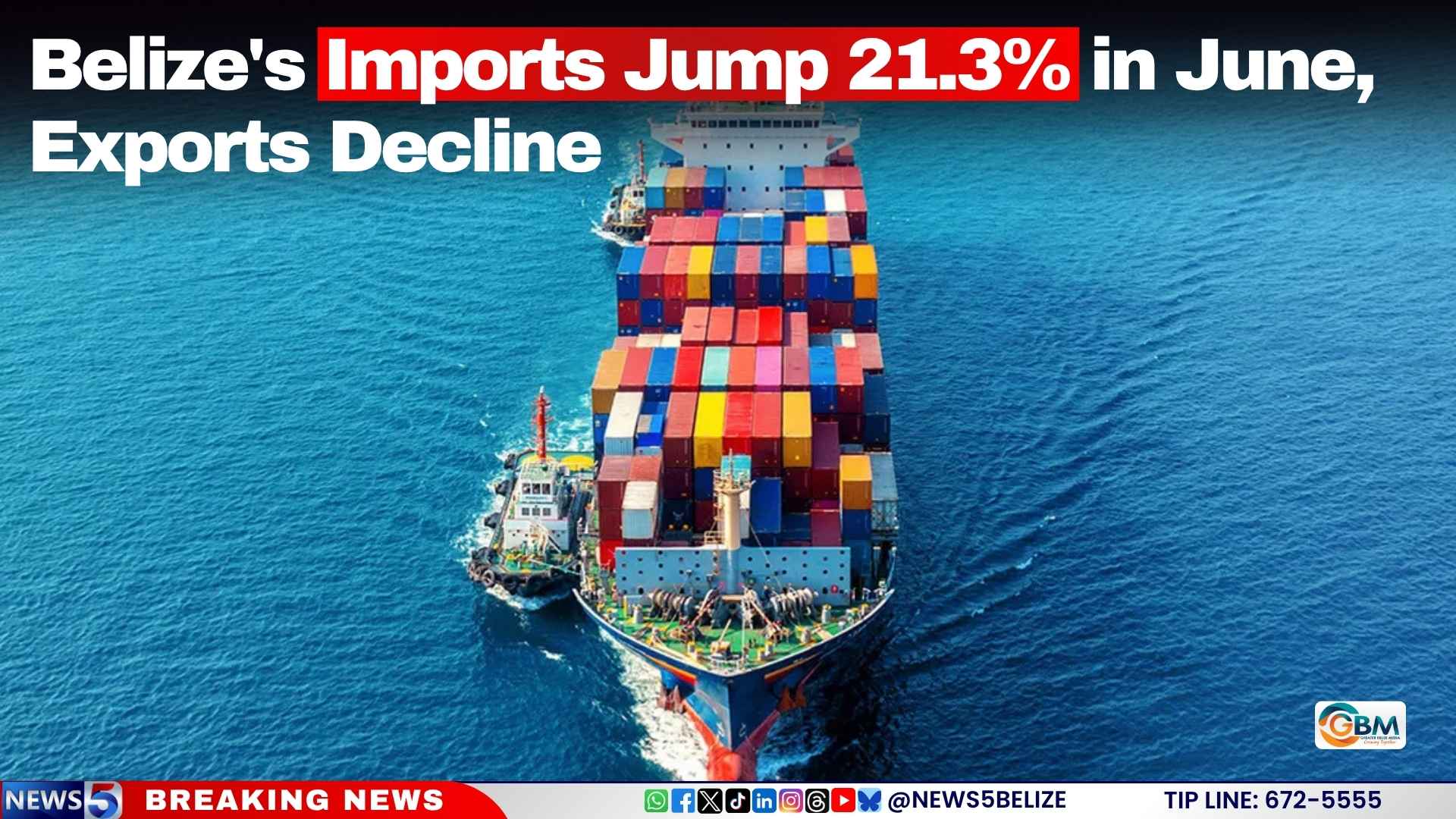
  • Belize’s Imports Jump 21.3% in June, Exports Decline

    Belize’s Imports Jump 21.3% in June, Exports Decline

    Newly released official trade data from Belize’s Statistical Institute paints a sharply divided picture of the country’s external commerce for June 2026, with total merchandise imports jumping by more than a fifth year-over-year even as domestic exports contracted by nearly 8%.

    According to the institute’s latest External Trade bulletin, overall imports hit $275.8 million in June 2026, marking a 21.3% increase compared to the same month in 2025. The growth was widespread across nearly all major commodity groups, with just one category – Other Manufactures – posting a monthly decline.

    The single largest contributor to the import expansion was the Mineral Fuels and Lubricants sector, which saw a $15.2 million jump to reach $48.2 million for the month. Two key factors drove this rise: elevated global crude and refined fuel prices, plus the resumption of large-scale premium fuel purchases that had been paused for a full 12 months. Following fuel, the Food and Live Animals category recorded a $12.1 million increase, fueled by rising imports of coffee and general grocery goods. Chemical Products also saw substantial growth, adding $9.8 million in import value as fertilizer costs climbed for local buyers.

    When looking at cumulative trade activity for the first half of 2026, the import growth trend holds even stronger: total inbound goods reached $1.651 billion, a 19.1% increase compared to the first six months of 2025. Fuel imports again led the way, growing by $92.8 million, while machinery and transport equipment – which included one large aircraft purchase – added another $60.7 million in import value over the half-year period.

    On the export side of the ledger, however, the performance told a far different story. Domestic exports from Belize fell 7.9% year-over-year in June 2026, dropping to just $26.0 million. The steepest declines were concentrated in key agricultural export sectors that form the backbone of Belize’s outbound trade: citrus export earnings plummeted by $10.1 million, sugar exports fell by $8 million, and cattle shipments dropped by $4.2 million. Banana and red kidney bean exports also posted lower earnings for the month, extending the downward trend across most agricultural categories.

    That said, not all export segments faced headwinds in June. Marine product exports bucked the trend, posting a $3.2 million increase in earnings, supported by both stronger global pricing and higher shipment volumes.

    For the full first half of 2026, the export contraction aligns with the monthly trend: total outbound domestic goods hit $166.6 million, representing a 12.7% drop compared to the same six-month period in 2025.

  • AFC en UEFA fel tegen FIFA-plannen voor verkoop World Cup-aandelen

    AFC en UEFA fel tegen FIFA-plannen voor verkoop World Cup-aandelen

    Global football governance is facing its latest high-stakes rift, as two of FIFA’s most powerful continental confederations have launched coordinated, fierce opposition to a controversial proposal from FIFA President Gianni Infantino that would sell a minority stake in the World Cup to private investors. Both the Asian Football Confederation (AFC) and the Union of European Football Associations (UEFA) have labeled the plan unacceptable, and have issued explicit threats to boycott FIFA-run tournaments if the proposal is pushed forward without broad consensus.

    Sheikh Salman bin Ebrahim Al Khalifa, who serves as FIFA senior vice-president and AFC president, has publicly criticized Infantino’s initiative, becoming the most senior global football official to join the growing opposition bloc. In a formal letter circulated to all 47 AFC member associations, which govern football across Asia, the Middle East and Australia, Sheikh Salman expressed deep disappointment that FIFA moved forward with the announcement without any meaningful prior consultation with continental bodies.

    Sheikh Salman warned that the proposal would fundamentally undermine the long-standing continental governing structure that underpins international football. He also urged AFC member associations to hold off on making any commitments or decisions on the plan until further inclusive consultations can be held. The AFC has made clear that the initiative has no path to success without the support of all of FIFA’s six continental confederations.

    Across Europe, UEFA, which represents 55 national member associations, has gone even further, voting unanimously to enact a full boycott of all FIFA events — including the men’s World Cup — if the investment plan moves forward. The hardline position was finalized during an emergency meeting of UEFA leadership and member representatives, with the confederation confirming in an official statement that it and its member unions will refuse to participate in FIFA competitions if the proposal is implemented.

    Infantino’s plan, first unveiled recently, calls for the creation of a $20 billion commercial subsidiary that will hold rights to the World Cup, with 20% of that subsidiary to be sold off to private investors. The lead backer for the stake is a New York-based investment firm founded by Joshua Kushner. To build support for the plan, FIFA has offered each of its 211 member national associations a $40 million payout conditional on their approval of the proposal by the September 19 deadline.

    The timing of the deadline has put early pressure on global football, with the next FIFA tournament — the Women’s U-20 World Cup — set to kick off in Poland on September 5, just two weeks before the approval cutoff. Both the AFC and UEFA have repeatedly emphasized that their opposition is rooted in a commitment to transparency, collaborative governance, and respect for the long-standing institutional structures that have shaped international football for decades.

    As the most widely viewed and financially lucrative sporting event on the planet, the World Cup represents an unparalleled revenue opportunity for FIFA. The governing body argues that bringing in private investment will unlock significant new revenue streams to grow the sport around the world. But the fierce resistance from the two largest and most powerful confederations underscores deep fears among regional governing bodies that the plan will erode their decision-making power and institutional control over the global game. The standoff lays bare the growing tensions between the push for commercial expansion at FIFA and the traditional, member-led governance model that has defined international football for more than a century.

  • Thea LaFond completes Commonwealth Games medal collection with triple jump gold

    Thea LaFond completes Commonwealth Games medal collection with triple jump gold

    Glasgow 2026 Commonwealth Games has delivered another iconic moment for Caribbean athletics, as Dominica’s beloved Olympic gold medalist Thea LaFond made history by claiming the top spot on the women’s triple jump podium, completing a full collection of Commonwealth Games medals across three consecutive editions of the games.

    LaFond sealed her gold-medal win with a standout leap of 14.60 metres, recorded with a +0.7 wind assistance, a result that put her far ahead of competitors and secured her place in the history books of Dominican sport. This latest victory adds a Commonwealth gold to the bronze medal she claimed at the 2018 Gold Coast Commonwealth Games and the silver medal she took home at the 2022 Birmingham Commonwealth Games, making her the first Dominican athlete to earn a medal sweep of every color at the multi-sport event.

    The milestone achievement marks yet another high point in LaFond’s storied career, which already includes an Olympic gold medal from the 2024 Paris Games, cementing her status as one of the most decorated Caribbean track and field athletes of her generation. Following the win, the Prime Minister of Dominica, Roosevelt Skerrit, offered his public congratulations to the star athlete in an official post shared to the government’s Facebook page.

    In his message, Skerrit framed LaFond’s latest win as a source of immense national pride for the small island nation. “Congratulations to Thea Lafond-Gadson on winning Gold in the Women’s Triple Jump at the 2026 Commonwealth Games,” Skerrit wrote. “Your achievement is another proud moment for Dominica! Way to go Champ!” The post quickly drew thousands of likes and celebratory comments from Dominicans at home and abroad, as well as fans of track and field from across the globe.

  • Beneficial ownership register to ‘meet global transparency standards’

    Beneficial ownership register to ‘meet global transparency standards’

    Barbados is entering a critical phase of regulatory reform as it implements a landmark beneficial ownership disclosure regime, a policy shift that will determine the island nation’s compliance with international anti-money laundering and counter-terrorism financing standards. Government officials have issued clear warnings that widespread failure to comply with the new rules could open Barbados to crippling international financial sanctions and lasting harm to its reputation as a trusted global financial jurisdiction.

    The new framework, a joint initiative between the Ministry of Energy, Business Development and Commerce and national business development agency Business Barbados, creates a centralized, securely encrypted public repository that records the identity of the ultimate human individuals who own or control corporate entities registered across the country. Unlike historical corporate registries that only list legal entities, this new system cuts through layered shell company structures to name the real parties that profit from or control business activity in Barbados.

    Speaking at a press breakfast briefing, Sangene Watkins Diang, Director of the Business Compliance Division at the Ministry, outlined that the regulatory architecture was built through a strategic collaboration with Business Barbados, the country’s official corporate registration body. “As the first point of contact for all new businesses entering Barbados’ formal economy, Business Barbados is truly the cradle of the island’s incorporated commercial activity,” Watkins Diang explained. “Their contribution to this initiative went far beyond basic stakeholder outreach: they brought on-the-ground practical insight, decades of operational expertise, and a shared commitment to building a system that is both robustly effective and accessible for businesses of all sizes.”

    Wainelle Alleyne-Jones, Head of business facilitation and advisory services at Business Barbados, joined government officials to emphasize the agency’s commitment to supporting businesses through the transition to the new rules. Under the landmark legislation, any individual that holds at least 20 percent of a company’s shares, voting rights, or partnership interests, or holds the power to veto board decisions, is required to be formally registered as a beneficial owner.

    The regulatory reform comes after the Beneficial Ownership Bill was passed by Barbados’ House of Assembly, bringing the jurisdiction one step closer to full alignment with global anti-financial crime standards set by the Financial Action Task Force (FATF) and the Caribbean Financial Action Task Force (CFATF). The bill is now scheduled for a final vote in the Senate before receiving presidential assent from President Jeffrey Bostic to become law.

    International financial oversight bodies now judge jurisdictions not only by whether they have passed matching legislation on paper, but by whether they can demonstrate that the new rules are operational and effective in practice, local authorities noted. The new framework is specifically designed to block complex, opaque corporate structures from being exploited by criminal actors for money laundering, terror financing, drug trafficking, and the proliferation of illegal weapons, Watkins Diang confirmed. With a verified central database in place, law enforcement and authorized regulatory bodies can quickly confirm the identity of ultimate corporate controllers when responding to legitimate domestic or international investigation requests.

    To reduce barriers to compliance for smaller business operators, the legislation establishes a dedicated Business Compliance Team focused exclusively on supporting micro, small, and medium-sized enterprises, which are legally categorized as domestic threshold enterprises. Recognizing that small businesses often face limited administrative capacity and tight budget constraints, the specialized team will actively support owners in reviewing, correcting, and filing their required beneficial ownership documentation without passing on excessive legal costs, Watkins Diang explained.

    Officials have moved to address concerns over data privacy, stressing that the centralized beneficial ownership database is strictly protected and access is limited only to authorized parties. Access is restricted to approved regulatory bodies, law enforcement agencies, parties acting under a valid court order, or official requests made under international treaties. This structure ensures that sensitive proprietary commercial information remains fully protected from public disclosure or access by commercial competitors.

    The Barbadian government faces a hard deadline of June next year to prove the operational effectiveness of the new framework to international peer review panels. Officials emphasized that full compliance across all sectors of the national business community is non-negotiable to avoid severe penalties, including widespread de-risking by large global financial institutions and the potential loss of critical correspondent banking relationships that underpin the island’s international trade and financial activity.

    Barbados has already worked successfully to remove itself from international financial grey lists through a series of recent legislative and diplomatic reforms, and government officials have reiterated that every registered company on the island, regardless of its size or revenue, shares responsibility for protecting the national economy from reputational damage. Watkins Diang made a direct appeal to local media and business support organizations to help spread awareness of the new requirements across every corner of the island’s business community.

    “I urge you, the media, to help us get this message out to every company in Barbados: compliance is not optional,” she said. “We also need your help to help business owners understand what the beneficial ownership register is designed to do: boost national corporate transparency, and ultimately protect Barbados’ standing in the global economy.”

  • Soufrière ranks second among world’s happiest travel destinations

    Soufrière ranks second among world’s happiest travel destinations

    A new study from Irish travel insurance provider JustCover has ranked the quiet Caribbean coastal town of Soufrière, Saint Lucia, as the second most joy-inducing travel destination on the planet, based on a deep dive into millions of real traveler experiences.

    To uncover which global spots leave visitors feeling genuinely happy, the firm analyzed more than one million online travel reviews from 155 destinations around the world. Researchers tracked how frequently travelers used language that expressed unfiltered genuine happiness in their descriptions of local attractions, then compiled the results into a 100-point “Happy Place” scoring system.

    When all the data was calculated, Soufrière earned an impressive score of 95.2, putting it just behind the list’s leader, Tulum, Mexico. What makes Soufrière such a standout for traveler joy? The small town on Saint Lucia’s southwestern coast is best known as the home of the Pitons, two dramatic towering volcanic peaks that form one of the Caribbean’s most iconic landmarks and are protected as a UNESCO World Heritage Site. It also offers easy access to Sulphur Springs, the Caribbean’s only drive-in volcano, where visitors can soak in popular mineral-rich mud baths touted for their wellness benefits.

    Beyond one-of-a-kind natural landmarks, Soufrière has built a reputation as a versatile destination for all types of travelers. Adventure seekers can snorkel the crystal-clear waters surrounding the Pitons, explore jungle trails on ATV tours, or hike the volcanic slopes, while those looking for relaxation can unwind at the town’s world-famous luxury resorts. For years, this combination of natural wonder and recreational variety has made Soufrière one of Saint Lucia’s top tourist draws, and the new ranking confirms what many visitors have long believed: it is one of the most joyful places to visit in the world.

    The full top 10 happiest destinations, per JustCover’s analysis, also includes other beloved global spots: Tulum, Mexico claimed the top spot with a perfect 100 score, followed by Soufrière, then a tie between Oaxaca, Mexico and Las Vegas, United States at 88.0. Rounding out the rest of the top 10 are Maui (United States, 84.6), New York City (United States, 81.5), Cappadocia (Turkey, 77.5), Rio de Janeiro (Brazil, 75.2), Chicago (United States, 74.0), and Toronto (Canada, 71.4).

  • Dominica Bike Festival 2026 set to draw over 300 overseas riders for four-day celebration

    Dominica Bike Festival 2026 set to draw over 300 overseas riders for four-day celebration

    The Caribbean island nation of Dominica is preparing to welcome hundreds of motorcycle enthusiasts from across the region and across the globe for its third annual Dominica Bike Festival, a four-day celebration of two-wheeled culture set to run from July 31 to August 3. Organized by local group 767 Bike Life with backing from Dominica’s Ministry of Tourism and the Discover Dominica Authority (DDA), the event has expanded steadily since its launch, with this year’s edition projected to draw more than 300 participating riders — a notable jump from 2024’s gathering, which brought 233 visiting riders alongside 470 local competitors and nearly 5,000 total spectators over two days at Canefield Airport.

    This year’s participant roster boasts a truly international footprint, with riders set to travel from 13 countries and territories including Antigua and Barbuda, Barbados, Brazil, Curaçao, Grenada, Guadeloupe, Martinique, Saint Lucia, St. Kitts and Nevis, St. Maarten, St. Thomas, St. Vincent and the Grenadines, and the United States. Adding star power to the lineup are several high-profile international stunt riders and digital content creators, among them Brazil’s Vinicius Moffati, Lil E of St. Maarten, Miami Skeet from the U.S., and prominent automotive influencer Nick Lue. These guests are expected to share their experiences at the festival with their millions of global social media followers, putting Dominica’s tourism offerings in front of a vast new international audience.

    The packed event schedule kicks off on Friday, July 31, with a free opening celebration along Dame Eugenia Charles Boulevard, running from 5:00 PM to 8:00 PM. After the opening ceremony, attendees will gather for an informal meet-and-greet at The Lot Bar and Grill. High-octane drag racing competitions will take over Canefield Airport on Saturday, while Sunday will be dedicated to thrilling stunt exhibitions and skill-based contests that test the precision and daring of participating riders. The festival will conclude on Monday, August 3, with a scenic island-wide ride that starts at the Bayfront Cruise Ship Berth, makes stops at multiple local communities across Dominica, and ends with a closing gathering at Le Village Beach Club.

    For Dominica’s tourism sector, the growing popularity of the bike festival represents a significant economic boost, DDA Chief Executive Officer Marva Williams explained. “The growth from 233 visiting riders last year to more than 300 expected this year shows increasing regional and international interest in the Dominica Bike Festival,” Williams said. “Importantly, that growth translates into additional visitors staying in our accommodations, dining at our restaurants, using local transportation and exploring the island during their time in Dominica.”

    To ensure the event runs smoothly and safely for all participants and spectators, organizers have coordinated comprehensive safety protocols with local police, fire departments, and emergency medical services. All attendees and competitors have been reminded to adhere to official event guidelines throughout the four-day gathering to maintain a secure and enjoyable environment for everyone involved.

  • Traffic arrangements for carnival events at National Cricket Stadium

    Traffic arrangements for carnival events at National Cricket Stadium

    As Grenada prepares for its widely anticipated annual carnival celebrations, the Traffic Department of the Royal Grenada Police Force (RGPF) has released a comprehensive set of adjusted traffic regulations to manage movement around the National Cricket Stadium, the primary venue for all major carnival shows. The new rules, officially announced through the Office of Commissioner of Police, are designed to prevent gridlock, improve pedestrian safety, and ensure smooth access for attendees, staff, and emergency responders throughout the event period.

    For vehicles approaching the National Cricket Stadium venue, only two primary access routes will be open during the events. Drivers may enter the stadium precinct either via Queen’s Park Road, accessed from its intersection with Cherry Hill, or through the Stadium Ring Road connected to Hump Back Bridge at the River Road public junction.

    To streamline traffic flow, several stretches of road surrounding the venue will be closed to all vehicle entry for the duration of the carnival shows. These restricted entry zones include the entire stadium compound accessed from the Mt Gay/Mt. Rush direction, Old Fort Public Road from its junction with Lucas Street, Cemetery Hill starting at its intersection with Church Street, and the section of Stadium Ring Road running from the Mt Rush Public Road junction toward Humpback Bridge.

    A broad no-parking regime has also been implemented across multiple surrounding roads to clear lanes for moving traffic. Prohibited parking areas include the full loop of the ring road encircling the National Cricket Stadium, River Road between the La Qua Brothers Crematorium junction and Purcell’s Lumber Yard, Cherry Hill Public Road from the Grenada Welders location to its intersection with Melville Street, Melville Street from the ‘Keep Left’ Roundabout to the Rubis Gas Station exit, all of Cemetery Hill, and the full length of Mt Rush Public Road. As a provision for extra vehicle capacity, permitted overflow parking is designated on one side of Stadium Ring Road opposite the PetroCaribe and Grenlec facilities.

    Parking has been segmented into dedicated zones for different groups attending the events. Designated parking for VVIP and VIP guests will be established on a section of the Wesley College ground. Performers, event vendors, on-duty police personnel, and event support workers have been allocated parking spaces at Gate 6 of the stadium. For general attendees, multiple public parking zones have been set up within reasonable proximity of the venue, including the Kirani James Athletic Stadium car park, Wesley College Ground, the main Bus Terminus, Ariza Car Park, Old Trafford, and Tanteen Playing Field.

    Once carnival events conclude each day, a one-way traffic system will be activated on key routes to prevent exit bottlenecks and speed up dispersal of crowds. The assigned one-way directions are: River Road public road toward De Caul roundabout, Mt Rush public road toward Mt Gay, Mortley Hill toward Sans Souci, and the intersection of Stadium Ring Road and Mt Rush Public Road toward Humpback Bridge.

    To ensure rapid response in any emergency situation, a dedicated fixed emergency route has been mapped out for emergency service vehicles. The route runs along Cemetery Hill, Lucas Street, Church Street, and Grand Etang Road, connecting the stadium precinct directly to the General Hospital.

    The updated traffic arrangements come as carnival draws thousands of local attendees and international visitors to the National Cricket Stadium each year, with organizers emphasizing that the new rules are intended to make the celebration as convenient and safe as possible for all participants.

  • 10 youth entrepreneurs awarded grants

    10 youth entrepreneurs awarded grants

    On July 30, a government-backed youth entrepreneurship initiative handed out seed grants of up to EC$3,000 to 10 emerging young business owners across Grenada, marking a key milestone in the country’s push to empower youth-led economic development. The award ceremony, hosted by the Ministry of Youth and Sports at the Public Workers’ Union Conference Room in Tanteen, kicked off a broader support scheme that combines hands-on business training with accessible financing for new and expanding ventures.

    The YOUtrepreneur Programme is a collaborative effort between the Ministry of Youth and Sports and the Grenada Development Bank (GDB), built on the foundation of a prior business development course delivered by the Grenada Investment Development Corporation (GIDC). Out of more than 60 applications received from aspiring young founders across Grenada, Carriacou, and Petite Martinique, 50 candidates completed a comprehensive training curriculum covering core business skills including business planning, risk assessment, financial record-keeping, cost management, customer service, and long-term business continuity planning. After a rigorous selection process, 10 trainees were awarded seed grants to launch or scale their operations, while all 50 completed trainees retain eligibility to apply for 1% concessional micro-loans capped at EC$30,000, provided they meet the programme’s formal compliance requirements.

    This funding round forms a core part of the Grenadian government’s national strategy to formalize and support youth-led micro-enterprises across all three islands. The initiative targets founders between the ages of 18 and 35, with a specific focus on growing ventures in agribusiness and agricultural technology — two sectors identified as critical to strengthening Grenada’s food security and economic resilience. Two award recipients highlighted how the early-stage funding will advance their mission-driven work in these priority areas.

    Chad McFarlane, founder of Felix Park-based climate-smart agribusiness Paragon Farms, will use his grant to launch a new apiculture division alongside his existing crop operations. “This is for the bees… to get the hives and everything organised for bee farming,” McFarlane explained of his plans.

    Shenelle Young, founder of agri-tech startup Green Zource, is developing a digital platform that directly connects small-scale local farmers with large institutional buyers across Grenada, Carriacou, and Petite Martinique. Her grant will cover critical early-stage costs including legal consultation to ensure the platform meets local regulatory requirements, domain registration, and digital service subscription fees. While Young noted the grant alone does not cover all the costs of building her startup, she emphasized that it provides an invaluable jumping-off point to speed up her go-to-market timeline.

    Institutional leaders at the ceremony stressed that formal regulatory compliance is a non-negotiable foundation for long-term business growth. Debbie Farray, Business Development Officer at GDB, reminded participants that steps including obtaining a tax identification number and registering for the National Insurance Scheme are essential to building legitimate, bankable businesses that can qualify for future financing, secure government contracts, and scale successfully.

    Programme coordinator Carlene Perryman also announced a flexible, ongoing application model that sets the YOUtrepreneur Programme apart from traditional annual funding cycles. Rather than restricting applications to set annual windows, the Ministry and GDB will accept and review applications on a rolling basis, allowing them to support young founders at any stage of business development. Perryman encouraged interested young people to reach out to Farray directly to learn more about eligibility for grants, low-interest loans, and free business training, and noted that while YOUtrepreneur focuses on 18 to 35-year-old founders, additional support schemes are available for entrepreneurs outside that age range.

    A brief unexpected power outage interrupted a keynote address by Senator Seville Francis, but the moment showcased the collective commitment of the room: Francis continued her remarks without amplification, while attendees and journalists pulled out their personal device lights to illuminate the stage for the audience. In her address, Francis emphasized the broader impact of the programme, saying these young entrepreneurs are “building industries, creating jobs, strengthening our food systems, and positioning Grenada as a regional hub for innovation.”

    The ceremony closed with all grant recipients receiving formal certificates of recognition. In addition to funding and training, programme officials will provide ongoing post-award mentorship and regular progress check-ins to ensure recipients meet their business goals and use funding in alignment with their approved business plans.