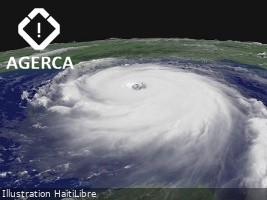
The 2026 Atlantic hurricane season formally got underway on June 1, launching a six-month period of weather risk that will extend through the end of November for vulnerable coastal nations including Haiti. While official U.S. forecasting from the National Oceanic and Atmospheric Administration (NOAA) points to a higher likelihood of a milder-than-average season this year, local risk management leaders are sounding a clear warning: even one powerful storm is enough to trigger catastrophic damage in Haiti’s current unstable state.
NOAA’s official outlook puts the probability of a below-normal hurricane season at 55%, with a 35% chance of near-normal activity and just a 10% chance of an above-normal season. The agency’s forecast, which carries a 70% confidence level, projects 8 to 14 total named storms (systems with sustained winds of 63 km/h or higher). Of those, 3 to 6 are expected to strengthen into hurricanes with winds of at least 119 km/h, and 1 to 3 could intensify into major Category 3, 4 or 5 hurricanes packing winds of 179 km/h or more. For comparison, an average Atlantic season typically sees 14 named storms, seven hurricanes, and three major hurricanes, putting 2026’s projected activity well below historical norms.
But the Alliance for Risk Management and Business Continuity (AGERCA), a Haitian risk management body, stresses that a forecast for lower overall activity does not eliminate the threat of disaster for the Caribbean nation. “Even a single hurricane can devastate communities, claiming lives, forcing mass displacement, destroying critical infrastructure and knocking out essential services,” the organization noted, emphasizing that risk cannot be dismissed based on seasonal outlooks.
This year’s hurricane season opens against an uniquely precarious backdrop for Haiti, which has been grappling with widespread gang violence that has driven massive population displacement, left large swathes of the country inaccessible to aid groups, weakened already fragile public infrastructure, and severely strained the government’s ability to coordinate emergency response.
Against this context, AGERCA has issued an urgent call to action for all segments of Haitian society – from individual citizens and local communities to government institutions, private businesses, and civil society organizations – to prioritize immediate hurricane preparedness measures.
The organization has outlined a set of key actionable steps for groups and individuals to take ahead of any potential storm landfall. First, it urges the public to only obtain weather and emergency updates through verified official channels, including Haiti’s Civil Protection Directorate, the national Hydrometeorological Unit, AGERCA itself, and established, reputable media outlets. It also advises organizations to update their internal emergency contact lists and key focal point information, review existing business continuity plans to account for current operating conditions, and secure critical physical documents, digital data, equipment and core assets.
For individual households, AGERCA recommends assembling a customized emergency kit stocked to meet specific family needs, and pre-identifying reliable alternative communication channels that can be used if standard cell service and internet connections are disrupted during a storm. Finally, the organization urges the public to avoid spreading unconfirmed information, which can spark unnecessary public panic and undermine inter-agency emergency coordination efforts when a storm approaches.