
On September 7, 2026, Belize’s Court of Appeal issued a landmark ruling that reaffirms the primacy of constitutional protections even amid a public safety crisis, striking down a 2020 state of emergency declared for southside Belize City as unconstitutional. The decision comes after the appellate court reviewed conflicting 2025 rulings from the nation’s High Court, ultimately resolving the legal dispute and setting a clear new precedent for how governments can respond to rising violent crime. The core holding of the ruling: a rising tide of crime and violence does not grant state authorities the right to suspend fundamental constitutional rights guaranteed to all people in Belize. Judges on the appellate panel found that government officials failed to meet the required legal standard to justify a state of emergency: they could not prove that criminal activity was so widespread and uncontrollable that ordinary criminal legislation and law enforcement procedures were incapable of addressing the crisis. The court further confirmed that all arrests and detentions carried out under the 2020 emergency declaration violated the constitutional rights of the people detained during that period. The ruling resolves consolidated claims brought by 18 men who were detained under the state of emergency, all of whom are now entitled to receive constitutional damages for the rights violations they experienced. The Court of Appeal upheld damage awards that had already been granted to 13 of the claimants, and added compensation awards for the remaining five appellants. Each detainee will receive $15,000 in compensatory damages and $7,000 in vindicatory damages, a standard structure for constitutional rights violation claims in Belize. Leslie Mendez, the lead attorney representing the group of appellants, explained the far-reaching implications of the court’s decision for future governance and emergency policy in the country. In an interview following the ruling, Mendez noted that the appellate court reconciled the two conflicting High Court rulings from 2025, ultimately endorsing the legal position previously set out by Justice Nadine Nabie. While the ruling establishes the current state of the law in Belize, Mendez confirmed that parties on either side retain the right to file a final appeal with the Caribbean Court of Justice, Belize’s highest judicial body, to seek further clarification on the legal standard for emergency declarations. When asked about the process for claimants to collect their awarded compensation, Mendez explained that while there is no formal statutory limitation period for constitutional claims, courts retain discretion to assess whether claims can proceed after significant delays. Whether detainees can immediately collect their awards will depend on court review once formal claims for payment are filed. Most notably, Mendez emphasized that the ruling creates a clear, enforceable legal threshold that any future government must meet to declare a state of emergency, preventing future overreach in the name of public safety and crime control. This report is adapted from a verbatim transcript of an evening television newscast originally published online.
作者: admin
-

Recent Cayo Violence Fuels Sweeping Police Crackdown
Less than two weeks ahead of September 7, 2026, three brutal homicides shook the Cayo District of Belize, leaving residents on edge and prompting law enforcement to launch a sweeping, targeted crackdown on the illegal drug trade and unlicensed firearms that authorities believe are at the root of the recent surge in violence.
Investigators have not yet finalized connections between the three killings, but preliminary assessments point to a growing turf war over control of local drug trafficking networks as the likely catalyst for the bloodshed. Community anxiety over the sustained violence has pushed police to ramp up patrols, execute targeted search warrants, and dismantle suspected criminal operations across the district, resulting in multiple arrests and significant seizures of contraband just days after the murders.
Assistant Superintendent of Police Stacy Smith, the department’s staff officer, confirmed that law enforcement’s priority remains rooting out the criminal actors driving the district’s rising violence. In an official statement outlining early results of the crackdown, Smith detailed three high-profile arrests made on September 1, 2026, the first day of intensified operations.
First, authorities executed a court-authorized search of a residential property on Benque Viejo Road, where they uncovered 3.7 grams of cocaine. Two local men — 26-year-old Shadrack Garcia and 27-year-old Jorge Aldana, both residents of the Cayo District — were taken into custody and face joint charges of possession of a controlled substance with intent to distribute.
Minutes away in Santa Elena, a second operation led to the arrest of 22-year-old Quentin Palacio. Just after 5 p.m. on September 1, officers on patrol noticed Palacio riding a motorcycle and attempted to stop him for questioning. Palacio attempted to flee the scene, but was quickly pursued and taken into custody. A search of the bag he was carrying uncovered five 9-millimeter G80 brand rounds of ammunition. Palacio now faces formal charges of unlawful possession of ammunition without a valid firearms license.
The third arrest unfolded that same evening in the Boyton neighborhood of San Ignacio around 7:30 p.m. During a routine stop-and-search, officers detained 26-year-old Gian Landero. A search of his person uncovered a Nescafe-branded glass bottle holding five separate small plastic packages, each containing suspected cocaine. The contraband weighed a total of 127.9 grams, and Landero was charged with possession of a controlled drug with intent to supply.
This report is adapted from a verbatim transcript of an evening television newscast, with Kriol language commentary standardized to official spelling for clarity, and reflects the first wave of law enforcement action following the district’s recent deadly violence.
-

Senior Citizen Busted with Crack in San Pedro
A 67-year-old local resident of San Pedro Town is now facing a federal drug trafficking charge after law enforcement officers discovered a stash of suspected crack cocaine during a routine late-night patrol, authorities confirmed this week.
Jose Gonzalez, a long-time San Pedro resident, was taken into custody on September 2, following a stop by patrolling officers who noticed suspicious behavior from Gonzalez around 11:30 p.m., according to Assistant Superintendent of Police Stacy Smith, the staff officer overseeing the case.
After officers pulled Gonzalez over for questioning, they informed him that they would conduct a legal search of his person. The search turned up a total of 3.89 grams of substance that field tests confirmed to be crack cocaine, Smith said in an official statement detailing the arrest.
Gonzalez has since been formally charged with possession of a controlled substance with intent to supply, a charge that carries serious legal consequences under Belizean drug laws. Investigations into the case are still ongoing, as law enforcement continues to probe potential connections to larger local drug distribution networks. This report is a transcribed excerpt from a televised evening news broadcast, with all local Kriol language statements converted to standard English spelling for clarity in the online version. Viewers can access the full unedited broadcast via the link published alongside this story.
-

Ranchito Woman Charged After Trying to Dump Crack
In an incident that unfolded at a residential property in northern Belize’s Ranchito Village, a 38-year-old local woman has been taken into custody and formally charged on two criminal counts linked to illegal narcotics, law enforcement officials have confirmed.
On September 7, 2026, officers executed a planned search at the home of Sandra Pineda, located in the Corozal District community. According to Assistant Superintendent Stacy Smith, a staff officer with the police service, when authorities arrived at the residence and identified themselves as law enforcement, Pineda immediately attempted to eliminate critical evidence.
“When officers approached the residence and identified themselves as police officers, a female came to the door, subsequently identified as Pineda, and upon seeing the police officers, she threw an object from her hand,” Smith detailed in an official briefing. “When that object was retrieved, it was observed to contain suspected crack cocaine amounting to 20.31 grams.”
Beyond the charge of possession of a controlled drug with intent to supply — which falls under the umbrella of drug trafficking offenses in Belizean law — Pineda faces an additional count of obstruction of justice in response to her attempt to discard the illicit substance.
This report is adapted from a televised evening newscast, originally published as a full transcript for online distribution. All official statements from law enforcement have been preserved in their original context for accuracy. No further details on upcoming court appearances or additional co-conspirators have been released by police as of the publication date.
-

Liean Cabb Busted With Crack in Stann Creek
BELIZE CITY – A 23-year-old resident of Belize’s Stann Creek District is now facing serious drug trafficking charges after local law enforcement seized nearly 6.3 grams of suspected crack cocaine during a planned search of her home, authorities confirmed this week.
The operation unfolded shortly after 12:30 a.m. on September 1, when officers carried out a court-authorized search warrant at Cabb’s residential property. Acting on prior intelligence, the search team uncovered the concealed narcotic, leading to the immediate arrest of the suspect, said Assistant Superintendent of Police Stacy Smith, a staff officer with the department.
“Police have formally arrested and charged twenty-three-year-old Liean Cabb of Stann Creek District for the offense of possession of controlled drugs with intent to supply,” ASP Smith stated in an official comment confirming the bust. The total seizure weighed in at 6.29 grams of confirmed suspected crack cocaine.
The arrest comes amid a growing trend that has law enforcement officials across Belize increasingly concerned: authorities have documented a steady rise in the use of crack cocaine and powdered cocaine across the entire country, with the sharpest increases recorded among young adults of both genders.
This report is adapted from a transcript of a televised evening news broadcast, with all spoken content preserved accurately for public distribution. Kriol-language statements included in the original broadcast have been transcribed using a standardized spelling system to ensure accessibility and clarity.
-
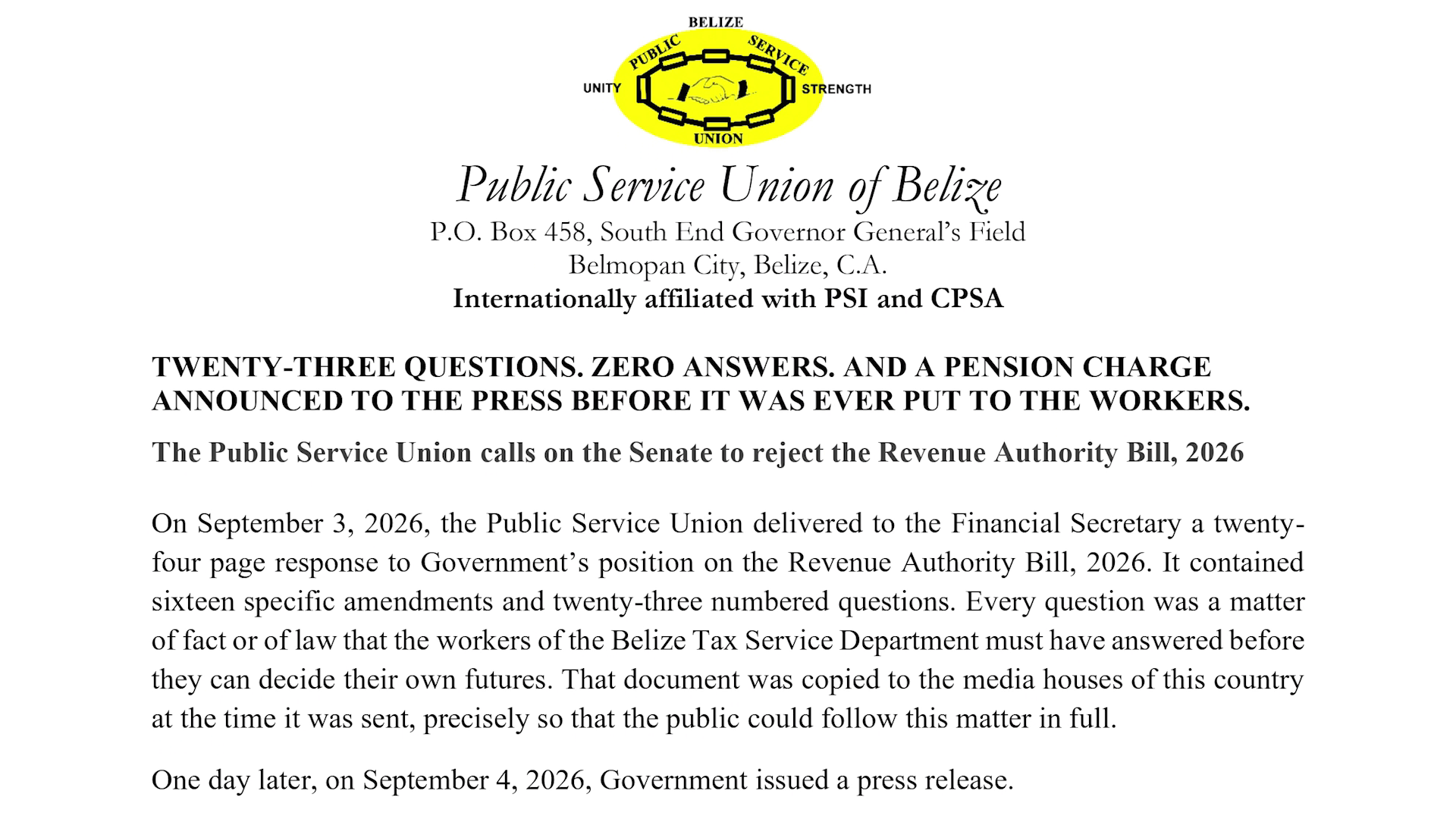
PSU Urges Senators to Scrutinize Revenue Authority Bill
As the proposed Belize Revenue Authority Bill heads toward senate review, the nation’s largest public sector labor organization has launched a fierce campaign to block the legislation in its current form, warning of unchecked executive power and irreversible risks to public sector workers’ retirement security.
Dean Flowers, president of the Public Service Union (PSU), has issued a clear call to upper house legislators: reject the rushed approval of the bill until critical unanswered questions around transparency, accountability, and excessive ministerial authority are formally addressed. According to Flowers, the draft legislation concentrates unprecedented discretionary power in the hands of the finance minister and the chief executive officer of the proposed new authority, creating gaps that undermine democratic oversight of the nation’s tax and revenue systems.
Flowers also alleged that government leaders are already considering procedural maneuvers to bypass the senate if the bill faces defeat. Under Belize’s Constitution, money bills can be sent for governor general assent after a 30-day waiting period if the senate fails to approve them, a pathway Flowers described as an unconstitutional “usurpation” of the upper house’s legislative role. While the government has previously used this procedure for other controversial pieces of legislation, Flowers warned that moving forward with it here would erode trust in Belize’s democratic institutions.
The pushback from the PSU comes as the Ministry of Finance frames the bill as a much-needed modernization reform, arguing that establishing a standalone revenue authority will streamline outdated tax administration processes and boost national revenue collection. But the union has rejected the government’s framing, pointing out that core governance commitments have not been codified in the legislation. The union’s most immediate concern, however, centers on the impact of the reform on hundreds of current Belize Tax Service Department employees.
Flowers has issued a direct warning to tax department workers against rushing to accept positions with the new authority, noting that the reform will formally abolish their existing civil service roles. According to PSU analysis, only 153 new roles will be created under the restructuring, leaving roughly 80 current employees without guaranteed positions. Flowers also alleged that some workers have already been privately offered guaranteed jobs ahead of the official application process, pointing to a lack of fairness and transparency in the planned hiring process.
Most critically, Flowers emphasized that the government has failed to provide clear, formal guarantees for affected workers’ pensions and retirement benefits. While the Pensions Act entitles workers whose positions are abolished to full retirement benefits, Flowers said the government has not publicly committed to honoring these obligations, leaving hundreds of workers facing uncertain financial futures. If the bill passes, Flowers noted, taxpayers will ultimately be responsible for covering lifetime pension payouts for workers put out of a job by the restructuring, a cost the government has not included in its public projections for the reform.
Beyond warning workers, the PSU has issued a formal call to both the Senate and the National Trade Union Congress of Belize to move beyond rhetorical positions and actively mobilize against the bill in its current form, urging cross-sector labor and legislative opposition to block approval until sweeping amendments are made to address the union’s core concerns.
-

42 Public Officers Honored for Decades of Service
On September 7, 2026, a landmark recognition ceremony was held in Belmopan, the capital of Belize, to shine a long-overdue spotlight on 42 public servants who have dedicated decades of their careers to advancing government operations and serving the nation’s population. For many years, these committed public officers carried out their critical roles largely outside of public attention, their consistent contributions going uncelebrated despite being the backbone of effective public administration across the country.
The formal honors were presented by Henry Charles Usher, Belize’s Minister of Public Service, who took the opportunity to center the narrative on the individual and collective sacrifices these public servants made throughout their tenures. During the ceremony, Usher highlighted that the steady functioning of Belize’s government depends entirely on the steady commitment of career public officials, who often prioritize the public good over personal acclaim. He emphasized that the recognition was not merely a ceremonial gesture, but a tangible acknowledgment of the decades of loyalty, problem-solving, and service these 42 individuals have extended to all Belizean people.
This report is adapted from a transcribed broadcast of a primetime evening newscast, with transcribed Kriol-language remarks formatted according to the outlet’s official standardized spelling protocol for the language. Full video coverage of the entire newscast, including the full ceremony segment, is available for viewing on the publication’s digital platform.
-

Short Power Outage at PGIA Cause Great Concern
On a Sunday morning in September 2026, passengers passing through Belize’s main aviation hub, Philip Goldson International Airport (PGIA), were caught off guard by an unexpected short power outage that disrupted terminal operations, leaving many travelers frustrated and concerned over potential travel disruptions. But what seemed like an unplanned critical infrastructure failure was actually a pre-scheduled part of system integration work, according to local energy officials.
Belize Electricity Limited (BEL), the country’s primary power provider, clarified that the outage was intentionally carried out as part of testing and integration procedures for the commissioning of its new Emergency Gas Turbine. During the transition between power systems to evaluate performance under real-world operating conditions, temporary short service interruptions are an expected part of the assessment process. Following the unplanned public disruption that caught airport travelers off guard, BEL has already implemented additional safety protocols to minimize unexpected impacts as the testing program moves forward.
While the outage cut commercial grid power across the entire airport surrounding area, Belize’s Air Traffic Control (ATC) team confirmed that all core air traffic operations continued without interruption throughout the event. ATC records show the full outage was logged at 9:52 Sunday morning, after several hours of intermittent power fluctuations from the BEL grid earlier that day. As soon as the main commercial power failed, backup generators connected to the critical Radar Room and Air Traffic Control Tower activated instantly. This automatic failover kept all essential radar systems, communication networks, and tower operations fully operational throughout the outage.
Officials confirmed that thanks to the robust backup infrastructure in place, there were no flight delays or disruptions to either arriving or departing aircraft at any point during the planned testing event. This report is adapted from a televised evening newscast transcript, with original Kriol language content standardized to consistent spelling where applicable.
-

Upcoming Carnival Elections Could Transform Annual Road March
Belize’s 2026 Carnival Road March drew one of the largest, most energetic crowds the annual cultural spectacle has seen in recent years. Amid the dazzling costumes, pulsing soca beats and joyful street parades, however, growing tensions and structural flaws within the event have moved to the forefront of industry conversations. The 2026 competition saw several of the nation’s most popular and high-profile Carnival bands opt out of the Road March entirely, leaving a single mas camp to claim an unchallenged victory. This lopsided outcome has sparked urgent concerns among stakeholders that the beloved annual event is losing its core competitive spirit, just as regional Carnival events draw increasing numbers of local attendees away. Now, as the Belize Carnival Association prepares to hold its first leadership election in decades this coming November, industry leaders, long-time sponsors and cultural stakeholders are engaged in heated debate over what reforms are needed to reinvigorate the Road March and secure the future of Belizean Carnival. News Five correspondent Shane Williams explores the challenges facing the event ahead of the critical vote.
The 2026 Road March delivered the same familiar winners to the podium: Soca Moca claimed the senior division crown for the sixth consecutive year, while Soca Massive retained the junior division title. While Soca Moca’s historic six-peat will go down in Belizean Carnival history, the entire event now stands at a critical crossroads. For the first time in more than 30 years, the Belize Carnival Association will open leadership elections to new candidates this November, and the incoming governing body will face the urgent task of reimagining the Road March to compete with a growing number of dynamic regional Carnival celebrations that increasingly draw local and international travelers away from Belize’s event.
Veteran Belizean promoter and businessman John Marsden, who has studied Carnival operations across the globe for decades, argues that fundamental changes to scheduling, marketing and ancillary programming are needed to boost competitiveness and attendance. “I believe we have to market our dates at minimum more than six months in advance, right? Give people a good amount of months to plan, prep, buy tickets, because the cost of tickets is not cheap to reach Belize around high season perse. And carnival is known to be a higher peak of flights, right? So the airlines normally take that up. So marketing is one. We have to try find a way to bridge the gap between sponsorship from the private sector to try help the bands in a number of ways.”
Marsden emphasizes that Belize already has all the raw ingredients to host a world-class Carnival, from abundant local creativity to unmatched street energy, but event organizers need to adopt a bolder, more holistic approach to building the annual celebration. “Yes, you will have prettier costumes. Yes, you will have more energetic people but you have to find a way to make coming to Carnival more exciting. I have this party to go to, this artist to come in, have our Belizean people step up their game in the music, make them perform, make them get more stage show, right? Learn to make the parties surrounding the Carnival weekend more exciting, more generous, more – encourage more people to come in, right? And all blend into one because if the surrounding parties are good, anywhere you go, any Caribbean country, any – if we want to consider Brazil, it’s the parties surrounding the Carnival that make it exciting and not necessarily solely the Carnival itself.”
Funding gaps have emerged as the single biggest barrier to greater competition: only two senior bands participated in the 2026 Road March, with most other top groups opting out due to lack of financial resources. Complicating this issue, reports indicate that much of the annual private sponsorship funding is allocated to non-competing bands, including well-known groups like Titans and Belizean Jewels. Longtime Carnival sponsor Reynaldo Malik explains that outdated event rules may be directing much-needed sponsorship revenue away from competing bands. Private businesses seek robust brand visibility in exchange for their investment, but current regulations cap major competing bands like Soca Moca and Mother Nature to just one parade truck, severely limiting the brand exposure they can offer backers.
Drawing on successful models from regional Carnivals, Malik has called for a rule overhaul that would allow every interested band to compete, including the introduction of separate small and large band categories, permission for multiple parade trucks for bigger groups, and a renewed focus on rewarding creative costume and performance design. The incoming leadership will also need to balance growing demands for a more family-friendly event with the preservation of Belize’s long-held Carnival traditions. The Belize Council of Churches has stated it supports the nation’s cultural heritage but has called for participants to adopt more modest attire, particularly given that the event is open to attendees of all ages.
As the November election draws closer, the central question remains: which candidate will be able to navigate these competing expectations and steer Belize Carnival into a new, more sustainable era of growth? Shane Williams reporting for News Five.
-

Leading the Region: Belize Turns Ocean Commitment Into Action
On September 7, 2026, Belize cemented its position as a global climate and ocean conservation trailblazer by officially launching a national implementation framework for the United Nations High Seas Treaty, in partnership with the country’s Ministry of the Blue Economy and the United Nations Development Programme (UNDP). As the first nation in the Caribbean and Central American region, and only the third country across the globe, to ratify the landmark global agreement, Belize is moving rapidly to align its domestic ocean governance policies with the treaty’s ambitious conservation goals.
Belize’s involvement in shaping the High Seas Treaty stretches back years, long before the agreement was finalized. Beverly Wade, Chief Executive Officer of Belize’s Ministry of the Blue Economy, explained that the small coastal nation played an outsized role in guiding the treaty’s negotiation process. On behalf of the Caribbean Community (CARICOM) and the Alliance of Small Island States (AOSIS) — two blocs representing dozens of climate-vulnerable coastal and island nations — Belize led key negotiating working groups, with Belizean Ambassador Felson serving as co-chair of one of the core panels drafting the treaty’s official text.
Wade emphasized that for a small island nation like Belize, high seas protection is not a distant global issue — it is a matter of domestic survival. “What affects the high seas affects us,” Wade noted, adding that Belize also has a clear stake in fair, managed access to the resources of areas beyond national jurisdiction. The new implementation framework, she said, will build the institutional and regulatory mechanisms Belize needs to both protect vulnerable high seas ecosystems and exercise its legal right to access these areas responsibly.
Michael Lund, Deputy Resident Representative of UNDP Belize, praised the country’s unprecedented speed and commitment to turning global ocean commitments into local action. Lund pointed out that the High Seas Treaty took 20 years of international negotiation to finalize, making Belize’s early ratification and rapid launch of an implementation framework all the more notable. “Belize again shows that it is punching above its weight indeed and engages internationally,” Lund said. “It shows that it is not just countries with the largest fleet but the fastest feet.”
The UN High Seas Treaty, a landmark global agreement focused on protecting the 64% of the world’s oceans that lie outside of any single country’s national borders, covers four core priority areas: the fair and sustainable management of marine genetic resources, capacity building for developing nations to advance ocean conservation, the development of comprehensive environmental impact assessments for activities on the high seas, and area-based conservation and management tools to protect vulnerable marine ecosystems. For small island developing states like Belize, which face disproportionate risks from ocean degradation and climate change, early action on the treaty sets a critical precedent for other nations in the region and around the world to follow.