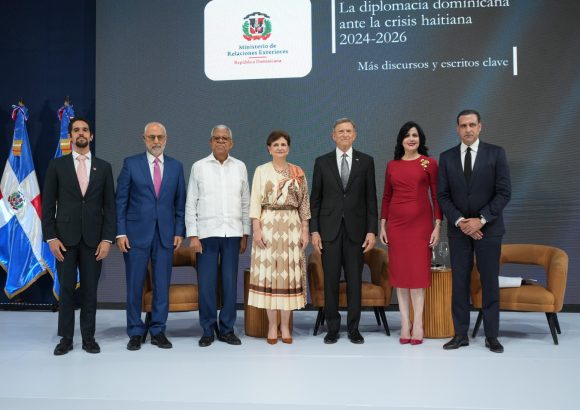
On a recent official event held in Santo Domingo, the Dominican Ministry of Foreign Affairs (MIREX) unveiled a new authoritative publication that chronicles the nation’s targeted diplomatic push to rally global backing for Haiti amid its spiraling political, security, and humanitarian collapse. Titled *Dominican Diplomacy in the Face of the Haitian Crisis 2024-2026: More Speeches and Key Writings*, this volume marks the second installment in an ongoing series tracking the Dominican government’s response to the instability spilling across its shared border with Haiti. The launch ceremony was opened by Vice President Raquel Peña, and followed by a substantive panel discussion featuring leading legal scholars and veteran diplomatic practitioners.
Co-edited by three top Dominican diplomatic figures — Foreign Minister Roberto Álvarez, Deputy Foreign Minister Rubén Silié, and career diplomat Anselmo Muñiz — the compilation brings together a full range of primary materials from the 2024-2026 period. These include official speeches, formal diplomatic correspondence, multilateral resolutions, and records of on-the-ground diplomatic initiatives that the Dominican Republic has pursued to shine a sustained international spotlight on Haiti’s crisis and secure tangible support for security and stabilization efforts.
Speaking at the book’s launch, Foreign Minister Álvarez outlined that the nation’s approach to the Haitian crisis has been rooted in the good-neighbor policy articulated by President Luis Abinader. He emphasized that Dominican leadership began sounding alarm bells about the growing risks in Haiti long before the full scale of the collapse gained widespread recognition from the global community. For most major world powers, Haiti’s crisis ranks as just one of many pressing global challenges, Álvarez noted, but for the Dominican Republic, it is an issue of existential national security that stands as the country’s top foreign policy priority.
A key throughline highlighted in the publication is the unprecedented cross-partisan national consensus that has shaped Dominican policy toward Haiti. The book documents how three former Dominican presidents — Leonel Fernández, Hipólito Mejía, and Danilo Medina — have joined the current administration in coordinated international advocacy on the issue. It also lays out the tangible contributions the Dominican Republic has already made to multinational security missions operating in Haiti, ranging from logistical backing and financial assistance to medical support. Beyond direct contributions, the text details the consistent work Dominican diplomats have done to ensure the Haitian crisis remains a core item on the agendas of major multilateral bodies and key global partner nations.