作者: admin

  • Independence Weekend Is Here: Drive Sober, Get Home Safe

    Independence Weekend Is Here: Drive Sober, Get Home Safe

    As Belize prepares to mark its 45th year of independence this weekend, public safety agencies across the country have stepped up coordinated appeals for responsible road use, particularly targeting impaired driving amid nationwide celebrations headlined by Orange Walk’s iconic Carnival Road March.

    The Ministry of Infrastructure Development and Housing has emphasized that upholding strict road safety standards remains one of its core priorities over the holiday period. In a public statement released ahead of the weekend, the ministry stressed that using a designated sober driver is a responsible, shame-free choice that can prevent tragic accidents and ensure all revelers return home without harm.

    This latest public safety appeal builds on a road safety awareness outreach held this past Saturday in downtown Belize City, which was organized as part of the Ministry of Health and Wellness’ ongoing “Stay Alive, Arrive Alive” September campaign. The interactive event, developed in partnership with the National Drug Abuse Control Council and the Belize Police Department, directly engaged with road users including motorists, cyclists, and pedestrians to discuss the importance of responsible behavior on streets and highways.

    “Road safety is everyone’s responsibility,” the Ministry of Health and Wellness affirmed in its messaging for the campaign.

    Authorities are extending the warning to all travelers, regardless of their plans: whether journeying to Orange Walk for the Carnival Road March, commuting between towns to gather with loved ones, or heading out for small-scale local independence celebrations, all motorists are strongly urged to avoid getting behind the wheel after consuming alcohol.

    Public safety officials are advising residents to plan ahead for a safe ride home: anyone intending to drink during independence festivities should arrange for a designated driver or book an alternative sober mode of transportation before celebrations begin, to eliminate last-minute risky decisions.

    As the nation comes together to mark 45 years of independence, agencies are calling on all Belizeans to celebrate the milestone responsibly, prioritizing the safety of themselves, their passengers, and other road users across the country.

  • Where is PC Kenyon Barrow? Search Continues

    Where is PC Kenyon Barrow? Search Continues

    Nearly a week after 24-year-old on-duty police officer Kenyon Barrow cut off all contact with friends and family, coordinated search operations resumed at dawn on September 20, 2026, to locate the missing law enforcement officer stationed in Orange Walk District.

    The official search team departed at 8:30 a.m. from the Belize Defence Force Camp adjacent to Muffles College Auditorium on San Andres Street, launching a fresh sweep of areas of interest in the region. As of the latest update, no trace of Barrow has been uncovered by search teams.

    The timeline of Barrow’s disappearance dates back to September 11, when the officer made his last confirmed contact with loved ones. Surveillance camera records obtained by investigators show Barrow leaving his West San Martin Street residence in Trial Farm around midnight on that date, with no confirmed sightings of the officer reported since then.

    News of Barrow’s unexplained disappearance has spread rapidly across local social media platforms, sparking widespread concern across the community. Friends, former classmates and relatives have shared public appeals, urging anyone with information to come forward and praying for Barrow’s safe return. A former educator who taught Barrow described him as a sharp, intelligent young man, while another community member who knows him characterized the officer as quiet and reserved, echoing calls for his safe recovery.

    For his mother, Therese Robinson, Barrow’s prolonged silence is completely out of the ordinary. In an interview with local outlet News 5 on Friday, Robinson explained that Barrow had always been consistent about answering her calls before his disappearance, and the uncharacteristic lack of communication has left her increasingly worried about his safety.

    “Everyone who knows Kenyon is worried sick about him,” Robinson said. “All I ask right now is that if he is safe and unharmed, he just reaches out to let us know he’s okay.”

    Robinson has conducted her own search for clues, tracing her son’s connection to a rental property in the Blackwater area. When she contacted the landlord of that residence, she learned Barrow had not been seen at the property for roughly two months, even though monthly rent had continued to be paid automatically online. That changed this week, however: the rent payment due this past Wednesday never went through, deepening the mystery around Barrow’s whereabouts.

    Robinson is asking any member of the public who may have seen Barrow or has information about where he could be to contact local law enforcement immediately, or reach her directly at the phone number 609-4492.

    In a background note from an unnamed police source, it has been revealed that this is not the first time Barrow has failed to report for duty without advance notice, though no further details about previous absences have been released to the public. Search operations are set to continue as investigators work to piece together what led to the officer’s disappearance.

  • “I Just Feel Lost”: Eugene Thompson Breaks Down in Emotional Livestream

    “I Just Feel Lost”: Eugene Thompson Breaks Down in Emotional Livestream

    A devastating turn of events has left a Belize City man displaced and distraught, sharing his raw grief with the public via an emotional live-streamed video that has drawn widespread attention to his crisis.

    On a Tuesday in late September 2026, a catastrophic fire tore through Eugene Thompson’s residence in the Belama neighborhood of Belize District, reducing the home he had built his life in to a pile of charred rubble. What makes the tragedy even more wrenching? The disaster came just 24 hours after Belize’s Family Court ordered Thompson to vacate the property amid an ongoing domestic dispute with his former common-law partner, Ashema Chang. The 15-day eviction order left Thompson with no permanent place to go even before the fire broke out, and the inferno has now destroyed any chance of returning to his home in the near future.

    In a 12-minute live broadcast shared online, a visibly shaken Thompson could not hold back his tears as he described the overwhelming despair of losing everything he owned. Walking through the still-smoldering ruins of his property during the stream, Thompson called the aftermath “pure shambles, pure nothing”, struggling to process the total loss of the space he once called home.

    “Anybody who sees me riding around out here would think I’m happy, but I’m not happy about nothing,” Thompson said in the broadcast. “I got food and I can’t eat it, can’t do nothing. I just feel lost. Everybody has emotions, and I have to walk back right now and look at something I once called home… pure shambles, pure nothing. How am I supposed to feel as a man?”

    Since the fire, Thompson has relied on the kindness of neighbors for emergency temporary shelter, turning to his community for a roof over his head after official channels offered only limited support. Local law enforcement has issued a wanted poster for Chang, who is currently sought for questioning in connection with the suspicious blaze.

    While government officials from the Human Services department have offered short-term temporary accommodation, Thompson says that band-aid solution does not address his core need: long-term support to rebuild the home he lost. He has also openly criticized the court system that forced him to leave the property just one day before the fire destroyed it, arguing that the ruling put him in an unthinkable position.

    “This system is messed up,” Thompson said. “The system just wants to put you in pain. I’ll be honest with you, this is pain—watching something you once called home turned to nothing. I’m tired of it, I’m tired of feeling bitter, I’m tired of feeling bad. I’ve never needed anything from anybody, I just tried to live a life, an honest life.”

    The incident has sparked local conversation about how the country’s legal system handles emergency eviction orders in domestic disputes, and gaps in support for people left displaced by unexpected disasters following court rulings.

  • The flavours that made us: Barbados is on the menu

    The flavours that made us: Barbados is on the menu

    As Barbados prepares to mark a landmark milestone – 60 years of national independence and five years as a republic – the island’s annual Food and Rum Festival is turning the celebration into an edible journey through Bajan identity, putting local culture, heritage, and culinary talent front and center.

    For acclaimed Barbadian chef Damian Leach, the connection between home and flavor is not just a professional focus – it is a lifelong, sensory memory. Before any dish touches his tongue, the scent of saltfish simmering in a pot is enough to carry him back to his childhood. Roasted breadfruit, its soft, creamy texture paired perfectly with salted cod, is another staple etched into his culinary origin story. Leach credits his mother and grandmother for his first lessons in flavor, noting that a great cook’s education begins at the family table. “You gotta learn flavours from home first,” he says, laughing that growing up eating well is the foundation of any great culinary career. Years of global exploration have expanded his palate, but he says those early, familiar tastes remain the heart of his work.

    That focus on home as a starting point is the core theme of this year’s festival, running from November 5 to 8. For event lead Carol Roberts Reifer, the 2025 gathering carries extra weight amid the dual national celebrations. “This year is especially meaningful as we celebrate 60 and five,” she explains. “Food allows us to share who we are in a way people can experience for themselves.”

    Widely hailed as the culinary capital of the Caribbean, Barbados already offers instant, joyful flavor experiences from the grilled fresh marlin served at Oistins beachside stalls to the crispy, hot bite of a traditional Bajan fishcake. This year’s festival builds on that legacy, inviting attendees to explore how a new generation of local chefs is reimagining those beloved classic flavors.

    The event traces its origins back to 2010, when it launched as the Barbados Food, Wine and Rum Festival, drawing big-name international culinary stars like Marcus Samuelsson and Anne Burrell to the island. In 2016, ahead of the 50th anniversary of Barbados’ independence, the festival rebranded to its current name, shifting the spotlight to local Barbadian culinary talent. A decade on, that commitment to elevating homegrown creators remains central to the festival’s programming.

    One of the festival’s most anticipated signature events is Rise & Rum, themed “Bridgetown, Early Saturday Morning”, which honors the island’s culinary roots. Leach’s personal, memory-rich connection to homegrown flavor infuses the event, bringing warmth rooted in the people who shaped him and the tastes he first discovered as a child.

    No celebration of Bajan culinary identity would be complete without rum, Barbados’ iconic gift to the world. The island is universally recognized as the birthplace of rum, with a distilling tradition stretching back to the 17th century – legendary distillery Mount Gay traces its own heritage all the way to 1703. For award-winning local mixologist Ashley Morgan, a distinctly Bajan cocktail is about more than just local rum: it draws from every ingredient grown on the island. “Most of everything that you can find [in a great Bajan cocktail] is local on the island,” she says, pointing to the unique, bright flavor of locally grown Barbadian grapefruit as a standout ingredient. Morgan has kept most of her festival menu under wraps, sharing only one tantalizing hint: meringue will make a surprise appearance in one of her signature creations. The full reveal will have to wait until November.

    The festival’s premium Liquid Gold Feast event carries the theme “These Fields and Hills”, centered on the slogan “This is what sustains us”. The event centers the often-unrecognized work of local farmers and producers, tracing the full journey of Bajan cuisine from farm to table. Over the coming weeks, the festival will highlight more of these growers and their work ahead of the main event.

    The festival officially kicks off with a launch event at Haymans on October 10, with the main November programming opening with “Oistins Under the Stars” on Thursday, November 5, starting at 6 p.m. with free admission for the public. The beachside location already draws crowds for its evening grilled fish and live music, making it a natural, welcoming opening for the celebration.

    On Friday, November 6, international chef demonstrations will take place across three scenic locations: Speightstown Esplanade, Hastings Rocks and Pile Bay. Later that evening, the Rum Route event kicks off at 6 p.m., dedicating an entire evening to celebrating the island’s most famous spirit.

    Saturday brings an early start for Rise & Rum, which begins at 4 a.m. on November 7 at Copacabana on Bay Street, with Morgan leading the mixology programming. Attendees will enjoy breakfast and signature cocktails as the sun rises over Carlisle Bay. The festival also features live entertainment from top local Bajan acts including Alison Hinds, Rupee and Lil Rick, adding another layer of local culture to the celebration of Bajan identity.

    The festival wraps up on Sunday, November 8 with the Liquid Gold Feast at CARIFESTA House in Waterford. Leach will be joined by other leading local culinary talents including Javon Cummins and pastry chef Esther James, alongside visiting international chefs Fatmata Binta and Jason Howard.

    Roberts Reifer says the festival’s core goal is to create a space that feels meaningful for both locals and visitors. “We want Barbadians to recognise something of themselves here, and visitors to get to know the people behind the food,” she explains. “The farmers, fishermen, the mixologists, the culinary artists and the families who kept these traditions alive all have a place in this celebration.”

    A celebration marking two major national milestones deserves a generous spread, and this year’s festival makes room for both beloved familiar favorites and exciting new discoveries. This November, the whole island of Barbados is on the menu – and all are invited to come hungry.

    Ticket pricing for individual events is set in Barbados dollars: $200 for Rum Route, $250 for Rise and Rum, and $350 for Liquid Gold Feast. A combination ticket for Rise and Rum and Liquid Gold Feast is available for $500. More information and ticketing can be found at ticketnation.bb.


  • Caribbean infrastructure challenge is bankability not capital

    Caribbean infrastructure challenge is bankability not capital

    Despite boasting a robust pipeline of infrastructure proposals and ample access to global capital, the Caribbean region continues to struggle to translate development ideas into investment-ready, financially viable projects capable of enduring economic volatility, political shifts, and multi-decade operational timelines. That key finding took center stage during a dedicated session at the 2024 Caribbean Infrastructure Forum (CARIF), titled “The Mechanics of Bankable Projects: How To Best Use the Tools Available”, which brought together top leaders from regional banking, development finance, and global advisory to outline pathways for attracting larger volumes of private capital to the region’s critical infrastructure sector.

    Speaking at the panel, Kemar Polius, Senior Director and Head of Corporate Banking and Sustainable Finance at CIBC Caribbean, framed project bankability as fundamentally rooted in investor confidence. “Capital follows confidence: confidence in project sponsors, confidence in long-term cash flows, confidence in regulatory frameworks, and confidence in contractual agreements,” Polius explained. With a presence across 10 Caribbean markets and a track record of leading or arranging more than $1.5 billion in infrastructure deals over the past 10 years — supporting high-priority assets including ports, airports, and hospitals — Polius noted that most project failures occur long before financing proposals reach commercial lenders.

    “Where we see projects stall or collapse is long before they come to us for a term sheet or final financing approval. The bottleneck is almost always on the project preparation side,” he said, pointing to common gaps including incomplete feasibility studies, unresolved regulatory permitting, and fragmented or inconsistent regulatory frameworks that erode investor trust. “We are not short of project ideas, and we are certainly not short of available capital, as the strong attendance here at CARIF proves. The missing piece is consistent, high-quality project preparation.”

    The session, moderated by Victoria Miles, Founding Partner of ImpactA Global, assembled a cross-sector panel of experts including Polius, Roger Kirton (Director of Deal Advisory at KPMG Barbados and the Eastern Caribbean), Naweed Nuhuman (Director of Deal Advisory for KPMG CARICOM), and Pablo Pereira dos Santos (Principal for Public-Private Partnerships at the Inter-American Development Bank, IDB). Panelists explored a range of mechanisms available to governments seeking to mobilize private investment, including public-private partnerships (PPPs), blended finance structures, risk guarantees, and strategic risk allocation. Across all discussions, however, participants consistently circled back to the non-negotiable importance of early-stage preparation, predictable revenue streams, credible regulatory and contractual frameworks, and assigning risk to the stakeholder best positioned to manage it effectively.

    Polius also warned against the common pitfall of aligning long-lived infrastructure projects with short political election cycles. “Many projects stall out because they are designed to fit the term of a single administration, but infrastructure assets by their nature operate across decades,” he said. “The contractual frameworks that underpin these projects absolutely must stand the test of time and survive political transitions.” He cited the $300 million Prince George Wharf redevelopment project in The Bahamas as a successful model: the project maintained consistent momentum across multiple changes in government and continued construction through the peak of the COVID-19 pandemic, which brought unprecedented disruption to the Caribbean’s core tourism sector. At the project’s opening ceremony, three consecutive Bahamian prime ministers were in attendance, a visible demonstration of the cross-administration continuity that builds long-term investor confidence.

    Pereira dos Santos echoed this assessment, noting that political and institutional continuity is particularly critical given the extended timelines of major infrastructure development. A complex project can require three to six years of preparation before it even reaches the market for financing, he explained, and the resulting operating concession can extend for 30 years or more. “When you sign the final agreement, the project isn’t over — it’s just getting started,” he said.

    The discussion also covered the rising use of blended finance, and the role that multilateral development institutions play in helping projects reach financial close. Polius described concessional financing and partnerships with multilaterals as valuable “accelerators” that can support early-stage project preparation, strengthen government institutional capacity, and provide guarantees and other risk-mitigation tools that make projects attractive to commercial investors. However, he emphasized that development finance should complement, rather than replace, private commercial capital, outlining three core principles to guide this collaboration: additionality (confirming concessional support is necessary for the project to move forward), targeting (ensuring the intervention addresses a specific identified risk), and proportionality (matching the level of support to the actual need).

    Pereira dos Santos reinforced this view, noting that blended finance delivers the greatest value when it is used to address residual risks after a project has already been fully prepared and structured. “Finance cannot fix all the foundational flaws an underprepared project has. Trying to do that is a guaranteed recipe for failure,” he said.

    Limited project scale remains an additional persistent challenge for the Caribbean, where many high-priority projects in emerging sectors like renewable energy are relatively small by global investment standards. Panelists identified project aggregation and the development of repeatable, predictable project pipelines as key strategies to address this barrier, allowing investors to aggregate smaller assets into larger, more attractive investment bundles. Kirton emphasized that regional governments need to move beyond publishing generic lists of infrastructure ambitions to give investors the clarity they require. “Investors don’t just want to see a laundry list of desired projects. They need prioritized proposals, completed preparation, clear procurement processes, stable regulatory frameworks, and a visible pipeline that lets them plan long-term capital deployment,” he explained.

    The session also highlighted a growing shift in investment interest beyond traditional Caribbean infrastructure assets such as airports, seaports, and tourism-related developments. Panelists noted that renewable energy, water infrastructure, climate-resilient construction, and digital infrastructure are all attracting rising attention from global investors.

    For the Caribbean, unlocking this wave of new capital will depend less on proving that infrastructure is needed — a case that is already widely accepted — and more on consistently delivering well-prepared projects that investors can confidently back over the long term. As Polius summed up, the core requirements for success are straightforward but non-negotiable: credible project sponsors, predictable long-term cash flows, durable contractual agreements, and regulatory environments built to last.

  • Youth urged to resist exploitation

    Youth urged to resist exploitation

    At a Youth Sunday gathering hosted by Whitepark Wesleyan Holiness Church earlier this week, top law enforcement official Adrian Broomes delivered a compelling call to action to Barbados’ younger generation, urging them to push back against harmful external influences and guard against exploitation by adults who seek to use minors for criminal enterprise.

    The event, held under the unifying theme “Come to Yourself,” drew a diverse crowd of young attendees, including a contingent from the Barbados Cadet Corps. Broomes, who serves as Deputy Commissioner of Police, emphasized to the crowd that independent critical thinking and intentional decision-making are the strongest tools young people have to protect their long-term life trajectories.

    In blunt remarks highlighting a growing troubling trend in Barbados, Broomes warned that criminal actors are deliberately targeting minors to carry out illegal acts, operating under the dangerous assumption that children will receive more lenient legal punishment than adult offenders.

    “From my vantage point as Deputy Commissioner, I can confirm that there are adults out there manipulating children to do their dirty work, because they believe that even if a child is arrested and incarcerated, they will be released quickly. What these predators ignore is that they are destroying the futures of these young people forever,” Broomes stated.

    Beyond warning against exploitation by criminal adults, Broomes also pressed young attendees to resist pervasive peer pressure that pushes many into dangerous lifestyles and causes them to abandon their core values. Even in an era increasingly dominated by artificial intelligence, he argued, young people must stay rooted in their authentic selves rather than conforming to harmful trends.

    “Artificial intelligence has a way of normalizing the fake, the inauthentic, the imposter. My message to you today is simple: don’t be fake. Be who you really are, and stay true to your values,” he said.

    Broomes reminded the youth that real courage means stepping away from the crowd when the crowd is heading down a harmful path, rather than blindly following along to fit in. He also reserved special praise for the Barbados Cadet Corps, whose members he described as “jewels” and “flowers” among their peers for their commitment to upholding high personal and community standards.

    Closing his remarks, Broomes encouraged all young Barbadians to take full ownership of their own futures and reject outside attempts to control their choices. “Don’t let anyone else write your story for you. This is your life, your journey. You have to stand up for yourself,” he said, adding that young people should celebrate their individuality, because their unique differences are what make them who they are.

  • Naar een betrouwbare energievoorziening voor Suriname

    Naar een betrouwbare energievoorziening voor Suriname

    Suriname is facing a rapidly expanding electricity demand that outpaces earlier projections, particularly across its EPAR grid which supplies over 80% of the nation’s total power consumption. With positive economic outlooks and projected industrial expansion on the horizon, energy officials and independent experts warn that both peak power demand and total annual energy consumption will continue to climb steadily in the coming decades. Recent recurring power deficits and inadequate reserve capacity have already forced widespread rolling blackouts across the country, making it clear that urgent investment in new power generation capacity can no longer be delayed.

    In response to this pressing national energy challenge, a team of senior energy specialists with deep expertise in Suriname’s unique energy landscape has developed an initial conceptual proposal for a phased construction of a modern power facility, planned for the former Bruynzeel site in Beekhuizen. The plan retains full flexibility: if further feasibility assessments covering spatial integration, environmental impact, logistics, flood risk and grid connection rule out the Beekhuizen location, the same modular design can be deployed at an alternative site across the country.

    At the core of the proposal is a system of modular RICE (Residual Oil Diesel Engine) generation units, each with an output capacity of roughly 20 megawatts (MW). The modular design allows the plant to be expanded incrementally in line with growing demand, with a maximum potential total capacity of up to 300MW. Final determination of the optimal total capacity, balanced for both technical and economic performance, will be completed following a detailed demand forecast and full feasibility study. Critically, the plan also allows for future conversion of the plant’s engines from liquid fuel to domestically sourced natural gas, pending further research into gas availability, composition, supply security and the development of required pipeline infrastructure.

    The proposed plant will be connected to a new high-voltage substation equipped with custom transformers and switching equipment. Final voltage level selection, with options including 161 kV, 110 kV, 33 kV and 12 kV, will be determined based on detailed load flow, short circuit, grid stability and reliability analyses, aligned with long-term planned upgrades to the EPAR grid.

    The project also incorporates a Battery Energy Storage System (BESS) linked directly to the plant, designed to enable rapid frequency regulation, absorb sudden power fluctuations, provide backup support during generation unit outages, and speed up grid restoration after disruptions. The BESS system will reduce the need for costly spinning reserve capacity from the RICE units, allowing the generation facilities to operate at far higher efficiency. A separate systems analysis will finalize the required power output and storage capacity for the BESS, which will also be able to support future large-scale solar photovoltaic generation by smoothing out rapid fluctuations in solar power output. For liquid fuel supply under the initial design, transportation via the Suriname River is planned.

    Preliminary cost estimates for the first phase of construction sit at approximately $150 million USD. Project planners emphasize that this is an initial conceptual figure, which will be refined and validated during the feasibility study and detailed engineering phases. Future expansion phases will be implemented incrementally, aligned with actual demand growth and evolution of Suriname’s national energy system.

    To account for uncertainty around future demand growth, the expert team modeled four distinct demand growth scenarios for the EPAR grid between 2025 and 2040, starting from a 2025 baseline peak demand of 285 MW. Under a 2% annual growth scenario, peak demand would reach 384 MW by 2040, while a 7% annual growth rate would push peak demand to 786 MW. The base case 3% annual growth scenario projects peak demand of 444 MW by 2040, while a 5% growth scenario puts 2040 peak demand at 592 MW. The proposed incremental expansion to 300 MW of total capacity aligns particularly well with the 5% growth scenario, which sees peak demand rise by roughly 307 MW between 2025 and 2040.

    Planners note that final required generation capacity will depend on more factors than just peak demand growth alone: planners must also account for existing capacity deficits, required reserve margins, scheduled maintenance, unplanned outages, retirement of older generation units, variable output from renewable energy, other planned energy projects, and the capacity contribution from the BESS system. A comprehensive integrated system and feasibility study will be required to finalize the project’s exact scale and construction timeline.

    The proposal calls for NV EBS, the operator of the EPAR grid, to take the lead on advancing the concept to the next phase of development. It urges EBS’s executive board and supervisory board, the Ministry of Natural Resources, the Ministry of Finance and Planning, and the Office of the President to prioritize this initiative as a critical national infrastructure project. The conceptual plan was developed by Samuel Mehairjan MSc, an electrical power engineering expert with 38 years of experience in the power sector, and Priyel Tedjoe MSc, a power systems specialist with international experience in power system and high-voltage substation development, and is being presented to stakeholders for further development.

  • LIAT Air Flight to Antigua Declares Emergency After Leaving Guyana

    LIAT Air Flight to Antigua Declares Emergency After Leaving Guyana

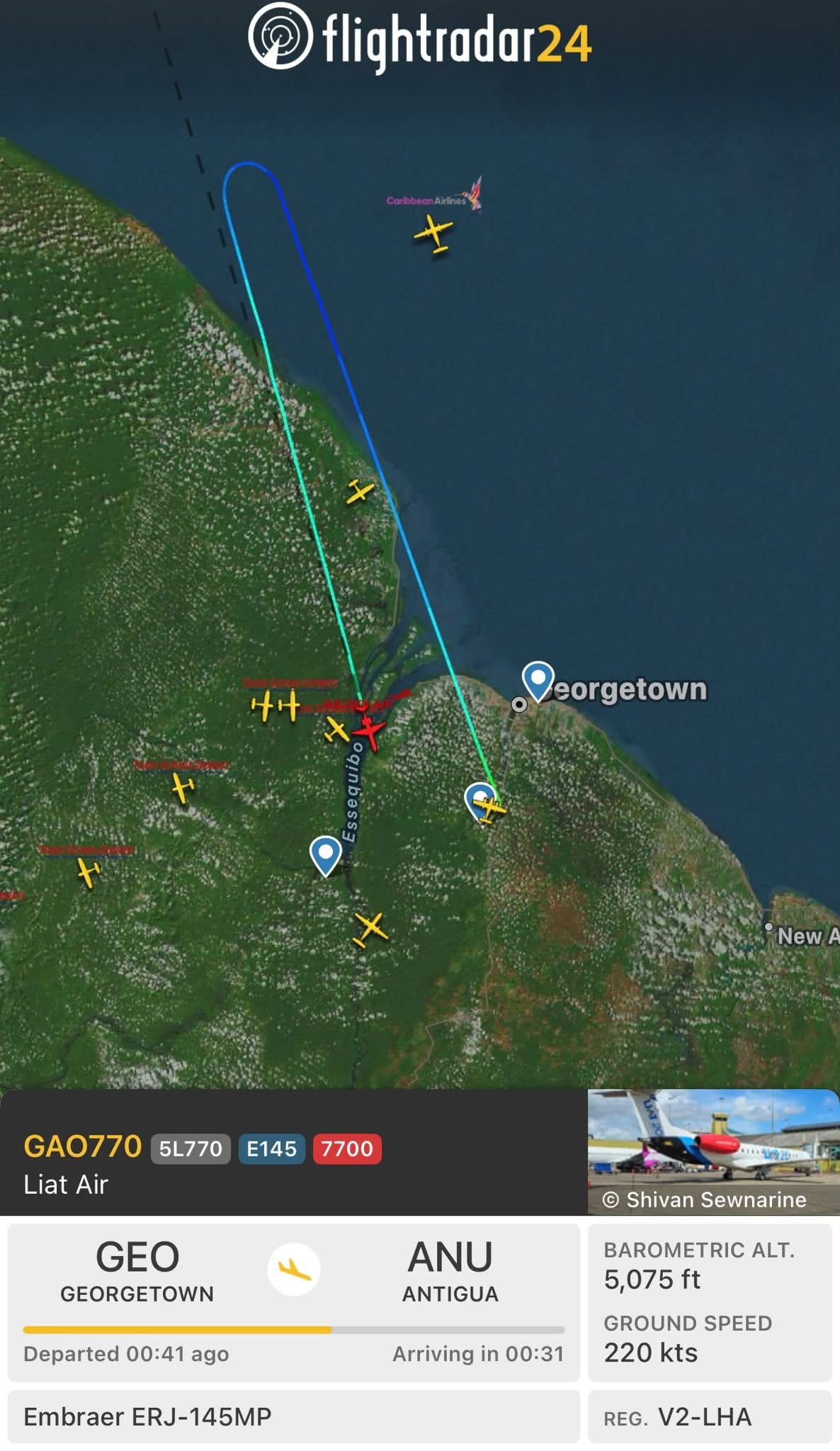
    On Sunday, an in-flight emergency triggered an urgent code transmission from a LIAT Air passenger jet traveling from Georgetown, Guyana to Antigua, just minutes after the aircraft departed its origin airport, according to data compiled by global flight tracking services.

    Flight GAO770, the regional carrier’s scheduled service between the two Caribbean-connected destinations, transmitted the transponder code 7700 — the globally recognized aviation signal that alerts air traffic control to a general on-board emergency — as confirmed by flight tracking platform Flightradar24. The aircraft in question, a 50-seat Embraer ERJ-145MP with the registration number V2-LHA, was cruising at an altitude of roughly 5,075 feet and holding a ground speed of approximately 220 knots when the emergency was declared.

    Publicly available flight tracking data captured the jet deviating from its planned flight path, executing a turn over coastal waters just off Guyana’s shoreline shortly after departure. Records from the flight tracking service confirm that the regional turboprop jet is permanently operated by LIAT Air for its scheduled inter-island and regional routes.

    At the time of the emergency declaration, the flight had been airborne for just 41 minutes, well into its planned journey to the Antigua destination. As of the latest updates, aviation authorities and the airline have not released formal confirmation of what caused the emergency, nor have they confirmed whether the flight crew is diverting back to the original departure airport in Georgetown. It is important to note that while the 7700 squawk code formally alerts controllers to an active emergency, the code itself does not provide any details on the specific nature of the issue facing the aircraft.

    LIAT Air, a regional Caribbean carrier, maintains regular scheduled service between the Georgetown and Antigua route. As of Sunday, no additional details on passenger welfare, aircraft status, or the root cause of the emergency have been released to the public.

  • Abinader says Dominican Republic could begin rare earth exports in 2028

    Abinader says Dominican Republic could begin rare earth exports in 2028

    Speaking at the 2026 Concordia Annual Summit held in New York, Dominican Republic President Luis Abinader has put a spotlight on the Caribbean nation’s largely untapped mining potential, revealing an ambitious timeline to enter the global critical minerals market with its newly discovered rare earth deposits.

  • Anadegas to disconnect electronic payment terminals at 780 gas stations on Friday

    Anadegas to disconnect electronic payment terminals at 780 gas stations on Friday

    In the Dominican Republic, a looming industry standoff over electronic payment processing fees is set to disrupt fuel retail operations nationwide if stakeholders fail to reach a last-minute agreement. The National Association of Gasoline Retailers, locally known as Anadegas, has issued a firm warning that it will permanently disable all electronic payment terminals at 780 affiliated service stations starting at 6 a.m. local time on September 25, unless a compromise on card transaction and terminal costs is secured.

    The core of the conflict lies in the steep commissions that fuel retailers are required to pay for every credit and debit card transaction processed through Verifone electronic terminals. Association leaders argue that these fees eat up an unsustainably large portion of fuel sellers’ already razor-thin profit margins. Back in July, the group revealed that retailers collect just roughly 25 Dominican pesos (RD$) in gross margin per gallon of gasoline sold, yet up to RD$7 of that amount goes toward payment processing commissions when customers pay with cards.

    The financial pressure is amplified by the overwhelming dominance of card payments in the sector. Depending on a station’s location, between 60% and 90% of all fuel purchases are transacted via card, pushing the total share of the industry’s commercial margin eaten by fees to approximately 27%, according to Anadegas’ calculations. The association further claims that when compared to other markets in the region, Dominican fuel retailers face some of the highest payment processing and terminal service costs in the analysis the group conducted.

    Following the escalation of the dispute, multi-party negotiations were launched involving Anadegas, government regulatory bodies, financial institutions, and card payment service providers. In September, Dominican consumer protection agency ProConsumidor confirmed that the Ministry of Industry, Commerce and MSMEs (MICM) had stepped in alongside other government agencies to mediate the talks, with the explicit goal of preventing a disruption to consumer payment options at fuel stations.

    Despite weeks of multiple negotiating sessions, Anadegas President Juan Elías Pérez says no tangible, actionable resolution has emerged to address the retailers’ grievances. MICM has organized a final negotiating round for September 22, three days ahead of the planned terminal shutdown, with a delegation from Anadegas scheduled to attend. While Pérez confirmed the association will take part in the summit, he emphasized that participation does not equal an automatic suspension of the planned industrial action.

    “If this meeting turns out to be more of the same unproductive talks, we will not suspend our call to action,” Pérez stated. The association has acknowledged the mediation work carried out by MICM and ProConsumidor, but maintains that a permanent solution requires a formal decision from the highest levels of government. Preparations for the shutdown are already well coordinated across the association’s regional chapters, with the city of San Francisco de Macorís serving as the central mobilization hub for the Cibao region.

    As the deadline approaches, major transportation groups have begun preparing contingency plans to avoid disruptions to mass transit services. Mario Díaz, general secretary of the National Federation of Christian Social Transport Workers (Fenattransc), announced that mass transit operators are already positioned to maintain their own fuel supplies if card payments go offline at public stations. Díaz explained that large transportation organizations operate their own authorized fuel storage tanks and on-site internal pumps that are regulated by authorities, meaning their fleets will not be fully dependent on traditional retail fuel stations to maintain operations.

    With no binding agreement yet on the table, Anadegas has reaffirmed its commitment to moving forward with the terminal disconnection if no satisfactory resolution is reached before the September 25 deadline, leaving the outcome of the final negotiation round uncertain for consumers and businesses across the country.