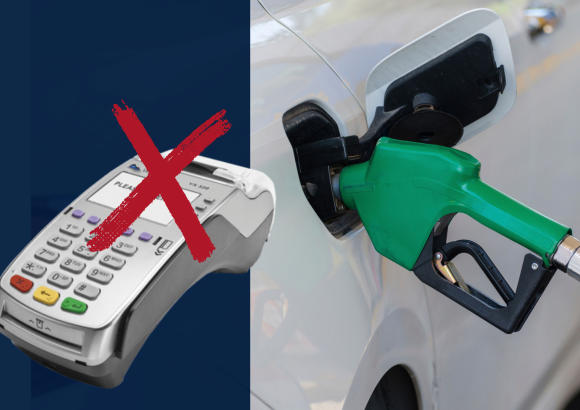
In the Dominican Republic, a looming industry standoff over electronic payment processing fees is set to disrupt fuel retail operations nationwide if stakeholders fail to reach a last-minute agreement. The National Association of Gasoline Retailers, locally known as Anadegas, has issued a firm warning that it will permanently disable all electronic payment terminals at 780 affiliated service stations starting at 6 a.m. local time on September 25, unless a compromise on card transaction and terminal costs is secured.
The core of the conflict lies in the steep commissions that fuel retailers are required to pay for every credit and debit card transaction processed through Verifone electronic terminals. Association leaders argue that these fees eat up an unsustainably large portion of fuel sellers’ already razor-thin profit margins. Back in July, the group revealed that retailers collect just roughly 25 Dominican pesos (RD$) in gross margin per gallon of gasoline sold, yet up to RD$7 of that amount goes toward payment processing commissions when customers pay with cards.
The financial pressure is amplified by the overwhelming dominance of card payments in the sector. Depending on a station’s location, between 60% and 90% of all fuel purchases are transacted via card, pushing the total share of the industry’s commercial margin eaten by fees to approximately 27%, according to Anadegas’ calculations. The association further claims that when compared to other markets in the region, Dominican fuel retailers face some of the highest payment processing and terminal service costs in the analysis the group conducted.
Following the escalation of the dispute, multi-party negotiations were launched involving Anadegas, government regulatory bodies, financial institutions, and card payment service providers. In September, Dominican consumer protection agency ProConsumidor confirmed that the Ministry of Industry, Commerce and MSMEs (MICM) had stepped in alongside other government agencies to mediate the talks, with the explicit goal of preventing a disruption to consumer payment options at fuel stations.
Despite weeks of multiple negotiating sessions, Anadegas President Juan Elías Pérez says no tangible, actionable resolution has emerged to address the retailers’ grievances. MICM has organized a final negotiating round for September 22, three days ahead of the planned terminal shutdown, with a delegation from Anadegas scheduled to attend. While Pérez confirmed the association will take part in the summit, he emphasized that participation does not equal an automatic suspension of the planned industrial action.
“If this meeting turns out to be more of the same unproductive talks, we will not suspend our call to action,” Pérez stated. The association has acknowledged the mediation work carried out by MICM and ProConsumidor, but maintains that a permanent solution requires a formal decision from the highest levels of government. Preparations for the shutdown are already well coordinated across the association’s regional chapters, with the city of San Francisco de Macorís serving as the central mobilization hub for the Cibao region.
As the deadline approaches, major transportation groups have begun preparing contingency plans to avoid disruptions to mass transit services. Mario Díaz, general secretary of the National Federation of Christian Social Transport Workers (Fenattransc), announced that mass transit operators are already positioned to maintain their own fuel supplies if card payments go offline at public stations. Díaz explained that large transportation organizations operate their own authorized fuel storage tanks and on-site internal pumps that are regulated by authorities, meaning their fleets will not be fully dependent on traditional retail fuel stations to maintain operations.
With no binding agreement yet on the table, Anadegas has reaffirmed its commitment to moving forward with the terminal disconnection if no satisfactory resolution is reached before the September 25 deadline, leaving the outcome of the final negotiation round uncertain for consumers and businesses across the country.