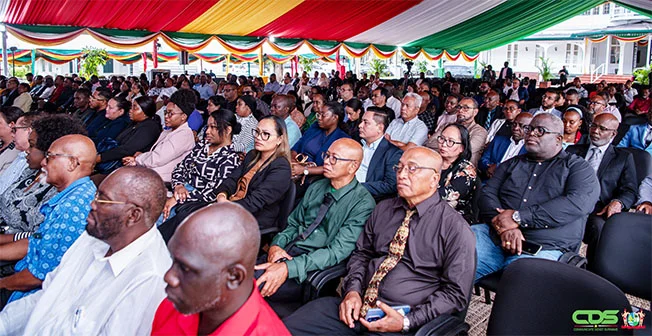
On November 19, Suriname’s government announced the official rollout of a nationwide specialized training program starting next week, targeted at all members of public sector supervisory boards, commissioner boards, foundation boards, and other oversight personnel attached to state-run institutions. The initiative, formally inaugurated at a Wednesday ceremony held at the Presidential Palace, is designed to elevate the professional expertise, operational quality, and ethical standards of public governance and oversight across all government-affiliated entities.
President Jennifer Simons, who delivered the keynote address at the opening event, emphasized that participation in the program is not a discretionary optional activity, and unexcused absences will trigger formal, pre-defined consequences for non-compliant participants. The training framework is directly tied to the new Civil Code provisions that introduce formal personal liability for public sector directors and oversight members for mismanagement, non-compliance, and failure to fulfill fiduciary duties. Simons outlined that the core long-term goal of the policy push is to cultivate a new public governance culture anchored in four non-negotiable pillars: specialized professional competence, full operational transparency, uncompromising personal integrity, and consistent, timely public accountability. She confirmed that her administration has already submitted formal requests for quarterly progress reports from all covered oversight bodies, and she will personally monitor attendance records across all training sessions to enforce full participation. “Accountability is not a voluntary favor that public officials grant to the state or the public,” Simons stated explicitly. “It is an inherent, non-negotiable component of the core responsibilities that every person accepts the moment they take on a public administrative or oversight role.”
Three local firms were selected through a fully transparent public tender process to design and deliver the curriculum: the Suriname Knowledge and Expertise Center (KES), Integrity & Governance Suriname N.V., and HR Point N.V. The program, branded “Board Refreshment”, is structured around the action learning pedagogical model, which integrates theoretical instruction directly with real-world case scenarios drawn from Suriname’s public sector operational context to ensure practical, immediately applicable skill building, per an official release from Suriname’s National Communications Service.
Robby Rijssel, representing KES, noted that effective public sector oversight requires far more than basic familiarity with laws and regulations: it demands consistent independent judgment, critical analytical thinking, unwavering personal integrity, and strong financial and strategic planning acumen. Sharmila Ramadhin from Integrity & Governance Suriname added that the training will push participants to move beyond passive attendance at board meetings, to actively ask targeted, critical questions about institutional plans, operational risks, and on-ground implementation progress for all public projects and policies. John Maboeb of HR Point explained that the curriculum also places heavy emphasis on strengthening individual accountability mindsets, alongside technical legal and financial knowledge, to build the professional courage and willingness for oversight members to take clear, public stances on high-stakes governance issues when required. The Surinamese government projects that the full program will drive measurable improvements in oversight performance, reduce administrative misconduct, and foster a far stronger culture of proactive accountability across all state institutions.