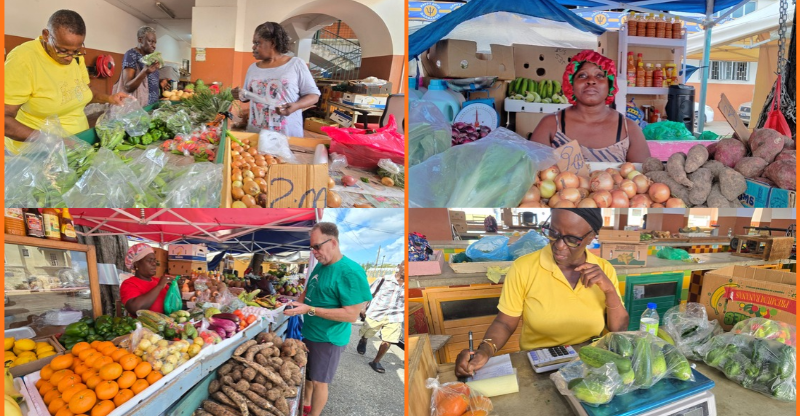
Traders operating at Barbados’ iconic Cheapside public market are sounding urgent alarms over cascading operational strains driven by shrinking local harvests, surging wholesale costs, and growing dependence on imported food staples, with many warning that household grocery bills are set to rise sharply in the run-up to the Christmas festive period. These on-the-ground accounts emerged just 24 hours after local farming communities issued their own public advisory that reduced yields for a wide range of domestic crops would push retail food prices upward through the end-of-year holiday season.
Vendors report that core staple items including tomatoes, carrots, and yams have become increasingly difficult to source from local agricultural producers, forcing many small business owners to divert a larger share of their tight operating budgets to imported stock just to keep their market stalls fully stocked for regular and seasonal customers. Marlene, a market veteran with decades of experience selling fresh produce at Cheapside, noted that tomatoes represent one of the most acute pain points, with both exorbitant wholesale pricing and inconsistent quality leading to significant, unplanned financial losses for her small operation. “You might purchase 23 pounds of tomatoes at wholesale, and end up having to toss a large portion of the batch because a significant share is spoiled or damaged,” she explained. She added that locally grown carrot supplies have also dwindled drastically compared to previous years, leaving far less domestic stock available for her to purchase.
To turn even a slim profit, Marlene says she is forced to retail tomatoes at $11 to $12 per pound, after paying $8 per pound at the wholesale level. She attributes the vast majority of the current supply crunch to a prolonged, severe regional drought that has decimated harvests for a wide range of small, high-demand herbs and vegetables. “When drought conditions persist, you can barely source thyme, parsley, marjoram, none of those common culinary herbs at all,” she noted. A second Cheapside vendor shared that she recently turned down a wholesale listing for a single box of tomatoes priced at $196, as her weekly produce procurement budget had already surpassed $500 for that week. Instead, she opted to purchase smaller batches of locally grown tomatoes, which she retails at roughly $8 per pound to keep costs marginally lower for her regular customer base.
Beyond rising produce costs, vendors face additional financial pressure from surging packaging expenses, a burden that is amplified when many shoppers push back against small fees for plastic or paper bags. “Some vendors charge $13 for a single bag, others $17, and customers often get frustrated about that,” the vendor added. She also flagged that the end of the local pear harvest season is creating new frictions, as customers frequently react with anger when informed of higher seasonal pricing. “This is the very last week we have local pears available, and when we tell shoppers the updated price, many of them become verbally hostile, even though we have no control over the supply shortages.” Even amid these frictions, she noted that a large base of long-time loyal customers continues to patronize her stall regularly.
Althea, another Cheapside vendor who also runs her own small farming operation, explained that the challenges extend far beyond sourcing affordable stock, as many customers demand full refunds or replacement items for alleged quality issues without providing proof of damage or returning the claimed faulty goods. “One customer threw down three pears, and all of them split open – pears cost between $6 and $8 each right now. On two separate occasions, a customer complained that pears and pumpkins I sold them were low quality, but refused to bring the items back or send any photos to prove the issue, and I still replaced both orders out of my own pocket, taking a total loss on those goods.” She added that most local shoppers do not fully grasp the cascading risks that both farmers and market vendors face, from total crop failures to underwhelming harvest yields that erase months of hard work and investment. “Most people have no idea what we are actually dealing with behind the scenes,” she said, noting that rising food costs are a widespread challenge across the Caribbean region, not isolated to Barbados.
Althea currently has thriving plots of cauliflower, broccoli, and sorrel growing on her farm, and is optimistic she will have fresh, locally grown stock available for shoppers in the lead-up to Christmas. She also produces small-batch natural fruit juices that she distributes across the island, and is urging local consumers to shift more of their grocery spending to Cheapside Market to support small local vendors. “Stop complaining about high food prices at other retailers, come down to Cheapside and see for yourself that we still have affordable, reasonably priced produce,” she said. “For the past three weeks, I’ve been selling squash for $1 per pound, pumpkin for $1 per pound, watermelon for $2 per pound, and sweet potatoes for $2 per pound – those are prices no large supermarket can match.”
Angela, a long-time Cheapside vendor, confirmed that a growing share of seasonal holiday produce will need to be imported to meet expected Christmas demand, with popular culinary herbs like parsley and thyme already in critically short supply. She did note that a handful of local vegetables, including okra, melons, and cucumbers, remain in steady, abundant supply for the time being. Local shoppers interviewed at the market offered mixed perspectives on the ongoing price shifts: one anonymous female shopper noted that market prices remain far more reasonable than the steep price tags at large chain supermarkets, and that she regularly purchases okra and sweet potatoes at Cheapside. She added that she is not particularly worried about her Christmas grocery shopping this year, as her family will not be joining her for the holiday celebrations. Another regular shopper, Lorna, explained that she selects her produce specifically to align with her personal health needs. “I love eating bora beans and spinach, but I cannot consume okra, pumpkin, or squash for health reasons, so I stick to purchasing green leafy vegetables and peppers for my weekly meals.”
Market vendors struggle with rising costs