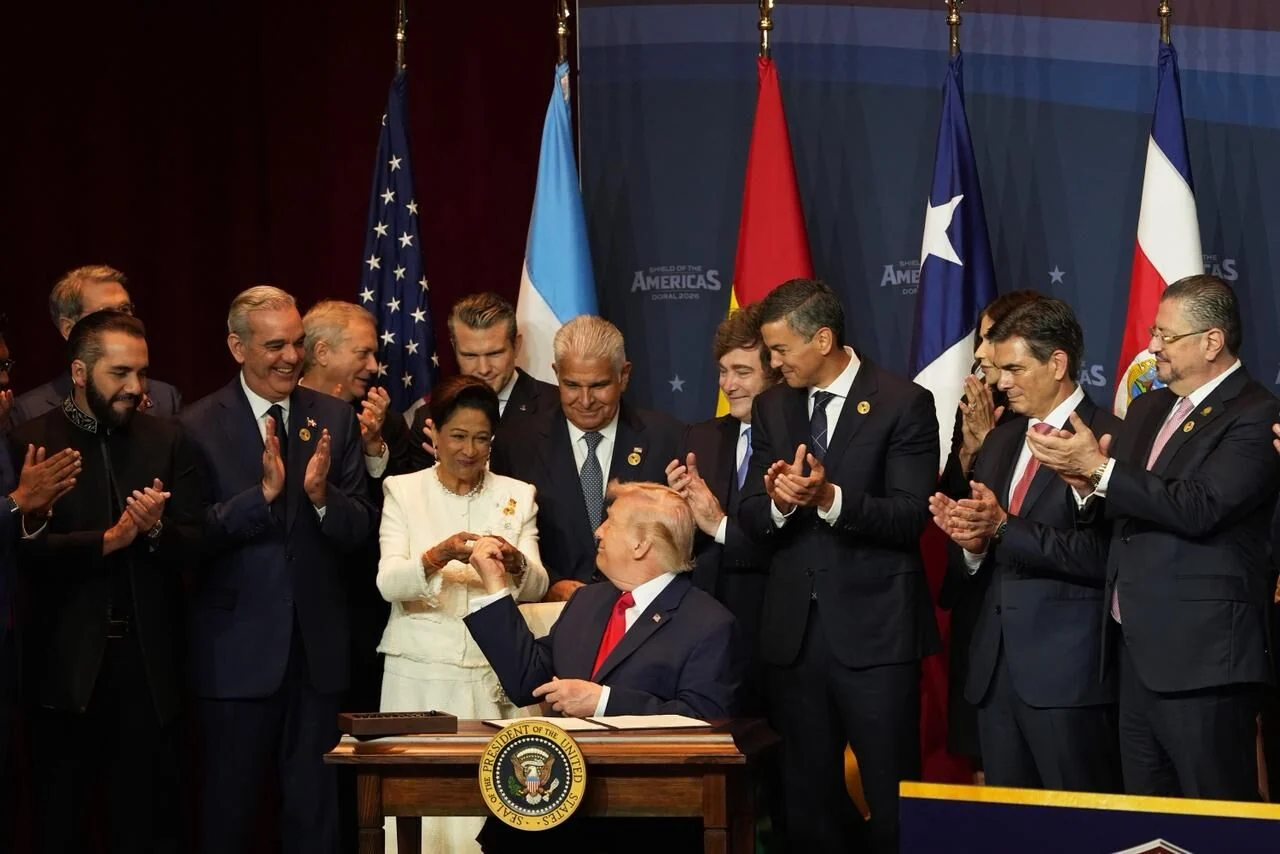
Over her two years in office, Trinidad and Tobago Prime Minister Kamla Persad-Bissessar has steadily steered her nation’s foreign and security policies into close alignment with the agenda of former and current U.S. President Donald Trump’s administration, openly criticizing prior Democratic U.S. leadership while welcoming expanded U.S. military presence across the Caribbean and endorsing a high-stakes, lethal counter-narcotics campaign in regional maritime waters.
Persad-Bissessar has made no secret of her public admiration for Trump, at one point praising his unyielding “fighting spirit.” In the lead-up to the U.S.-led military ouster of former Venezuelan leader Nicolas Maduro, her administration greenlit the installation of a U.S. military radar on Tobago and pledged “unflinching” operational access for U.S. armed forces operating in the region. That close bilateral alignment now faces a critical new stress test, following U.S. midterm election results that handed Democratic lawmakers full control of both chambers of Congress, flipping long-held Republican seats and defeating multiple Trump-endorsed congressional candidates.
While Trump remains in the presidency, retaining authority over U.S. military and foreign policy portfolios through January 2029, the newly empowered Democratic-controlled Congress will hold sweeping investigative powers to scrutinize his administration’s actions, potentially drawing renewed international scrutiny to Trinidad and Tobago’s overt alignment with U.S. operations in the Caribbean. Starting this January, Democratic-led House committees will be authorized to convene public hearings, issue legally binding subpoenas, and compel witness testimony. International media reports indicate a top priority for these probes will be the U.S. military’s lethal maritime strike campaign targeting alleged drug-smuggling vessels across the Caribbean and Pacific, an operation that has killed more than 240 people to date and drawn widespread condemnation from the United Nations, Amnesty International, and global legal experts over alleged human rights violations.
In September of the previous year, as U.S. Defense Secretary Pete Hegseth pushed to launch kinetic lethal strikes against vessels suspected of trafficking illicit drugs through Caribbean waters, Persad-Bissessar publicly cheered the initiative, going so far as to urge U.S. forces to “violently” eliminate all drug traffickers operating in the region. Her supportive statements continued even as the families of two Trinidadian fishermen came forward to confirm their relatives were killed in one of these U.S. military strikes. The families, represented by the American Civil Liberties Union and the Center for Constitutional Rights, filed a federal lawsuit titled *Burnley v. United States* earlier this year in the U.S. District Court for the District of Massachusetts, alleging the two deaths constituted extrajudicial, unlawful murders on the high seas – a finding that could serve as foundational evidence for impeachment proceedings targeting Hegseth. Separately, CNN reported that House Republicans are poised to hold a formal vote to formally rebuke Hegseth, after lawmaker Thomas Massie announced plans to introduce an impeachment motion against the defense secretary in the coming week.
Persad-Bissessar’s administration has repeatedly maintained it had no operational involvement in the U.S. maritime strike campaign that continued through 2026, and that no such strikes were ever launched from or conducted within Trinidad and Tobago’s sovereign territorial waters. Attorney General John Jeremie previously announced he had retained independent legal counsel from a UK King’s Counsel to review two core questions: first, whether U.S. strikes on alleged drug vessels in international waters, or hypothetically within Trinidad and Tobago’s territorial sea, complied with international law; and second, whether U.S. military operations launched from Trinidad and Tobago as part of Operation Southern Spear, targeting the Maduro government in Venezuela, were legally permissible. Jeremie stated the legal review fully absolved Trinidad and Tobago of any liability for U.S. strike activities, even if operations were conducted near or within its maritime borders.
Veteran political scientist Dr. Bishu Ragoonath, speaking to local outlet the Express on Wednesday, argued that Trinidad and Tobago held no meaningful operational role in the U.S.-led counter-narcotics operations. “Trinidad and Tobago was nowhere involved in any of those kinetic actions. As noted in prior U.S. congressional hearings, our country only offered diplomatic support for the U.S. effort to remove Maduro, alongside several other Caribbean nations that granted U.S. forces access to their airports and related infrastructure,” Ragoonath explained. “Any congressional investigation will be focused on establishing direct evidence of decision-making from the U.S. Navy and the chain of command that ordered those missile strikes. Trinidad and Tobago never fired a single missile, and we were never party to any of the strike-related decision-making processes – that is a verifiable fact.”
Persad-Bissessar’s ideological alignment with the U.S. Republican Party predated her 2025 election as prime minister. In 2024, while serving as opposition leader, she published a public statement harshly condemning the then-sitting Democratic U.S. administration for what she described as a “woke extreme far-left agenda.” That same year, she publicly congratulated Trump on his re-election, lauding his “resilience, commitment and fighting spirit” while dismissing the prior Joe Biden-Kamala Harris administration as a total “disaster” for the American public. Her statement went on to accuse the Democratic administration of violating basic common sense and public morality, eroding longstanding norms of civil public life, harming children through progressive social policies, censoring dissenting viewpoints, undermining religious and conservative values, fueling unnecessary conflicts across the globe, weaponizing the judicial system against political opponents, and enabling widespread nepotism, corruption, surging crime, rising poverty, homelessness, and widening wealth inequality.
In the lead-up to Trinidad and Tobago’s April 2025 general election, Persad-Bissessar echoed a series of core GOP policy priorities, including calls for expanded civilian access to firearms, the reintroduction of religious instruction in public schools, and pledges to implement aggressive migrant deportation policies and stricter border controls. After her election, her government’s overt alignment with U.S. interests accelerated amid a large-scale U.S. military build-up in the Caribbean and the Trump administration’s authorized campaign to oust Maduro in Venezuela. After granting U.S. forces unconditional access to Trinidad and Tobago’s territory in the event of a Venezuelan military attack on Guyana, her administration hosted the U.S. guided-missile destroyer USS Gravely at a local port – a move that prompted Venezuela to sever all natural gas ties with Trinidad and Tobago and formally declare Persad-Bissessar persona non grata. In December 2025, the government further approved the deployment of a U.S. military-grade air defense radar on Tobago and granted U.S. military aircraft full access to the nation’s commercial and military airports, though the radar system was removed earlier this year. That March, Persad-Bissessar attended Trump’s Shield of the Americas Summit, formally committing Trinidad and Tobago to the Americas Counter Cartel Coalition, which she framed as a critical step to strengthen local efforts to combat gun and drug trafficking.
In February 2026, as the U.S. escalated economic and military pressure on Cuba by cracking down on shipments of sanctioned Venezuelan oil to the island nation, Persad-Bissessar publicly stated her government did not recognize what she called the “dictatorial” regime in Havana. Weeks later, when the U.S. launched Operation Epic Fury against Iran, a strike that killed former Iranian Supreme Leader Ayatollah Ali Khamenei and sparked a weeks-long regional war in the Middle East, Trinidad and Tobago’s Ministry of Foreign Affairs issued a statement formally endorsing the U.S. action, framing it as a necessary step to “prevent oppressive regimes from acquiring nuclear weapons capabilities that would jeopardise international peace and security.” The government also formally designated Hezbollah, Hamas, and Iran’s Islamic Revolutionary Guard Corps (IRGC) as official terrorist entities. Most recently, Trinidad and Tobago broke a decades-long historical voting precedent by abstaining from the annual UN resolution calling for an end to the longstanding U.S. embargo on Cuba, and also declined to support a separate UN resolution backing the International Criminal Court, in line with U.S. efforts to pressure the global judicial institution.
Former UNC MP and ex-Trinidad and Tobago permanent representative to the United Nations Rodney Charles, now an opposition lawmaker, issued a public statement in the wake of the U.S. midterm elections urging the Persad-Bissessar government to reverse course on its unpopular foreign policy stances. Charles warned that the nation’s uncritical, unwavering support for Trump’s agenda was pushing Trinidad and Tobago toward global isolation. “We need to stop taking embarrassingly unpopular positions on the world stage, from our votes on the Cuban embargo and the ICC, to abandoning our longstanding commitment to the Caribbean as a zone of peace, to our alleged involvement in Venezuela’s internal affairs and potential co-conspiratorial role in the extrajudicial killings in Caribbean maritime waters,” Charles said. “This entire list of policies is driven by blind, uncritical support for a deeply unpopular U.S. president. Without an immediate course correction, we risk becoming a global pariah, sidelined at the UN, within CARICOM, and across all major multilateral forums, perpetually siding with a tiny minority of nations on key global votes.”
Charles went on to warn that upcoming Democratic-led congressional investigations could unearth damaging evidence linking Trinidad and Tobago to both the ouster of Maduro and the alleged extrajudicial killings in Caribbean counter-narcotics strikes. He offered concrete policy recommendations for the government, including retaining the legal services of former president Anthony Carmona – a retired high court judge – to advise on potential ICC-related legal challenges, rather than hiring expensive external UK King’s Counsel; engaging specialized public relations firms to develop targeted diplomatic damage control strategies to build positive ties with Democratic lawmakers via backchannel diplomatic initiatives; and assembling a cross-sector task force of local and international experts, including academics from the University of the West Indies, to develop evidence-based, public-facing foreign policy frameworks to be debated openly in parliamentary sessions and national public consultations, so that the entire Trinidad and Tobago population can collectively shape the nation’s future global positioning.
Kamla aligned T&T’s foreign policy to Trump. Now what?