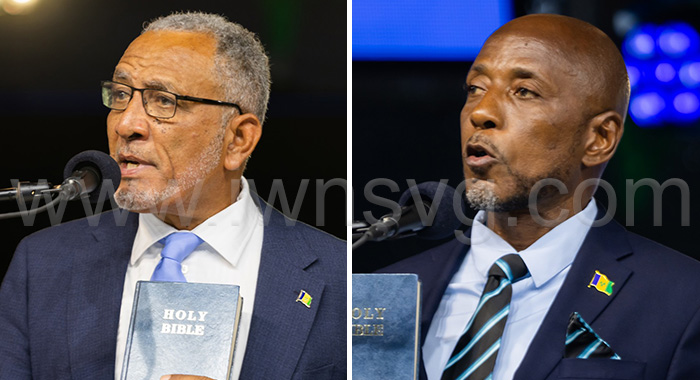
Two weeks ahead of the first anniversary of the New Democratic Party (NDP)’s landslide 2025 general election victory in Saint Vincent and the Grenadines, legal teams on both sides of two landmark parliamentary eligibility petitions will reconvene at the Kingstown High Court on Tuesday morning to present final oral arguments before Justice Gertel Thom. The four-day hearing, scheduled to run through Friday per the official Eastern Caribbean Supreme Court cause list, caps a months-long evidentiary process that wrapped up witness testimony on October 1, with all required written submissions formally filed by the November 4 deadline. The legal challenge traces back to the November 27, 2025, national polls, where the NDP secured 14 of 15 House of Assembly seats, ousting the Unity Labour Party (ULP) after nearly 25 consecutive years in power. Prime Minister Godwin Friday was sworn into office the day after the election, with his full cabinet, including Foreign Affairs Minister Dwight Fitzgerald Bramble, formally taking oaths of office on December 5, 2025. The two petitions were filed post-election by defeated ULP candidates Augustus Carlos Williams and Luke Browne: Williams, who contested the Northern Grenadines seat against Friday, earned just 339 votes to Friday’s 2,185, with 11 ballots rejected; Browne, in his fourth consecutive bid for the East Kingstown constituency and second face-off against Bramble, garnered 1,727 votes compared to Bramble’s 2,728, with 19 ballots discarded. Both legal actions name as respondents not just Friday and Bramble, but also Supervisor of Elections Dora James, the national Attorney General, and the respective returning officers for the two contested constituencies: Devon Ollivierre for the Northern Grenadines, and Jacqueline Browne for East Kingstown. The petitioners are urging the court to void both election results under the longstanding “wasted vote” legal principle, arguing that Friday and Bramble were ineligible to stand as candidates under Section 26(1)(a) of the national Constitution. Their core contention is that the pair’s voluntary acquisition of Canadian citizenship by naturalisation – Friday in 1990, Bramble in 2005 – places them in a position of “acknowledgement of allegiance, obedience or adherence to a foreign power or state”, disqualifying them from parliamentary office. The defence, by contrast, argues that Section 25 of the Constitution, which extends eligibility to Commonwealth citizens, protects the two officials’ right to hold their seats, making the dual Canadian citizenship status no barrier to public office. The trial’s evidentiary phase unfolded across two distinct sittings: the first in late July 2026, and the second running from late September through the final witness appearance on October 1. During the July proceedings, Justice Thom declined to rule on a preliminary application from lead defence counsel Anand Ramlogan, SC, to strike out the petitions entirely, instead electing to hear full testimony from all relevant parties. For the petitioners, Williams, Browne, and four campaign workers gave evidence that they had distributed and posted public notices in the two constituencies before polling day, warning voters that any ballots cast for Friday or Bramble would be legally classified as wasted votes. Two of the four campaign workers faced rigorous cross-examination over the accuracy and distribution of those notices, while Canadian immigration lawyer Sarah McKinnis appeared virtually as an expert witness to testify on Canadian naturalisation rules. When the respondents presented their case in late September, they called 21 local witnesses over four days, alongside prominent Caribbean constitutional scholar Professor Hamid Ghany, who provided expert testimony on the intersection of Commonwealth citizenship rules and regional parliamentary qualification standards. Both Friday and Bramble took the witness stand during this phase, openly acknowledging under cross-examination from petitioners’ lead counsel Stuart Young, SC, that they hold active Canadian passports obtained through voluntary naturalisation, while insisting their dual status does not violate any constitutional eligibility rules. When speaking to reporters outside the courthouse, Bramble declined to speculate on whether he would renounce his Canadian citizenship in the event of an adverse ruling, stating he would not comment on hypothetical future scenarios. The defence also called dozens of Bequia residents and NDP supporters to testify on Friday’s behalf, plus East Kingstown residents familiar with Bramble’s community work. During cross-examination, these witnesses were questioned extensively about their longstanding political loyalty to the NDP, personal and professional ties to Bramble, and the exact date they first learned of the ULP’s pre-election objections to the two candidates’ dual citizenship status. Immediately following the close of testimony on October 1, Friday dismissed the legal challenges as the work of “sour grapes and sore losers”, telling assembled reporters the petitions represented a petty attempt to overturn the clear will of voters. Ramlogan echoed that sentiment, describing the bid to unseat the two elected representatives as fundamentally “anti-democratic”. Defence attorney Shirlan “Zita” Barnwell further noted that the decision not to renounce Canadian citizenship ahead of or during the trial was a deliberate choice, designed to secure a definitive, binding constitutional interpretation of dual citizenship eligibility rules that would apply to all future election candidates in the country. On the opposing side, Young told local media his legal team remains “very confident” in their case, noting the final ruling will hinge entirely on a strict textual and contextual interpretation of the country’s foundational Constitution. He added that both Friday and Bramble had “ample opportunity” to formally renounce their Canadian citizenship in the lead-up to the 2025 election, but deliberately chose not to take that step. Browne also pushed back against widespread public criticism that the petitions were filed purely out of bitterness over the ULP’s landslide election loss, pointing out that his party had publicly raised the dual citizenship issue repeatedly during the campaign, and that he would have considered filing the legal challenge even if he had won his East Kingstown seat. Once the four days of oral submissions conclude, Justice Thom is expected to reserve her ruling to deliberate on the complex constitutional questions at stake. The legal team representing petitioners Williams and Browne includes Stuart Young, SC, alongside attorneys Al Elliott and Carlos James, while the defence team for Friday and Bramble comprises Anand Ramlogan, SC, UK-based barrister Kate Temple-Mabe, and local legal practitioners Kay Bacchus-Baptiste, Shirlan “Zita” Barnwell, Zhinga Horne-Edwards, and Samantha Robertson.
PM, Bramble to return to court on Tuesday for election petition closing arguments