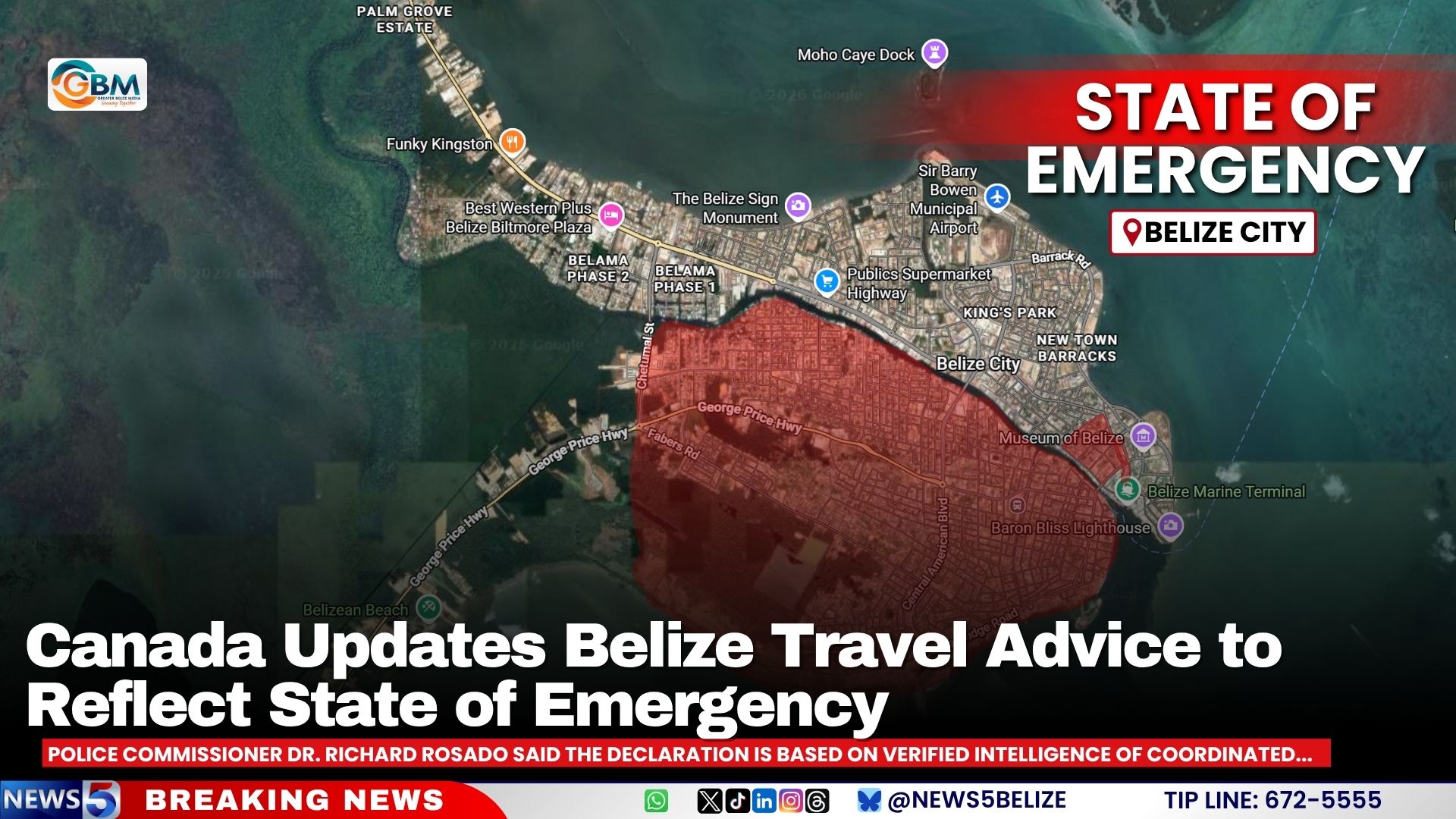
On November 6, 2026, the Government of Canada rolled out a revised official travel advisory for Belize, integrating critical details of the Central American nation’s recently declared public state of emergency while reaffirming longstanding warnings about widespread violent crime risks across the territory. The updated guidance, which supersedes a prior version issued on November 3, 2026, urges all Canadian nationals in Belize to maintain a heightened level of caution nationwide, and explicitly advises against any non-essential travel to the Southside district of Belize City, located south of the Haulover Creek River, due to persistent gang and narcotics-fueled violence that includes frequent homicides and targeted shootings.
The 30-day state of emergency in question was formally signed into effect by Belize’s Governor-General Froyla Tzalam on October 31, 2026, in response to an unprecedented spike in violent criminal activity that culminated in one of the country’s deadliest weekends in recent history: seven confirmed murders were recorded between the preceding Friday and early Sunday, with law enforcement officials attributing the bloodshed to escalating retaliatory gang rivalries. The emergency order covers targeted zones across two administrative districts: designated portions of Northside and Southside Belize City in the Belize District, plus swathes of Ladyville, Cotton Tree, and Unitedville in the Cayo District, alongside the Coastal Highway stretch running between La Democracia and Hope Creek.
Under the terms of the active state of emergency, local security forces are granted expanded authority to restrict civilian movement, conduct warrantless searches and property seizures, and detain individuals identified as persons of interest. Canadian travellers present in the designated emergency zones are notified to anticipate a sharply increased police and military footprint at checkpoints, carry valid government-issued identification at all times, and prepare for unplanned transportation delays across affected routes.
Beyond the emergency provisions, the updated advisory underscores that Belize maintains one of the highest per capita murder rates globally, with violent crime risks extending far beyond the previously high-risk Southside Belize City area to include incidents in the national capital of Belmopan. Documented threats include armed robberies, residential burglaries, physical assaults, and sexual assaults, with isolated violent incidents against foreign residents even occurring in popular tourist hotspots such as Caye Caulker, Hopkins, Placencia, San Pedro, San Ignacio, Corozal, and Seine Bight. The advisory also notes that local police resources to respond to violent incidents remain severely limited, with a large share of reported major crimes remaining unsolved, and clarifies that while tourists are not typically the primary targets of criminal groups, bystanders face tangible risk of harm if caught in crossfire during gang-related confrontations.
Additional contextual warnings included in the advisory flag elevated levels of criminal activity along Belize’s border with Guatemala, particularly in the Melchor de Mencos border crossing area, alongside long-range climate risks: El Niño weather patterns are projected to intensify through 2027, raising the likelihood of prolonged droughts, destructive flooding, and severe tropical storms, while the annual Atlantic hurricane season remains active through the end of November.
Belize’s Minister of National Security Michel Chebat defended the introduction of the emergency order, noting that targeted zones had recorded a sustained surge in shootings and homicides over the preceding 30 days, and that the government was obligated to deploy every available legal tool to curb violence and protect public safety. Police Commissioner Dr. Richard Rosado added that the emergency declaration was rooted in verified intelligence of coordinated, retaliatory gang activity, and that law enforcement had prepared case files on roughly 60 individuals deemed high-priority targets under the emergency provisions, though the majority had not yet been detained at the time of the advisory’s release.
The emergency measure has already sparked public pushback and legal scrutiny, however: multiple family members of individuals detained under the expanded powers have alleged that innocent civilians are being unlawfully held, with at least two separate families announcing plans to file formal legal challenges against the detentions. The use of sweeping state of emergency detention powers also faces existing judicial review, after Belize’s Court of Appeal ruled that a nearly identical 2020 state of emergency implemented to curb gang activity was unconstitutional; that ruling is currently pending a final appeal hearing before the Caribbean Court of Justice.