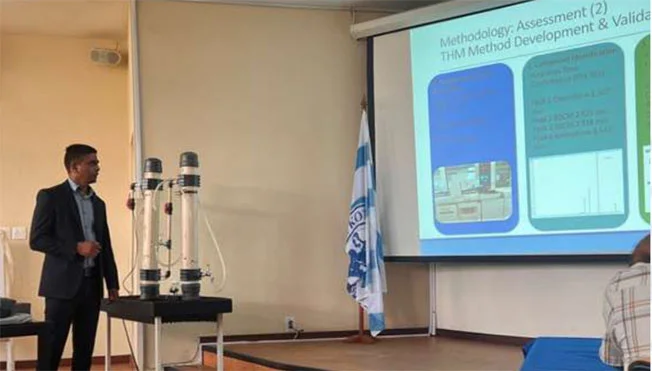
A recently unveiled master’s research project from the Anton de Kom University of Suriname (AdeKUS) has uncovered unrecognized chemical characteristics of the country’s groundwater sources that call for customized drinking water treatment strategies, rather than the one-size-fits-all approaches often applied globally. Conducted by chemical science graduate researcher Ritesh Gayadin as part of his postgraduate work through AdeKUS’s Interfaculty Graduate Studies and Research department, the two-year study analyzed conditions across seven active drinking water production sites nationwide, with a specific focus on tracking the formation and mitigation of harmful byproducts generated during standard chlorine disinfection processes.
Chlorine is a longstanding, widely adopted water treatment tool used to eliminate waterborne pathogens that cause life-threatening illnesses, but its interaction with naturally occurring organic compounds and bromide in source water can produce unintended disinfection byproducts, most notably a group of compounds called trihalomethanes (THMs). Long-term exposure to elevated THM levels has been linked to potential adverse health outcomes, prompting global public health bodies including the World Health Organization (WHO) to enforce strict concentration limits for the compounds in distributed drinking water.
One of the study’s most surprising findings defied a long-held global assumption in water management: groundwater reserves in Suriname’s coastal plain recorded total organic carbon (TOC) levels between 16 and 20 milligrams per liter, far higher than the concentrations typically found in local surface water sources. This runs counter to the standard industry premise that surface water almost always carries higher loads of natural organic material than sealed groundwater aquifers. At the La Liberté (PSLB) production site, researchers also detected a bromide concentration of 3.56 milligrams per liter, a level high enough to shift the profile of generated THMs toward more toxic brominated variants.
Crucially, all THM levels measured across the seven monitored sites remained well below WHO’s official safety thresholds, meaning no drinking water supplied from these locations currently poses an immediate public health risk. Even so, Gayadin’s team emphasizes that the unusual chemical profile of Suriname’s groundwater creates latent risk of future byproduct buildup if treatment systems are not adjusted to match local source water traits. To address this gap, the research team designed and successfully tested a pilot-scale granular activated carbon (GAC) filtration system that, with just 15 minutes of contact time, removed up to 70% of the organic precursor compounds that react with chlorine to form THMs. The study recommends scaling up the design using parallel modular filter units, which can be calibrated individually to match the unique chemical composition of each local water source.
Gayadin formally defended his thesis, titled *Assessment and Design Strategies for the Removal of Chlorine Disinfection By-Products in Surinamese Drinking Water Treatment Systems*, on September 25, 2026. The full set of research findings has been compiled into a peer-reviewed manuscript submitted to an Elsevier-run international scientific journal for formal publication, with the goal of making the tailored water treatment framework accessible to other tropical nations facing similarly unusual groundwater chemistry profiles.
Onderzoek: Surinaamse drinkwaterbronnen vragen om aangepaste zuivering