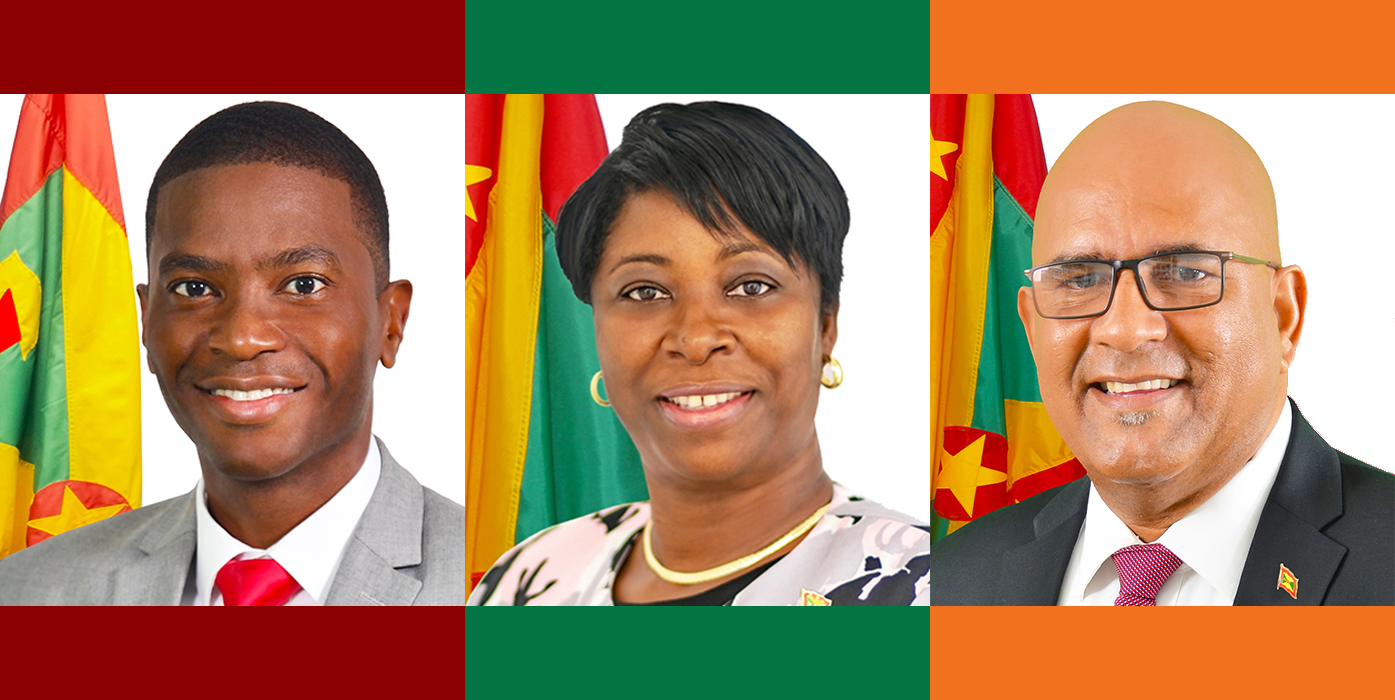
As formal candidate nominations closed on October 15, Grenada’s highly anticipated 5 November general election has entered its decisive final stretch, with three competing political parties vying to reshape the island nation’s political landscape and make unprecedented history. The contest pits incumbent Prime Minister Dickon Mitchell of the ruling National Democratic Congress (NDC), Opposition Leader Emmalin Pierre of the New National Party (NNP), and veteran legislator Peter David of the newly formed Democratic People’s Movement (DPM) against one another, with outcomes set to hinge on both national party appeal and hard-fought battles across the country’s 15 individual constituencies.
Founded in 1987, the NDC has secured three general election victories to date, in 1990, 2008, and most recently 2022, when Mitchell led the party to a 9-seat majority, ousting the previously ruling NNP under then-Prime Minister Dr Keith Mitchell. The 2022 poll saw the NNP claim the remaining 6 parliamentary seats, with the NDC edging out its rival by a narrow 2,472-vote, 4% national margin. Notably, the NDC has never before won two consecutive general elections, a milestone Mitchell is actively campaigning to reach as he seeks a second term at the helm. Central to his re-election pitch is the argument that many of his administration’s transformative, long-term policy initiatives spanning healthcare, education, and national infrastructure cannot be fully delivered within a single four-year term. “The NDC has always put people first, and this is an opportunity to make sure that we continue on that trajectory,” Mitchell stated, framing continuity as the core of his campaign to secure a renewed public mandate.
Mitchell’s personal re-election battle in the St David constituency presents a high-stakes subplot to the national race. In 2022, he defeated the NNP’s Oliver Joseph by a commanding 1,672-vote, 23% margin, but this cycle he faces a new challenger: first-time parliamentary candidate Noleen Thompson of the NNP. Thompson has centered her campaign on addressing unmet local needs, prioritizing targeted support for vulnerable groups including families raising children with disabilities and elderly residents, alongside expanded vocational training for young people, long-overdue improvements to the constituency’s strained transportation network, and new local job creation. She has pushed back against the incumbent’s record, claiming that promised employment gains have not materialized for many St David residents, and has pledged to deliver on a suite of social care commitments outlined in the NNP’s official manifesto if elected.
For NNP leader Emmalin Pierre, the election offers a landmark opportunity to become Grenada’s first ever female prime minister, should her party secure a national majority and she retain her own St Andrew South East constituency seat. Pierre has positioned the NNP as a fully prepared, governance-ready alternative to the incumbent administration, emphasizing that the party has already finalized detailed implementation plans for all its policy pledges rather than waiting to draft governing strategies after votes are counted. “We are preparing ourselves for governance. What we don’t want is to win an election, and then the next day you’re trying to figure out what you’re going to do,” she explained, framing administrative readiness and cross-national unity as the twin pillars of her party’s campaign. Pierre herself has held the St Andrew South East seat for three consecutive terms, winning the 2022 poll by a narrow 233-vote, 6% margin over NDC challenger David Andrew, who is mounting a second bid to unseat her this cycle. Andrew has expressed cautious but firm confidence in his campaign, noting that four years of grassroots engagement across the constituency has left him well-positioned to flip the seat.
The race’s wild card is veteran legislator Peter David, who is contesting the election under the banner of his new DPM, a party he founded after resigning from the NNP in 2025. David brings unparalleled local name recognition to the contest, having won the Town of St George constituency in four consecutive general elections: first as an NDC representative in 2008, then retaining the seat as an NNP member in 2013, 2018, and 2022, when he defeated NDC rival Claudette Joseph by a 211-vote, 9% margin. Expelled from the Tillman Thomas-led NDC in 2012 before his later departure from the NNP, David now faces two distinct challenges: defending his long-held Town of St George seat for an unprecedented fifth consecutive term, and proving that the DPM can emerge as a credible, sustainable third political force capable of attracting support beyond his personal loyal base. The party has nominated candidates in 9 of Grenada’s 15 constituencies, while the NDC and NNP have fielded full slates across every electoral district.
As campaigning intensifies in the final weeks before polling day, Grenadian voters are tasked with weighing the incumbent administration’s case for extended time to deliver its unfinished agenda, the NNP’s pledges of targeted social support and job growth, and the DPM’s pitch as a fresh alternative to the two long-dominant established parties. The final result will not only determine who occupies the office of Prime Minister, but will also reshape the balance of power in Grenada’s parliament and set the country’s national policy direction for the full next four-year term.