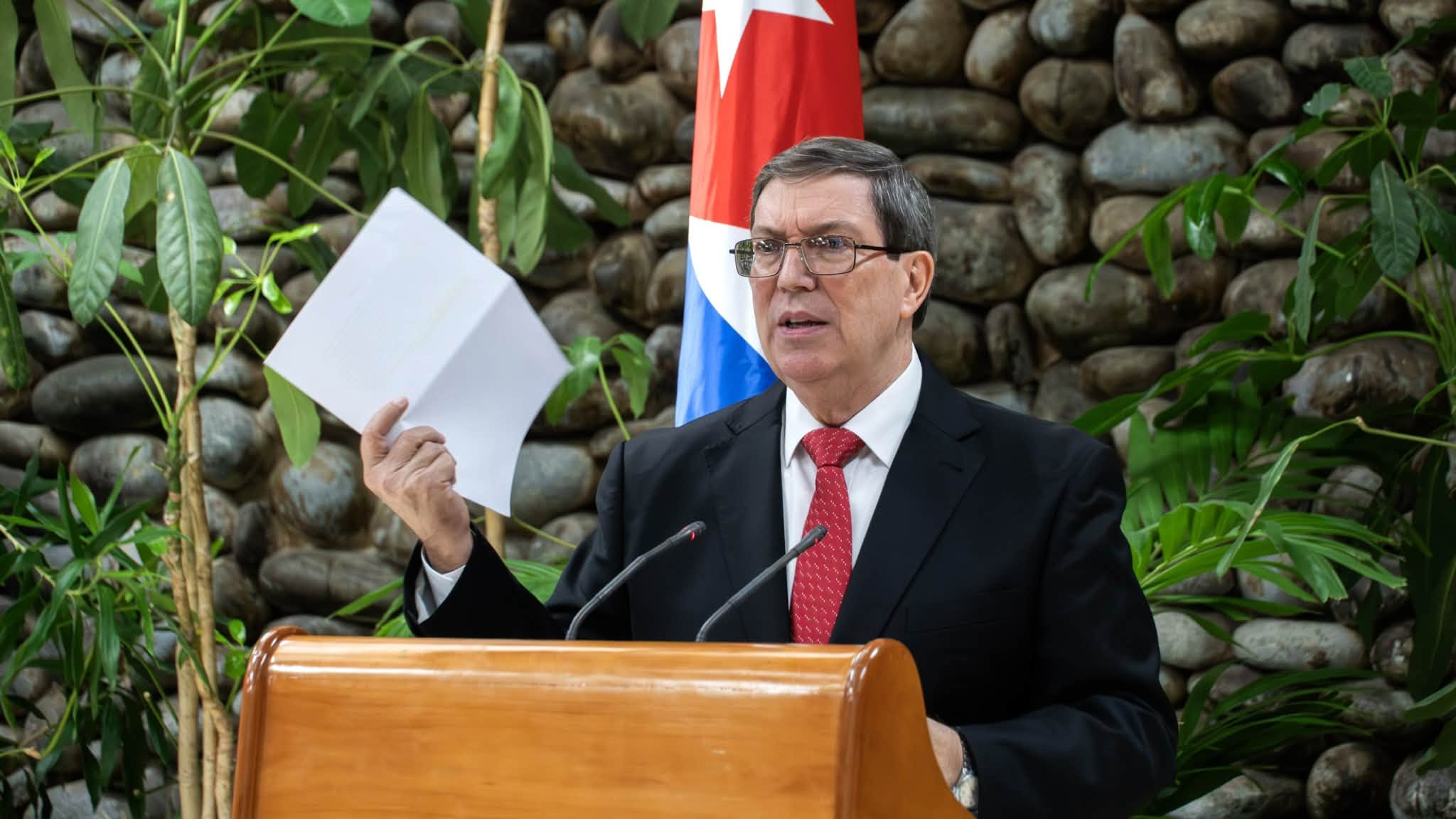
During a recent official press briefing, Cuban Foreign Minister Bruno Rodríguez publicly condemned the United States for deploying extreme, historically unparalleled coercive tactics to strong-arm sovereign nations into altering their voting stances ahead of the upcoming October 27-28 United Nations General Assembly deliberations over the long-running U.S. economic, commercial and financial blockade against Cuba. This year marks the 34th consecutive session of the UNGA that will review the landmark draft resolution titled “Necessity of Ending the Economic, Commercial, and Financial Embargo Imposed by the United States of America Against Cuba”.
Rodríguez emphasized that this year’s debate unfolds against a backdrop of the most aggressive escalation of the decades-old embargo policy to date, paired with a targeted energy blockade that he framed as a deliberate act of collective punishment inflicted on the entire Cuban civilian population. For the first time in the history of these annual votes, the 2025 (note: contextual timeline aligned with stated 2026 news publication date) UNGA resolution will explicitly condemn the extreme recent tightening of the U.S. embargo, a milestone the Cuban foreign minister affirmed will pass despite sustained pressure from the Biden administration. He outlined that 2026 has seen a dangerous confluence of amplified economic blockade measures, open political coercion, systematic obstruction of critical trade and humanitarian supply shipments bound for Cuba, and an unprecedented string of aggressive, targeted actions orchestrated by the U.S. Department of State.
To corroborate his allegations, Rodríguez presented a trove of official internal U.S. government documents that lay bare the sustained lobbying campaign Washington has waged over recent months to sway the policy positions of dozens of UN member states, with many of these pressure efforts personally overseen by U.S. Secretary of State Marco Rubio. The first of these documents, circulated directly by the State Department to foreign governments, urges recipient nations to reject what it frames as “Cuban propaganda”, and attempts to shift full blame for all humanitarian hardships facing Cuban civilians onto the Cuban government, erasing the causal role of U.S. restrictions. Rodríguez pushed back sharply against this framing, noting that the widespread suffering caused by the blockade is not the accidental collateral damage Washington repeatedly claims, but a deliberate, calculated outcome of a policy intentionally designed to foment widespread hardship, despair, and social instability among ordinary Cuban households.
A second document shared by the Cuban foreign minister, addressed directly to senior foreign dignitaries across multiple regions, carries explicit threats of sweeping punitive sanctions that would target any government, private company or individual that chooses to support the Cuban-backed UNGA resolution, and warns recipients to carefully weigh the personal and national consequences of backing the measure. A third document, distributed exclusively to government officials across European nations, attempts to justify the escalated U.S. pressure campaign by peddling unsubstantiated claims of Cuban links to the ongoing Ukraine conflict – accusations Rodríguez categorically dismissed as fully debunked by independent international investigators.
Rodríguez went on to catalog the full scope of U.S. pressure tactics deployed against wavering nations, including threats to suspend long-running bilateral development cooperation programs, arbitrary visa restrictions targeting foreign government officials and their immediate family members, overt interference in national electoral processes, covert support for domestic destabilizing activities in targeted countries, and calculated moves to inflict tangible harm on the economic and financial interests of non-compliant states.
“History will judge this era harshly, and no nation on Earth will be able to claim they were unaware, that they turned a blind eye, that they did not see the reality unfolding against our people,” Rodríguez stated during the briefing. “The entire global community knows full well that this deliberate policy causes ordinary Cuban families to endure hours of daily blackouts, days and weeks at a time without reliable access to clean drinking water, widespread breakdowns in public health services, and preventable deaths that would never occur if not for the blockade. We have seen the infant mortality rate double in recent months, not because of failures on our part, but because we cannot access critical life-saving medications, state-of-the-art medical treatment technologies, replacement parts for broken medical equipment, or even consistent grid power to keep facilities running.”
The Cuban foreign minister closed his remarks by expressing profound gratitude to the dozens of UN member states that have voted in favor of the anti-embargo resolution for nearly 30 consecutive years, a measure that simply calls for an end to the unilateral U.S. restrictions and full respect for core tenets of international law and international humanitarian law. He voiced full confidence that the broader international community will once again deliver an overwhelming, cross-regional show of support for the 2026 resolution, emphasizing a core central message: Cuba poses no threat to global peace, but the decades-long U.S. blockade against Cuba is itself a dangerous violation of global norms.
Cuba denounces extreme and unprecedented pressure from the U.S. to Change votes at the UN