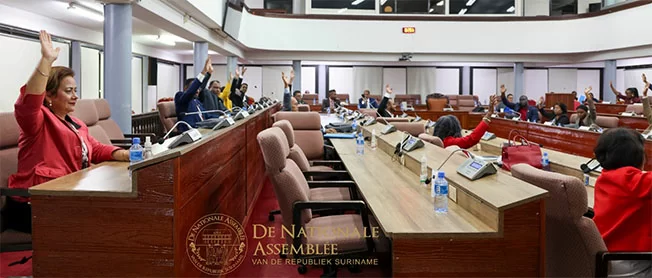
On October 21, Suriname’s National Assembly (DNA) passed a landmark vote approving four international child protection treaties drafted at The Hague, with 30 supporting votes from attending lawmakers. The approval clears the legal path for Suriname’s formal accession to the 1980 Hague Abduction Convention, 1993 Intercountry Adoption Convention, 1996 Child Protection Convention, and 2007 Maintenance Convention. The ABOP party faction walked out of the session earlier in protest over ongoing turmoil at the Suriname Telecommunications Authority and did not participate in the final vote.
These four treaties establish a standardized framework for cross-border international cooperation on family law matters involving children and parents. Key issues covered by the agreements include the safe return of children wrongfully removed across international borders, protections for children involved in intercountry adoption, regulatory clarity on parental responsibility rulings, and streamlined processes for collecting child support when a paying parent resides abroad.
The push for Suriname’s accession to the treaties stretches back years: the bill was first submitted to the assembly in 2023, following a 2022 study commissioned by the Ministry of Justice and Police, conducted with the involvement of UNICEF, that recommended Suriname join all four agreements. Minister of Justice and Security Harish Monorath expressed satisfaction with the long-awaited approval, noting that while significant preparatory work remains ahead, the legislative green light is a required first step to access international funding and move forward with implementation.
Despite the broad bipartisan support the treaties received, much of the parliamentary debate centered on whether Suriname has the institutional and financial capacity to deliver on its new international obligations. Lawmakers raised repeated concerns about the Bureau for Family Affairs (BUFAZ), which has been identified as the potential central authority tasked with implementing the treaties. Multiple assembly members questioned whether the under-resourced agency has enough trained staff, technical expertise, and budget allocation to take on the expanded mandate, pointing out that BUFAZ already struggles to fulfill its existing domestic responsibilities. Lawmakers also highlighted that the agency’s dedicated international affairs division, established specifically for this kind of work, is no longer operational.
Debate also covered key specifics of each treaty’s implementation in the Surinamese context. For intercountry adoption, lawmakers called attention to the elevated risks of exploitation, human trafficking, and illicit financial gains in cross-border adoption processes, pressing the government to outline clear regulatory oversight mechanisms and confirm how it will guarantee children are placed in safe, appropriate homes. Members also raised questions about how the treaty provisions align with local cultural practices, including the traditional *kweekje* foster care system. On the Hague Abduction Convention, lawmakers emphasized the critical need for fast-track legal procedures and strong cross-border collaboration with foreign authorities, questioning whether Suriname’s judiciary has the capacity to process these sensitive cases within the mandatory timelines set out in the treaty.
For the 2007 Maintenance Convention, which is designed to simplify cross-border child support collection, lawmakers noted that domestic child support enforcement already faces major challenges in Suriname, particularly when payers do not hold formal, permanent employment. Additional questions were raised about who will cover costs for legal aid, paternity testing, and court proceedings when paternity must be established, as well as how the new treaties align with Suriname’s updated Civil Code and whether the government plans to enter any reservations on specific treaty provisions.
Hakiem Lal Mohamed of the ruling VHP party called for a detailed, concrete implementation plan that clearly assigns institutional responsibility, maps required legislative reforms, and outlines dedicated budget allocations, stressing that the plan must prevent situations where vulnerable children and parents are passed between agencies without receiving meaningful support. Commission Chair Jennifer Vreedzaam of the NDP reiterated that accession is a critical step forward for child protection but pushed the government to share how many of the 2022 study’s key recommendations have already been put into practice.
Throughout the debate, lawmakers repeatedly emphasized that legislative approval of international treaties alone is not enough to deliver meaningful protection for children. BEP party lawmaker Ronny Asabina drew a parallel to ongoing gaps in domestic public services, pointing to the lack of accessible education for students in the Brokopondo district as evidence that Suriname must strengthen domestic child protection and education infrastructure first. The assembly also called for greater attention to the performance of the Suriname Ombudsman for Children and ongoing efforts to combat child labor, domestic violence, and sexual abuse of children.
With the DNA’s approval, Suriname has completed a key legal step toward joining the four international agreements. The ball is now in the government’s court to build out the required institutional frameworks, update operational procedures, and secure adequate funding to turn these international commitments into tangible protection for children and families across the country.