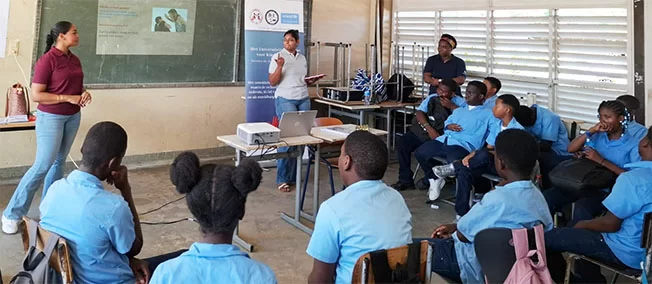
On a Tuesday in October, Suriname’s Public Prosecution Service (OM) officially kicked off a landmark community initiative called “Access to Justice”, designed to educate K-12 students across the country about their fundamental rights and pathways to support when facing harm, abuse, or other crises that threaten their well-being. Over the coming months, 20 primary and secondary schools selected for the program will host a series of targeted information sessions for enrolled students.
The project is the result of a collaborative partnership between the OM, the Institute for Children’s Rights (UK) at Anton de Kom University of Suriname, the Youth Police Division, and the Bureau for the Rights of the Child, with financial and programmatic backing from UNICEF. According to Maya Manohar, chair of the UK board, the official launch ceremony was hosted at LBO Nieuw Domineeschool, one of the participating institutions.
To ensure the program addresses the most pressing community needs, participating schools were handpicked by the OM based on the specific safety and welfare challenges they have identified within their student populations. Information sessions will roll out across three tiers of Suriname’s education system—ordinary primary education (GLO), lower vocational education (LBO), and extended lower secondary education (MULO)—running from October 2026 through February 2027. During each interactive session, students will receive clear, accessible information outlining their legally protected rights, introducing them to local support agencies that provide assistance to at-risk youth, and walking through the process of accessing formal justice system protections. The core overarching goal of the initiative is to lower structural and social barriers that keep children from seeking help, ensuring every young person knows who to turn to when they find themselves in unsafe situations.
Unlike traditional outreach led by adult administrators, the program’s information sessions will be led by trained undergraduate and graduate students from Anton de Kom University’s Faculties of Law and Social Sciences. UK leadership notes that this approach leverages the close generational alignment between the student trainers and participating school youth, allowing for more relatable, approachable information sharing that resonates better with younger audiences than formal adult-led presentations.
The initiative is explicitly aligned with core provisions of the United Nations Convention on the Rights of the Child, covering key rights including the right to accessible information, protection from abuse and neglect, the right of children to have their voices heard in matters affecting them, and the foundational principle that a child’s best interest must be a primary consideration in all actions impacting them.
Institutional representatives emphasize that the program fills a critical gap: while many children may have a vague awareness that they have rights, far fewer understand how to actually exercise those rights when they need protection. By delivering this education early in young people’s development, program organizers aim to enable earlier identification of emerging welfare problems, stopping unsafe situations from escalating into more severe harm before intervention becomes necessary.
For the Institute for Children’s Rights, leading the university’s participation in the Access to Justice program aligns with its core institutional mission of public social outreach and its longstanding commitment to expanding public awareness of child rights across Suriname.