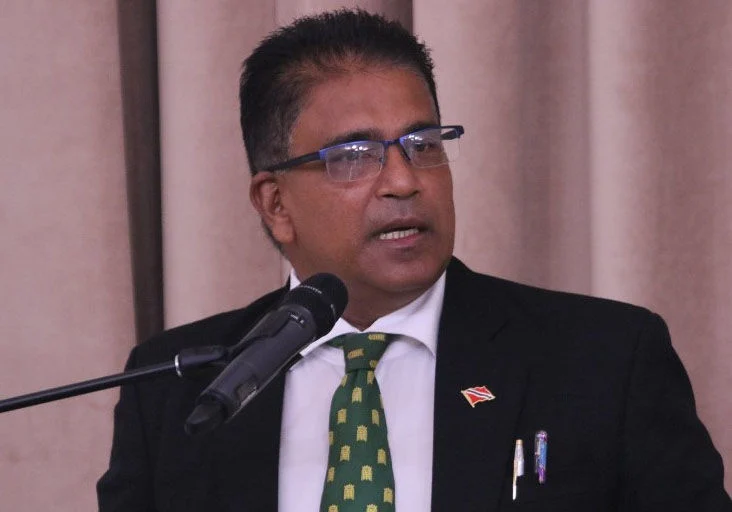
During a Saturday budget debate addressing Trinidad and Tobago’s energy sector priorities, Energy Minister Dr. Roodal Moonilal has publicly raised critical procedural gaps in the Dragon cross-border natural gas project, a major joint initiative with Venezuela, revealing that the only executed copy of the project’s core fiscal metering agreement held by the government is written in Spanish.
Moonilal told parliamentarians that a months-long search within the Ministry of Energy’s official archives has failed to uncover a fully executed English-language version of the binding agreement, which was submitted to the Trinidad and Tobago Cabinet for approval back in January 2024. According to the minister, the Spanish-language document on file bears the signature of both a Venezuelan energy official and his predecessor, former Energy Minister Stuart Richard Young. He noted that while an unexecuted English translation may exist in former minister Young’s personal document holdings, no official signed copy has been transferred to or stored at the ministry.
The fiscal metering agreement is widely recognized as one of the most technically critical components of the cross-border gas project, as it sets binding rules for measuring total gas output, defines technical standards for monitoring equipment, mandates regular calibration protocols, and establishes legal access rights for independent inspectors to verify production readings. Moonilal emphasized that without a fully executed, clearly understandable version of the agreement in Trinidad and Tobago’s official working language, the country faces unnecessary financial risk on a project valued at hundreds of millions of U.S. dollars. “Metering is non-negotiable for a fair energy partnership,” he explained. “You cannot enter into a major gas deal where there is ambiguity over how much product is being extracted, as that leaves room for unaccounted losses that directly impact national revenue.”
Moonilal questioned why the previous administration failed to complete the translation, verification, and official signing process for an English-language version of the agreement before presenting it to Cabinet for approval. Despite the identified procedural weaknesses inherited from the prior government, the minister reaffirmed the current administration’s full commitment to advancing the Dragon gas project. The government is continuing coordinated work with project partners Shell, the state-owned National Gas Company (NGC), and Venezuelan energy authorities to move the project toward its final investment decision (FID), with a target of first commercial gas production in the fourth quarter of 2027 or early 2028. Moonilal confirmed that moving forward, all official agreements for the project will be fully executed in English, saying, “I will guarantee that when I sign any binding agreement for this project, my Cabinet colleagues and the Prime Minister will be able to read it, fully understand its terms, and know exactly what commitments we are making on behalf of the nation.”
In addition to updating legislators on the Dragon project, Moonilal also provided new details on the government’s plan to restart operations at the idled Guaracara Refinery, noting that the global refining market landscape has shifted dramatically in recent years, sparking widespread international interest in the facility. The minister reported that interested parties from major energy markets across India, Africa, Europe, the Caribbean, and North America have submitted proposals to take over and reopen the refinery, and the government has now entered the final phase of selecting a preferred bidder or consortium.
“Our core priority is securing the best possible outcome for the people of Trinidad and Tobago,” Moonilal said. “We have met with all interested stakeholders, and we are running a transparent, inclusive process that gives every qualified bidder fair consideration.”
The minister outlined that limited refinery operations could resume as soon as three to six months after a bidder is selected, though full restart and expansion will require completion of all administrative and legal requirements. He noted that Trinidad and Tobago already has the skilled domestic workforce needed to operate the facility, and the main missing component is sufficient external investment capital. Reflecting on past failed partnerships that left the government owing $95 million from the previous NiQuan Energy operation, Moonilal emphasized that the current administration will not put taxpayer funds at unnecessary risk, noting that the government is moving deliberately to avoid repeating past mistakes that led to dangerous and costly outcomes, including the fatal 2023 explosion at the former NiQuan petrochemical facility in Marabella. “We are proceeding cautiously because cutting corners on this process would put lives and public funds at risk,” he said. “Once all legal and administrative checks are complete, we will reopen the refinery to deliver long-term economic benefits to the country.”