Suriname’s advanced border security and passenger screening initiative, known as the ICF Program, has been granted formal expanded powers to conduct additional screening of travelers and deny entry to high-risk individuals starting April 2026, according to official details released at the launch of the program’s first annual reports in Paramaribo’s Marriott Hotel on Friday.
The expanded powers, which have been underpinned by a state decree and an official order from the Ministry of Justice and Security dated April 16 2026, give the specialized ICF Unit a formal legal foundation to carry out secondary inspections and entry refusals. These measures can be triggered when a traveler is flagged for relevant risk screening, requires additional identity or documentation verification, or fails to meet Suriname’s current entry requirements. Program officials note that the strengthened mandate will allow competent authorities to access critical passenger information faster and deploy targeted interventions to address potential national security threats at the country’s borders.
As of the announcement, the ICF Unit has not publicly disclosed how many travelers have been subjected to additional screening or denied entry using these new powers.
Since the program’s full launch at the start of 2025, the ICF system has already supported early detection of a wide range of cross-border security risks. Flagged cases have included indicators of human trafficking, suspicious or falsified travel documents, individuals listed on international wanted lists, and travelers carrying cash exceeding the $10,000 reporting threshold. Reports indicate that alerts for undeclared large currency holdings make up a significant share of detected risk cases. All collected and analyzed data is shared with relevant law enforcement and border agencies to enable follow-up investigations and targeted inspections, though the released annual reports do not include concrete figures for total alerts, arrests, or confirmed criminal prosecutions stemming from these notifications. At this stage, there is no public data on how many alerts have ultimately led to the discovery of actual illegal activity.
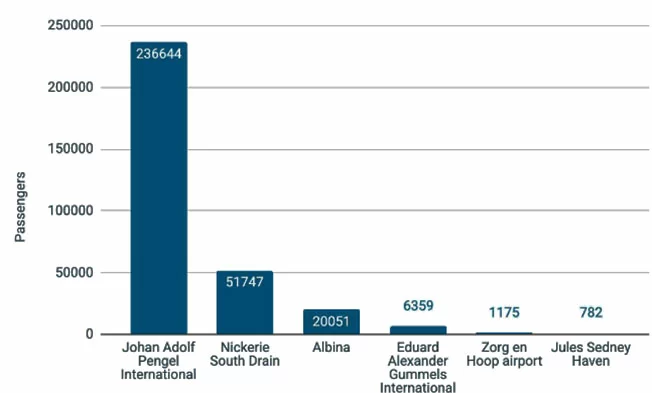
The first set of annual reports, which cover 2025 travel activity, provides a detailed breakdown of Suriname’s cross-border passenger movement. The 2025 Annual Incoming Statistics Report recorded 381,667 incoming passenger movements through official border entry points, while the 2025 Annual Outgoing Statistics Report counted more than 300,000 outgoing movements. Officials clarified that these figures reflect registered travel movements, not unique individual travelers, so a single person making multiple trips to or from Suriname will be counted multiple times in the dataset.
The data also reveals clear seasonal fluctuations in travel volume: December recorded the highest number of incoming passenger movements, while August saw the peak of outgoing travel. Program managers note that these insights can be used to optimize staff scheduling and the deployment of screening capacity at airports and other border posts to better match peak travel demand.
The annual reports confirm that the Netherlands remains the most critical travel connection for Suriname, ranking as both a top origin and destination country for outbound and inbound travel. Neighboring Guyana, French Guiana, and other countries across the Caribbean and the Americas also make up a large share of regional travel flow. For 2025, Dutch flag carrier KLM retained its position as the largest airline for incoming travel to Suriname, followed by national carrier Surinam Airways (SLM). The report cites KLM’s frequent, reliable service to Amsterdam and access to global connecting routes via Amsterdam Schiphol Airport as key factors supporting the airline’s leading market position.
Beyond border security and national safety, program officials say the aggregated travel data also has meaningful applications for tourism planning and economic policy development. The passenger registrations show where international visitors stay during their time in Suriname, with the Torarica Group named as the most frequently recorded accommodation provider, followed by Courtyard by Marriott and a range of independent hotels and apartment rentals. The report notes that while the data reveals general patterns of visitor accommodation, it does not represent a full picture of hotel occupancy rates, market shares, or the individual economic contribution of specific accommodation businesses.
With the publication of its first set of annual reports, the ICF Program is aiming to refine its processes for passenger registration, data analysis, and cross-agency collaboration to strengthen border governance. Officials acknowledge that the 2025 data carries an approximate 2% margin of error, driven by factors including delayed reporting, incomplete data entry, and post-publication data corrections. For this reason, the published figures are framed as an indicative overview of the scale and patterns of Suriname’s international travel activity rather than definitive exact counts.