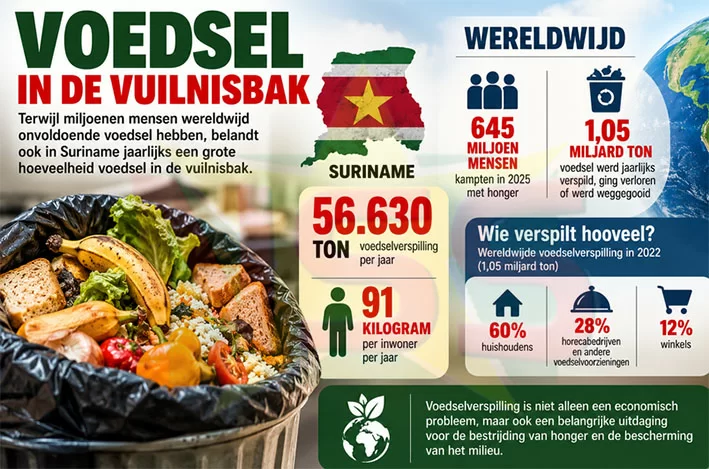
As the world observes World Food Day on October 16, new data from the United Nations Environment Programme (UNEP)’s 2024 Food Waste Index Report has put a stark spotlight on the massive scale of global food waste — a crisis that runs parallel to persistent widespread hunger across the globe. Even as hundreds of millions face chronic food insecurity, nations from small developing states to large economies throw away staggering volumes of edible food every year, including Suriname, where new estimates show domestic food waste totals 56,630 tonnes annually.
That national figure translates to an average of 91 kilograms of food thrown away per Surinamese resident each year. UN researchers note that due to limited available data for the country, these estimates should be interpreted with caution, but they still underscore a widespread trend of unnecessary food waste that exists at every income level worldwide.
Against the backdrop of World Food Day 2024, which carries the theme “Innovate today, nourish tomorrow”, the UN is amplifying calls for global action to boost food security, build more sustainable food systems, and cut back on pervasive food loss and waste across supply chains. Global statistics published by UN bodies paint a devastating picture: in 2022, approximately 1.05 billion tonnes of edible food was discarded by households, food service businesses, and retail outlets. This accounts for nearly 20% of all food available to consumers globally. Of this total waste, households are responsible for 60%, followed by food service and catering operations at 28%, and retail grocers and stores at 12%. Projections also indicate that by 2025, 645 million people around the world will experience chronic hunger.
While global hunger has declined for three consecutive years according to UN data, current rates still remain significantly higher than pre-COVID-19 pandemic levels. By 2025, an estimated 7.8% of the global population will face undernourishment. Africa bears the heaviest burden of this crisis: 309 million people on the continent are projected to be undernourished in 2025, equal to roughly one in every five African residents. Asia follows with approximately 292 million undernourished people, while Latin America and the Caribbean account for 32 million.
Beyond post-retail consumer waste, the UN Food and Agriculture Organization (FAO) estimates that 13% of all food produced globally is lost between harvest and retail sale. Poor storage infrastructure, inadequate transportation networks, and processing losses are the primary drivers of this early-stage waste, with fresh produce like fruits and vegetables particularly vulnerable to spoilage before reaching consumers.
Per capita food waste varies dramatically across countries, the UNEP report confirms. The global average per capita annual food waste totals 132 kilograms, 79 kilograms of which comes from household waste. The Maldives tops the global ranking with an estimated 260 kilograms of per capita annual food waste. Syria, the Dominican Republic, the Seychelles, Mexico, and Tunisia also rank among the nations with the highest per capita food waste, while Spain stands out as one of the countries with relatively low per capita waste levels. Researchers emphasize that these are preliminary estimates, and variations in measurement methods, dietary habits, food supply structures, climate, and refrigeration access must be factored into comparisons between nations.
Beyond the direct human impact of food waste amid widespread hunger, the crisis carries massive economic and environmental costs that are often overlooked. Wasted food represents not just the direct cost of the product itself, but also all the embedded resources that went into growing, processing, and transporting it: land, water, energy, and labor. The UN estimates that global food loss and waste costs the world economy more than $1 trillion annually. Furthermore, roughly 28% of the world’s total agricultural land is used to produce food that is ultimately never eaten. The climate impact is equally severe: food loss and waste accounts for between 8% and 10% of total global greenhouse gas emissions. When discarded food decomposes in landfills, it releases methane, a greenhouse gas 25 times more potent than carbon dioxide over a 100-year period, driving further climate change.
While systemic change across global food systems is needed to address the crisis, experts note that meaningful action starts at the household level, where most waste originates. There are multiple simple steps consumers can take to cut back on household food waste: planning meals in advance, making and sticking to a shopping list, taking inventory of existing food before buying new items, and storing food properly to extend its shelf life. Leftovers can be repurposed into new meals, and items like bread, meat, and prepared dishes can be frozen before they spoil to avoid unnecessary discarding. Carefully portioning food and using older products before newer purchases also cuts down on avoidable waste.
Public education around expiration date labeling is another key step to reduce confusion that leads to waste. Many consumers do not distinguish between “best before” (minimum durability) dates and “use-by” (expiration) dates: a “use-by” date relates directly to food safety, while a “best before” date only indicates when the product is at its peak quality, not when it becomes unsafe to eat. For example, the “best before” label on Heinz baby food referenced in this reporting does not mark when the product becomes unsafe, only when it is no longer at optimal quality. Consumers can still check products with expired “best before” dates for spoilage and consume them safely if they show no signs of going bad.
While reducing food waste alone will not solve global hunger — poverty, armed conflict, unequal access to food, and broken supply chains remain the core root causes of food insecurity — cutting waste can still deliver major benefits. Reduced food waste creates more efficient global food systems, lowers consumer and producer costs, eases pressure on natural ecosystems, and cuts greenhouse gas emissions, building a more food-secure future for all.