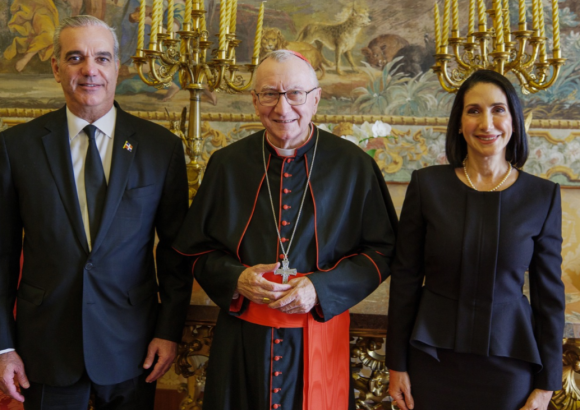
In a high-level diplomatic gathering held Thursday in Vatican City, Dominican Republic President Luis Abinader sat down for formal discussions with Cardinal Pietro Parolin, the Vatican’s Secretary of State. The meeting covered a wide range of topics, from global geopolitical shifts to pressing regional challenges across Latin America and the Caribbean, with a sharp focus on the ongoing crises in Haiti and Cuba.
Following the closed-door talks, President Abinader spoke to reporters on the meeting’s key takeaways, noting that representatives from the Holy See’s Foreign Affairs Commission also joined the discussions. Participants centered talks on issues of mutual concern for the Dominican Republic and the broader international community, including far-reaching economic consequences of the ongoing conflict involving Iran. Abinader highlighted that the conflict has amplified volatility in hydrocarbon prices, driving up costs for essential goods and services worldwide at a time when global markets already face widespread uncertainty.
One of the most prominent topics on the meeting’s agenda was the deepening political and humanitarian crisis in Haiti. Vatican officials shared their grave concerns over the instability plaguing the Caribbean nation, and raised questions about whether planned elections in Haiti can realistically proceed under current conditions. Abinader confirmed that the Dominican delegation used the meeting to outline the country’s official position and share evidence-based policy recommendations for addressing the Haiti crisis.
President Abinader characterized his discussion with Cardinal Parolin as constructive and positive, noting that the pair also turned their attention to domestic matters related to the Catholic Church in the Dominican Republic. Among these internal topics was the ongoing process of appointing a new Archbishop of Santo Domingo. Talks also touched on the Dominican Republic’s widely recognized progress in combating food insecurity, work that has previously earned praise from the United Nations Food and Agriculture Organization (FAO).
In a major announcement following the meeting, President Abinader confirmed that he formally extended an invitation to Pope Leo XIV to visit the Dominican Republic in 2027. Abinader clarified that the invitation remains open, but stressed that the final decision on whether the visit will go forward will depend on the pontiff’s ongoing health recovery. The Dominican president also conveyed his sincere wishes for a swift and full recovery for the Pope.
Abinader added that he has also invited Cardinal Parolin to visit the Dominican Republic in the near future, and emphasized the longstanding close diplomatic and people-to-people ties between the Dominican Republic and the Holy See, framing the meeting as another step forward in strengthening that bilateral relationship.