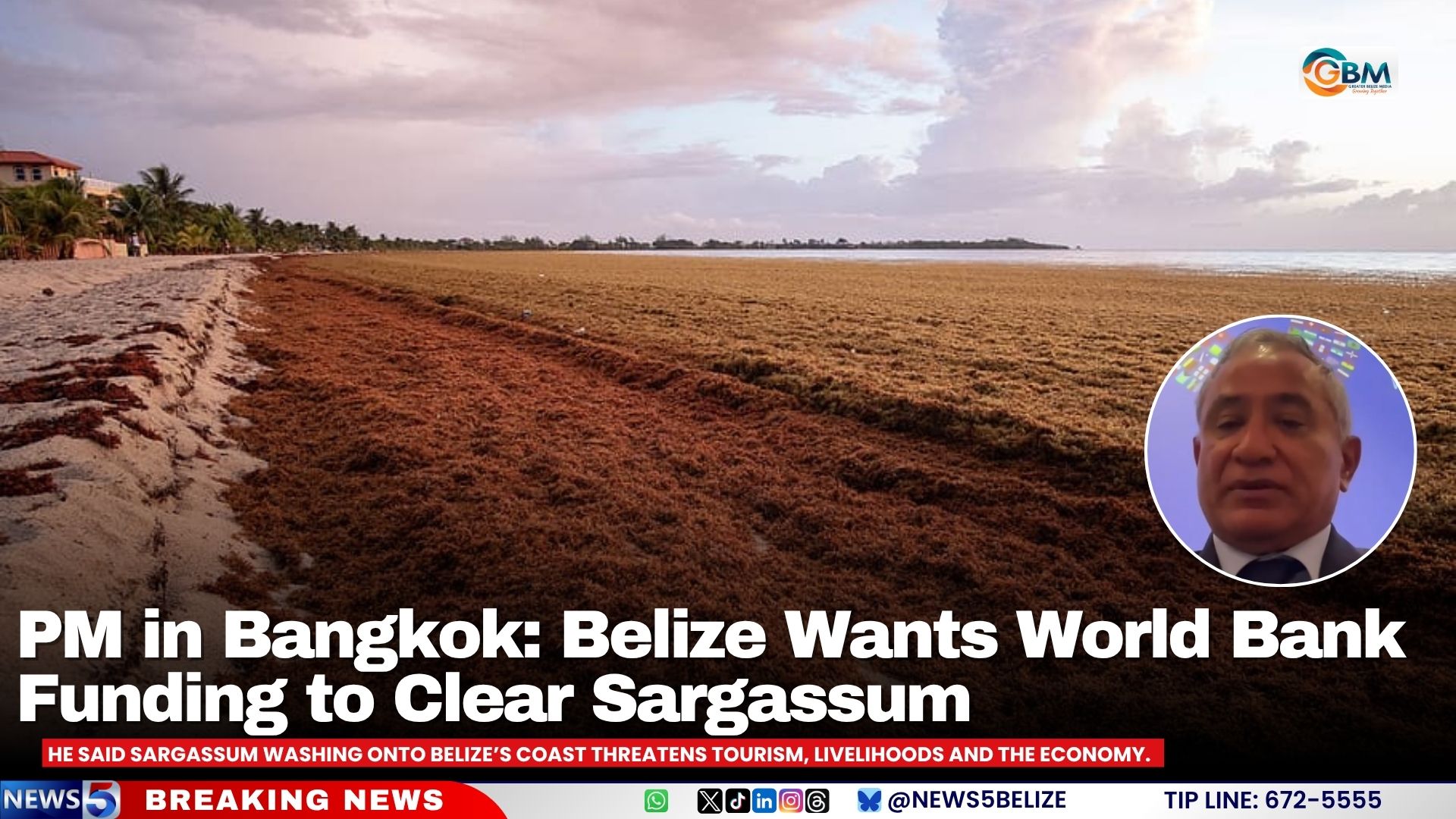
As global economic and development leaders gather in Bangkok for the 2026 Annual Meetings of the International Monetary Fund and World Bank Group, Belizean Prime Minister John Briceño has brought the Caribbean nation’s most pressing coastal and development challenges to the international stage, launching a formal request for World Bank financing to address a devastating sargassum invasion and unlock the seaweed’s potential as an energy source.
Briceño made the announcement via a social media statement from the Bangkok conference venue, where he is currently leading Belize’s delegation. As chair of the World Bank’s Small States Forum, Briceño will also lead an upcoming gathering of more than 50 leaders — many of them finance ministers from small developing nations — focused on delivering tangible outcomes for vulnerable small states.
The sargassum crisis, an environmental challenge disproportionately impacting low-lying coastal nations that have contributed little to the climate shifts driving the massive algal blooms, has already placed severe strain on Belize’s key economic sectors. Briceño emphasized that the relentless flow of sargassum washing onto Belize’s pristine Caribbean coast directly threatens the country’s $2 billion tourism industry, the livelihoods of thousands of coastal workers, and the broader national economy. “Belize bears the costs of challenges we did little to create,” Briceño noted, highlighting the inequity of climate impacts that hit small developing nations hardest despite their minimal contribution to global emissions.
The proposed financing would support two core priorities: large-scale removal of accumulated sargassum from coastal areas to protect tourism and ecosystems, and targeted research and pilot projects to explore converting the excess seaweed into usable energy. If successful, the project would turn a costly environmental crisis into an opportunity to boost Belize’s goal of greater energy independence.
Beyond the sargassum initiative, Briceño outlined three other urgent priorities for Belize’s delegation at the meetings: supporting small and medium-sized agricultural producers, strengthening national food security, and ending persistent power outages to expand energy capacity. Smallholder farmers in Belize have faced repeated climate and economic hardships in recent years, and Briceño stressed that shoring up the agricultural sector is foundational to both protecting household livelihoods and ensuring the country can feed its population.
On energy security, Briceño made clear that reliable, accessible electricity is a non-negotiable right for Belizean citizens. The government is working to end widespread blackouts and expand generation capacity, he explained, with support from the Millennium Challenge Corporation compact and its development partnership with the United States.
Briceño emphasized that for small vulnerable states, strategic planning means nothing without tangible action. “Strategies must become action, and action must produce results,” he said. The ultimate goal of all Belize’s advocacy at the meetings, he added, is to deliver better employment opportunities, expand access to opportunity, and raise living standards for all Belizean people. As the delegation pushes to have the country’s unique needs heard and addressed by global financial institutions, Briceño reaffirmed Belize’s commitment to leading on issues critical to small states: “Belize is here to help lead, and we will keep pressing for results that our people can see and feel.”
Encouraging progress has already been made on advancing the sargassum financing request, Briceño reported, with ongoing discussions moving forward with World Bank officials throughout the conference.