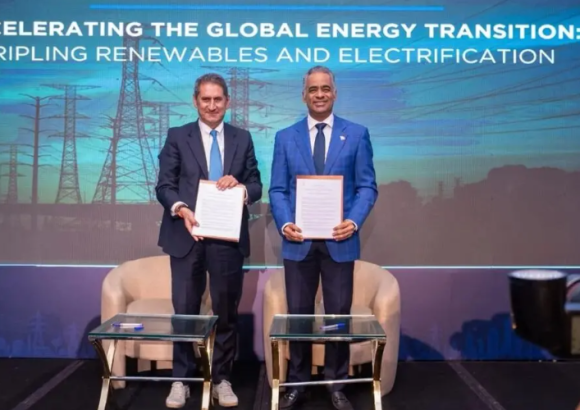
Against the backdrop of a global push to speed up the clean energy transition, the Dominican Republic has formalized a landmark collaboration with the International Renewable Energy Agency (IRENA) to drive renewable energy expansion across Latin America and the Caribbean. The partnership agreement, signed through the Dominican Republic’s Ministry of Energy and Mines (MEM), aligns directly with the global commitment to triple installed renewable energy generation capacity by 2030.
The non-binding letter of intent was signed by Dominican Energy and Mines Minister Joel Santos and IRENA Director-General Francesco La Camera on the sidelines of the High-Level Global Forum on Energy Transition. The signing officially launched the Alliance for the Acceleration of Renewable Energies in Latin America and the Caribbean, better known by its Spanish acronym PARLAC.
In his remarks following the signing, Santos reiterated the Dominican Republic’s long-standing dedication to restructuring its national energy portfolio. The country’s core priorities include broadening the share of renewable resources, cutting reliance on carbon-intensive imported fossil fuels, and shoring up national energy security to insulate against global market volatility. He went on to note that meeting the ambitious 2030 global renewables target will demand far more than political commitment; developing economies across the region need scaled-up private and public investment, upgraded and expanded power transmission grids, advanced utility-scale energy storage systems, broader adoption of end-use electrification, and improved access to cutting-edge clean energy technologies.
La Camera echoed Santos’ assessment, noting that widespread clean electrification holds transformative potential for developing economies across the region, unlocking lower energy costs, reduced emissions, and greater energy independence. Still, he emphasized that unlocking this potential requires three critical foundational changes: a dramatic increase in accessible climate finance, the implementation of clear, supportive regulatory frameworks, and the systematic removal of administrative and policy barriers that slow project deployment. As the leading global intergovernmental organization for renewable energy, IRENA will support PARLAC through facilitating cross-border knowledge sharing, advising on national policy design, and coordinating efforts to attract more investment, upgrade energy infrastructure, and strengthen climate resilience across the entire Latin America and Caribbean region.
Betty Soto, Dominican Vice Minister of Innovation and Energy Transition, highlighted the unique value of targeted regional cooperation to address the uneven challenges facing countries across the area. Small island Caribbean nations, in particular, face a disproportionate set of barriers: nearly universal dependence on expensive imported fossil fuels, heightened exposure to climate-fueled extreme weather events that disrupt energy infrastructure, limited available land for large-scale renewable projects, constrained existing grid capacity, and far higher capital costs for clean energy projects than larger economies. A one-size-fits-all approach cannot deliver results, making region-specific collaboration all the more critical, Soto explained.
At its core, PARLAC is designed to bridge the gap between global climate commitments and tangible, on-the-ground action. Through coordinated cross-country cooperation, sustained high-level political engagement, and intentional mobilization of investment, the alliance will work to advance renewable energy deployment across the region, ultimately contributing to the global goal of tripling installed renewable energy capacity by the end of the decade.