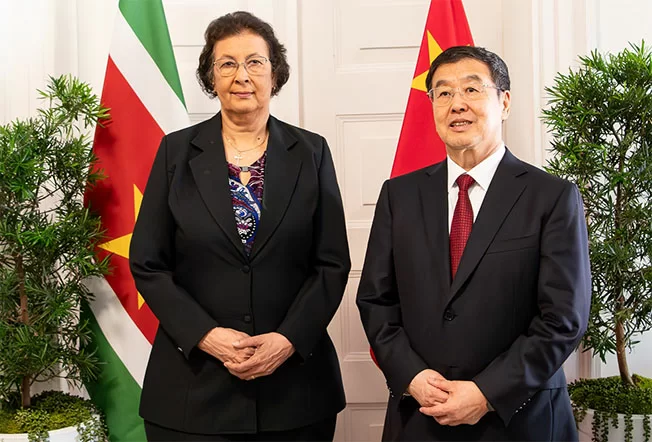
On Monday, against the backdrop of 50 years of formal diplomatic relations between Suriname and China established in 1976, Suriname’s President Jennifer Simons laid out the South American nation’s top cooperation priorities during a high-level meeting with a 14-member Chinese delegation led by Bater, Vice Chairman of the National Committee of the Chinese People’s Political Consultative Conference (CPPCC). The meeting, held at the Presidential Palace, was also attended by Melvin Bouva, Suriname’s Minister of Foreign Affairs, International Trade and Cooperation, and Chinese Ambassador to Suriname Lin Ji.
Simons emphasized that Suriname is eager to capitalize on this five-decade diplomatic milestone to attract increased Chinese investment, facilitate targeted technology transfer, and expand market access for Surinamese goods in the world’s second-largest economy. The president stressed that the country prioritizes tangible outcomes from its bilateral strategic partnership, particularly projects that drive Suriname’s economic diversification, create local job opportunities, support skills development for local workers, and bring advanced technical know-how to the nation.
Pointing to Suriname’s emerging offshore oil and gas sector, Simons noted that the nascent industry opens significant new avenues for bilateral collaboration. Beyond energy development, the Surinamese leader underscored the country’s goal to expand overall bilateral trade, create more opportunities for Surinamese enterprises to operate in the Chinese market, and strengthen connections between the two countries’ business communities. “We attach great importance to deepening bilateral trade and investment ties, fostering greater engagement between our respective business communities, encouraging mutually beneficial investment opportunities, and facilitating access for Surinamese products to the Chinese market,” Simons stated during the meeting.
She also recalled that over the past 50 years, bilateral cooperation has expanded across a wide range of key sectors, including infrastructure construction, energy development, mining, agriculture, public healthcare, education, and technology. Simons added that a core priority moving forward is the full implementation of cooperation agreements that have already been reached between the two sides.
In his remarks, Minister Bouva framed the Chinese delegation’s visit as a key opportunity to inject new momentum into Suriname-China relations. Over the past five decades, the two countries have built a solid foundation for partnership that provides a strong platform for further progress, Bouva noted. Going forward, the next stage of relations should focus on reaching specific agreements and delivering tangible outcomes, he added, asking, “Now it is important: how will we advance the next phase of this relationship?”
Following the meeting at the presidential palace, the Chinese delegation traveled to Suriname’s legislature, De Nationale Assemblee (DNA), where Bater held separate talks with DNA Speaker Ashwin Adhin and the leaders of all parliamentary political parties. During the discussion, Adhin highlighted the importance of knowledge sharing between the two sides, particularly in the areas of advanced technology and the operation of political institutions, noting that Suriname can draw valuable lessons from China’s decades of rapid development. He also emphasized the critical role of investment and youth engagement in strengthening future bilateral ties.
During the legislative meeting, Bater introduced the functional role of the CPPCC, China’s top political advisory body that brings together representatives from diverse political parties and social sectors to deliberate on national governance issues and provide policy recommendations. He explained that the organization gathers insights from across all segments of Chinese society to support evidence-based national decision-making.
President Simons also took the opportunity during the meeting to reflect on the deep historical and cultural ties that bind Suriname and China, dating back to the arrival of Chinese contract laborers in the country. Over the generations, the Chinese community in Suriname has made profound contributions to the nation’s economic, social and cultural development, she noted.
The Surinamese president reaffirmed that Suriname remains firmly committed to the one-China policy, which has served as a cornerstone of bilateral relations since diplomatic ties were first established in 1976. She described China as both a long-standing friend and an equal partner, with whom Suriname shares deeply rooted historical and cultural connections.
Looking ahead to the next 50 years of bilateral relations, Simons expressed her expectation that expanded cooperation will deliver sustained economic growth and mutual benefits for both countries. As of the current briefing, no new specific investment figures or signed agreements have been publicly announced following the meetings.