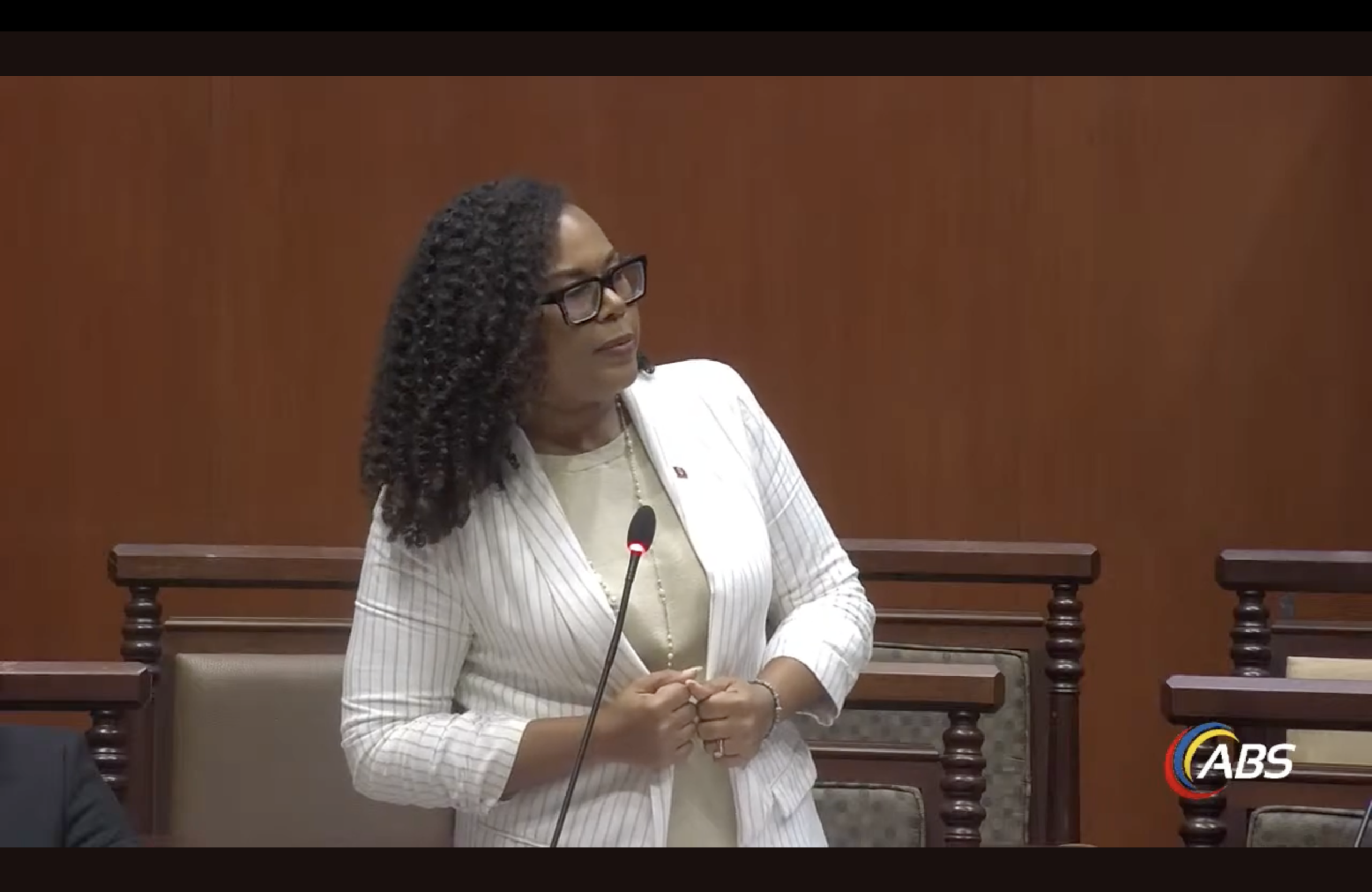
After a robust Senate debate centered on addressing rising gun violence in the nation, the upper legislative chamber of Antigua and Barbuda has approved the Firearms Amendment Bill 2026, a piece of legislation designed to hike criminal penalties for firearms-related offenses. Government Senator Abena St. Luce, a key voice in the debate, opened her remarks by extending gratitude to frontline law enforcement officers, who routinely put their own safety on the line to safeguard civilian communities across the country. She acknowledged that the difficult, high-risk work of policing often goes unappreciated, with officers facing widespread public criticism even as their successful interventions fly under the radar.
In particular, St. Luce highlighted the effective work of police and Defence Force personnel during this year’s Carnival season, when systematic bag and backpack searches turned up a range of contraband, prohibited sharp objects, and at least one illegal firearm. She noted that visible, consistent foot patrols in residential neighborhoods have already had a tangible impact, boosting residents’ sense of safety and security amid growing anxiety over gun violence. But despite this praise, St. Luce pushed for urgent improvement across two critical stages of the criminal justice system: investigation and prosecution. She stressed that even the harshest new criminal penalties included in the bill will be meaningless if suspects are not successfully convicted in court.
“We need you to step up a little bit more,” St. Luce told assembled law enforcement leaders and representatives from the Office of the Director of Public Prosecutions. She was quick to clarify that her call for reform was not an indictment of all current law enforcement work, but a reflection of the public’s growing desperation for measurable progress in reducing gun violence. Secure convictions, she argued, are the only way to hold violent offenders accountable and deliver long-awaited justice to the families of victims.
Outlining the scope of the new legislation, St. Luce explained that the bill moves beyond punishing only the person who uses a gun to commit a crime like robbery. Instead, it creates a framework to hold actors accountable at every stage of an illegal firearm’s path to a crime scene, including illicit manufacturers, black market sellers, unlicensed transferers, and smugglers who bring illegal weapons into Antigua and Barbuda. It also introduces new provisions addressing firearms stored or transported in private vehicles, boats, and other modes of transport: vehicle owners can face legal consequences if an illegal firearm is found in the car with a passenger, unless the owner can prove they had no prior knowledge of the weapon. St. Luce used this provision to urge all residents to be more cautious about the company they keep and the people they allow into their vehicles.
The bill also addresses the emerging threat of untraceable homemade firearms, with specific provisions regulating 3D printing, which can be used to produce untraceable guns and gun components. St. Luce issued a direct appeal to individuals involved in profiting from illegal gun smuggling and manufacturing, urging them to seek legitimate employment rather than contributing to a culture of fear and violent death across the country.
St. Luce also used the debate to voice a pressing concern: repeated reports of repeat gun offenders receiving sentences of less than two years, even for serious offenses like modifying flare guns into functional weapons or manufacturing homemade firearms. She emphasized that the increased penalties laid out in the bill are fully justified, pointing to the common reality that an illegal firearm often changes hands multiple times before it is used in a deadly crime.
Her remarks were framed by a recent, high-profile incident: an armed robbery at the local Multipurpose Centre, which brought renewed public attention to the gun violence crisis. While St. Luce acknowledged that rampant gun crime is a shared problem across the Caribbean region, she argued that Antigua and Barbuda does not have to accept the status quo, and should instead position itself as a regional leader in crafting effective solutions to the crisis.
To drive home the human cost of inaction, St. Luce named multiple local residents who have been killed by gun violence already this year, ranging from teenagers to older adults, noting that every death leaves an irreversible, devastating void in the victim’s family. “This debate is about more than just changing legislation or adjusting sentencing guidelines,” she said. “It is about people who have lost parents, children, and loved ones to senseless violence.”
St. Luce also echoed growing calls for shared responsibility in tackling gun crime, noting that police and government agencies cannot prevent violent offending on their own. Parents and community leaders must take greater responsibility for monitoring and guiding young people, she argued, adding that community members often learn of illegal activity long before law enforcement becomes aware. Residents therefore have a critical role to play in looking out for one another and sharing information to stop violence before it occurs.
Following the conclusion of the debate, the Senate gave final approval to the bill, which amends the existing Firearms Act to deliver stiffer penalties for all categories of firearms-related offenses.