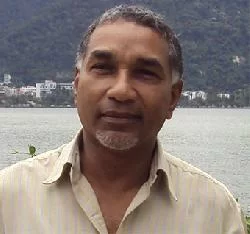
As the seventh installment of Jack Menke’s investigative series on Suriname’s growing offshore oil boom, this op-ed argues that the South American nation is on the precipice of repeating decades of harmful, failed development if it continues to prioritize fossil fuel extraction over a sustainable, nature-centered alternative.
Today, Suriname’s political and business elites are in the grip of offshore oil fever, aligning with major international oil giants to advance the Ministry of Oil, Gas and Environment’s (OGM) three-phase Suriname 1.0, 2.0 and 3.0 development strategy. By 2026, an estimated 50% of Suriname’s offshore territory – totaling at least 44,142 square kilometers – is already covered by active production sharing contracts, with elites eagerly anticipating full commercial production set to launch in 2028. Menke warns that this path will lock Suriname as a dependent junior partner to foreign multinational corporations, leaving the nation vulnerable to the widely documented “resource curse” that has plagued extractive-dependent economies across the Global South.
To understand why this new oil push is likely to fail, Menke traces decades of structural dysfunction in Suriname’s political and economic systems. Since independence in 1975, three overlapping economic spheres have taken root: a formal sector, a legal informal sector, and a large criminal economy dominated by illicit activities like cocaine trafficking. Over time, these three sectors have become increasingly intertwined within a corrupt patronage political system, where criminal interests hold outsized influence. Political elites divide up natural resource concessions and government positions among allies, placing unqualified party loyalists in key state institutions and blocking inclusive, long-term development to protect concentrated power.
This structural dynamic dates back to the 1987 constitution, which established a decentralized unitary state on paper but never implemented meaningful devolution of power. As interests tied to gold, drugs, bauxite, and logging took root, they were later joined by large-scale agricultural development and offshore oil, creating a seven-sided overlapping power structure that blends underworld and upperworld interests. After every election, the patronage model of coalition government is reinforced, leading to steady democratic erosion and further concentration of power – outcomes that directly contradict equitable development and the recognition of collective land and resource rights for Indigenous and tribal peoples.
Menke emphasizes that this current oil push is just the latest iteration of a colonial-era extractive development model that all nine post-independence civilian governments have continued. For more than a century, Suriname has experienced repeated cycles of temporary, non-inclusive economic boom driven by non-renewable resource extraction, that collapse as soon as the resource is depleted or the project ends. The iconic Brokopondo hydroelectric dam project serves as a stark case study: between 1965 and 1967, the project delivered an average annual economic growth rate of 13%, but growth turned negative immediately after construction concluded. None of the government’s promised goals of sustainable growth, widespread employment, or social justice were achieved. Meanwhile, multiple Maroon villages were submerged by the project’s reservoir, destroying local ecosystems and eliminating any prospects for long-term local development.
For the current offshore oil expansion, Menke points out that nearly all extracted crude will be exported with no local processing or value addition, creating few lasting linkages to Suriname’s domestic economy. Compounding this risk, the government has once again failed to develop a cohesive, long-term national development plan to anchor the oil sector. Instead, the current rush for oil concessions has opened the door to widespread illegal activity, destroying vast swathes of intact forest and Indigenous communal lands that hold far greater potential for sustainable long-term development.
Against this failing status quo, Menke outlines a clear, actionable alternative development path centered on Suriname’s greatest natural asset: its intact ecosystems and renewable resource base. This model is built on three core pillars: broad community participation, long-term environmental sustainability, and respect for harmonious cultural and biological diversity, and stands in direct opposition to the extractive model that destroys nature and marginalizes interior communities.
The alternative strategy focuses on five interconnected core priorities:
1. **Green economy development**: Prioritize sustainable agriculture, agroforestry, forestry, and ecotourism, supported by purpose-built core institutions for education, research, integration of traditional knowledge, and public health that enable broad public participation in development.
2. **Renewable energy expansion**: Scale up the development and deployment of domestic sustainable energy resources to meet national demand.
3. **Nature conservation and biodiversity protection**: Preserve Suriname’s globally significant ecological wealth for current and future generations.
4. **Local and collective development**: Invest in the growth of local communities while protecting their traditional lands, cultures, and natural environments.
5. **Sustainable production and income generation**: Build long-term economic activities that deliver stable employment and shared prosperity across all regions.
Menke calculates that this nature-centered model could deliver billions of dollars in annual revenue to Suriname from sustainable sectors including non-destructive forest products, medicinal plant cultivation, and ecotourism – far more shared and durable prosperity than oil extraction. This framework of Local Development, which centers people and nature in a national development plan, offers a sustainable alternative to the narrow Local Content policies promoted by the oil industry, which deliver limited benefits to most Surinamese.
To enable this transition, Menke calls for institutional reform that prioritizes knowledge building and sustainability, in partnership with credible international actors that center integrity, democracy, and shared development. He argues that fragmented civil society groups, academic experts, green NGOs, and ethical actors within existing political institutions must unify to build a strong countervailing power to challenge the influence of oil and extractive interests. Crucially, active participation of local Indigenous and tribal communities is required to ensure that any resource development projects respect Indigenous rights, protect the environment, and deliver tangible benefits to the communities that live on and steward Suriname’s lands.
Finally, strengthening local democracy and inclusive decision-making processes will ensure that revenue from natural resource development reaches all segments of Surinamese society and reduces persistent social inequality. A new development path, Menke argues, is the only way to stop the OGM’s oil-centered strategy from reinforcing decades of failed development, environmental destruction, false prosperity, and deepening inequality that has held Suriname back since independence.