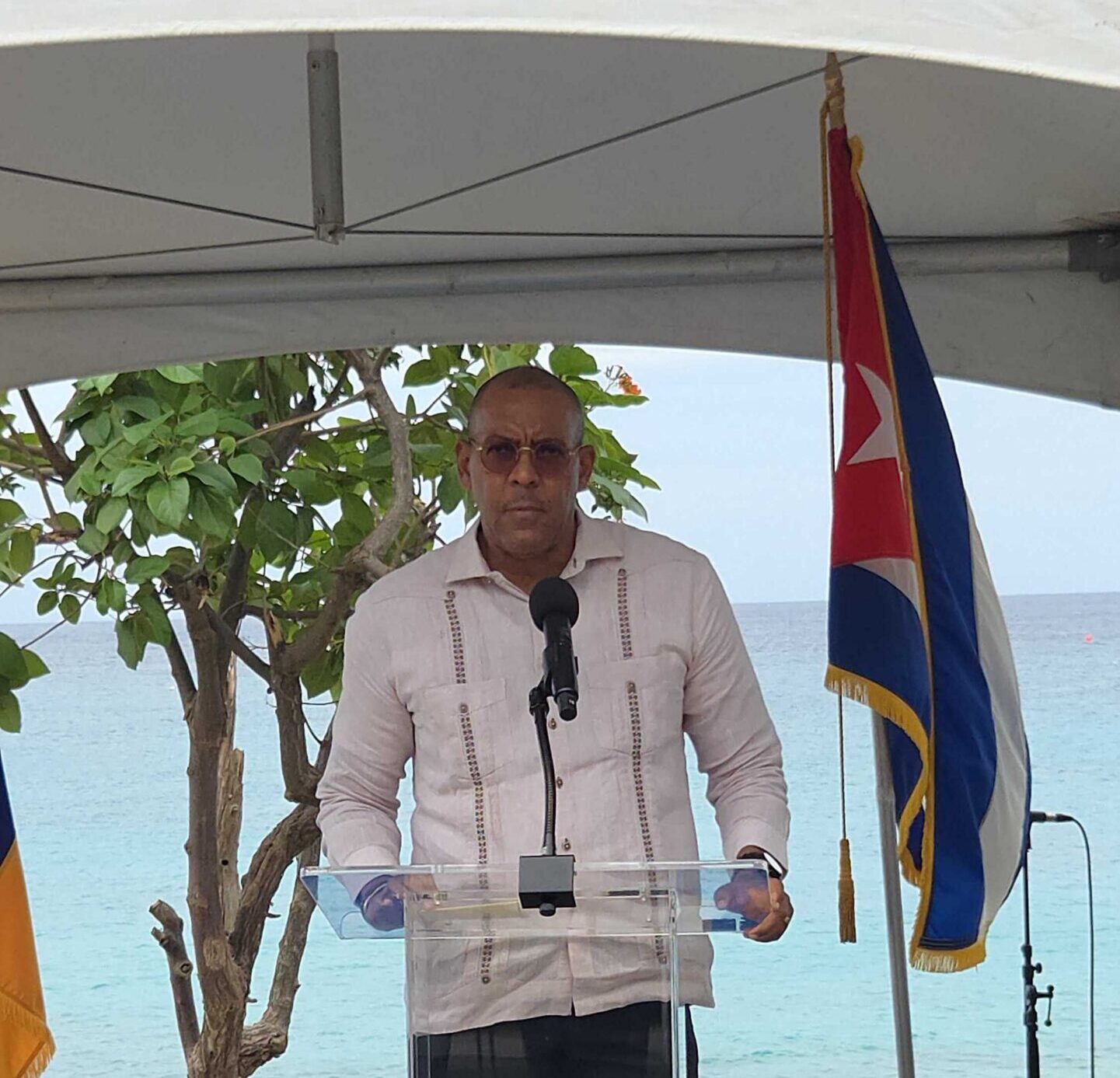
Fifty years after one of the darkest acts of international terrorism to touch the Caribbean, Barbados has reaffirmed its unwavering commitment to principle, using an anniversary commemoration to condemn long-standing geopolitical double standards and call for an immediate end to the decades-long U.S. economic embargo against Cuba.
The solemn ceremony, held on October 6 at the Paynes Bay monument honoring the 73 victims of the 1976 Cubana Flight 455 bombing, drew regional dignitaries, young students, and diplomatic representatives, including Cuban Ambassador Yanet Stables Cardenas and Guyanese Consul General Harry Hill. Senior Minister Kerrie Symmonds, who also serves as Member of Parliament for St James Central and Minister of Energy, Business Development and Consumer Affairs, led the event, extending the collective condolences and solidarity of the government and people of Barbados to Cuba and the victims’ families.
Recalling the attack that downed the civilian airliner just three miles off Barbados’ west coast just years after the island nation gained its independence, Symmonds framed the tragedy as the country’s first direct introduction to the harsh realities of transnational geopolitical conflict. All 73 passengers and crew on board were killed in the bombing, which remains a defining stain on Caribbean history.
“On that day, when the ill-fated Cuban aircraft was downed some three miles off this west coast of Barbados, we took a stand as the people of Barbados, and we have never deviated or departed from that stand,” Symmonds told attendees. “It was a stand which signalled to the world that small island though we were, and still are, we were prepared to stand with principle against injustice.”
The senior minister used his address to push back against what he called the selective morality and hypocrisy that continues to shape global responses to terrorism and economic policy. He pointed to a long-standing historical double standard: key figures linked to the 1976 bombing have never been held fully accountable for their roles, evading justice in foreign nations despite clear identification of their involvement. Symmonds emphasized that the global fight against terrorism cannot be a flexible tool shaped by political convenience, arguing that opposition to terror must be an unwavering principle regardless of ideology or economic interests.
“We do not believe that you can be against terrorism today, but because of issues of ideology, philosophy, or economic policy preference, that you are against terrorism tomorrow. It is either that you stand for it or you stand against it,” he said. “If the fight against terrorism is a principle when twin towers are brought to the ground wrongfully, illegitimately, wickedly, then the fight against terrorism must be a principle when evil men seek to place a bomb on board an aircraft and destroy the lives of innocent people.”
Beyond honoring the victims of the 1976 attack, Symmonds used the commemoration to reaffirm Barbados’ long-standing solidarity with Cuba, pledging that the island government would continue to leverage every international diplomatic forum to push for an end to the U.S.-imposed economic embargo that has been in place for more than six decades. He described the embargo’s ongoing impact on Cuba’s 10 million people as a deliberate, slow-moving humanitarian tragedy, pointing to widespread shortages of essential goods, crippling power outages, and strained public health systems that have pushed ordinary Cuban civilians into desperation.
“I use the word inhumanity because when people are starving, it is inhumanity,” he said. “I use the word inhumanity because when mothers cannot have running water in order to cook for their children, it is inhumanity. To watch a country be brought to its knees and a 10 million population be left in desperation conflicts with what we understand to be human development. It is a tragedy which is being rolled out in slow motion, and it is a tragedy which we can avoid, should avoid, and must at all costs continue to urge to be avoided.”
Symmonds also noted that Barbados and the broader Caribbean region owe Cuba a profound debt of gratitude for its decades of solidarity and support across critical sectors. He highlighted the work of Cuban medical brigades that saved countless lives across small Caribbean nations during periods of crisis when larger international partners offered little to no assistance, filling critical gaps in specialized care from cardiac surgery to ophthalmology. He also celebrated the lasting contributions of Cuban athletics coaches and the thousands of educational scholarships Cuba has provided to young Caribbean people, including constituents from his own St James Central constituency who have gained life-changing skills through the program.
Reaffirming that Barbados remains one of Cuba’s most steadfast allies in the Caribbean, Symmonds assured Ambassador Cardenas that the government would continue to advocate for mutual respect between nations, international justice, and the elimination of unilateral measures that disproportionately harm civilian populations. He closed the ceremony by expressing hope for a more equitable global order, renewed regional cooperation, and confidence in the enduring resilience of the Cuban people as they navigate ongoing economic and social hardship.