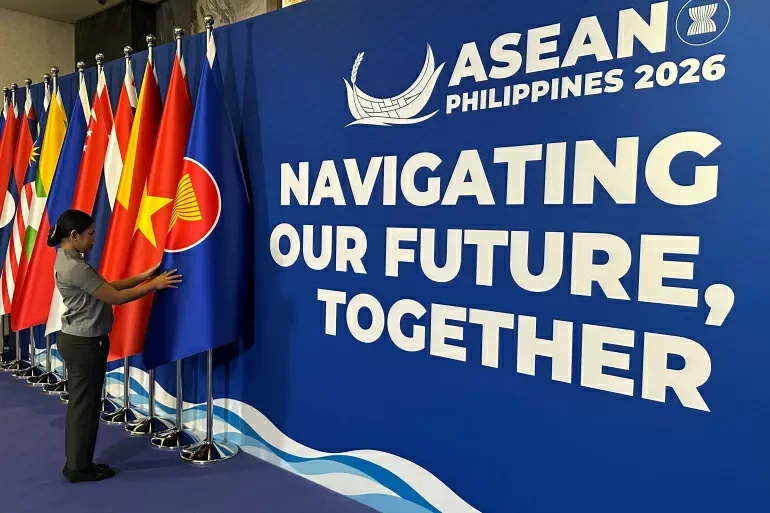
Against a backdrop of escalating geopolitical tensions between the U.S., Israel and Iran that have disrupted critical energy flows through the Strait of Hormuz, energy ministers from the 11-member Association of Southeast Asian Nations (ASEAN) are convening in Manila, the Philippines, this week to negotiate coordinated strategies to strengthen Southeast Asia’s long-term energy security.
Hosted by the Philippines, this year’s ASEAN chair, the 44th ASEAN Ministers on Energy Meeting (AMEM) is scheduled for October 7–8, with pre-meeting sessions and the accompanying ASEAN Energy Business Forum running from October 5 to 9. Top priorities on the agenda include building collective preparedness for future energy and fuel shortages, expanding cross-regional electricity interconnections, and diversifying regional energy supplies to reduce overreliance on unstable sources.
The ongoing Middle East crisis has laid bare the deep structural vulnerabilities of Southeast Asia’s energy system. Data from the International Energy Agency (IEA) shows that before the conflict erupted, roughly 60 percent of the region’s crude oil imports, one-third of its natural gas imports, and 45 percent of its refined oil product supplies came from the Middle East, making the Strait of Hormuz — the chokepoint through which most of these energy cargoes travel to Asia — a critical weak point for ASEAN’s energy security.
A April 2026 analysis from the ASEAN Centre for Energy estimated that 55 percent of ASEAN’s crude oil imports from the Middle East pass through the strait, meaning up to 28 percent of the region’s total final oil consumption could be directly impacted by sustained disruptions. While recent market data shows partial recovery of shipping traffic through the Hormuz in September, risks to maritime navigation and energy price stability remain unresolved. As of early October, Brent crude has held steady at or above $100 per barrel, with global supply chains and refining capacity still under significant pressure. Iran has further compounded uncertainty by announcing it will not fully reopen the strait until its specific political demands are met, keeping the key waterway a major geopolitical risk for global energy trade.
For the Philippines, the urgency of addressing these vulnerabilities is particularly acute. President Ferdinand Marcos Jr. declared a national energy emergency back in March 2026, citing the Middle East conflict, Hormuz Strait disruptions, and threats to domestic fuel supply. The government subsequently launched an emergency program to secure additional fuel imports, with four government-coordinated diesel shipments totaling more than 178 million liters arriving by late April. While supply conditions have improved since the emergency declaration, the country remains exposed: as of mid-September, the Philippines held just 57 days of gasoline reserves and just over 60 days of diesel reserves, according to the Department of Energy. Officials have continued rolling out measures to cushion the impact of sky-high global oil prices on consumers and public transport operators. Philippine Energy Secretary Sharon Garin has pushed for a unified ASEAN response, noting that shocks to global energy markets quickly transmit to the region, driving up fuel and food prices, raising production costs, and squeezing household budgets.
Compounding these short-term risks is a long-term structural challenge: Southeast Asia’s energy demand is surging even as domestic oil production declines. The IEA’s 2026 *Southeast Asia Energy Outlook* finds that per capita energy use in the region has jumped nearly 30 percent over the past decade, while regional oil production has fallen roughly 40 percent from its 1990s peak. Demand for electricity, in particular, is growing faster than any other energy carrier, with the IEA projecting average annual growth of 5.4 percent between 2026 and 2030, driven by industrial expansion, rising cooling demand, digitalization, data center growth, and broader electrification of the economy. Without major structural reforms, the IEA projects ASEAN’s annual fossil fuel import bill could surge from more than $80 billion in 2024 to roughly $245 billion by 2035, deepening the region’s exposure to global price shocks and geopolitical disruption.
A centerpiece of discussions in Manila is the further development of the ASEAN Power Grid (APG), a planned regional network designed to connect national electricity grids and enable cross-border sharing of power to improve stability. Progress on the project has accelerated in recent years: according to ASEAN’s latest energy cooperation roadmap, 9 of the 18 priority interconnection projects are now operational, with a total combined interconnection capacity of 10.2 gigawatts. A key milestone was also reached in 2025, when member states signed a strengthened memorandum of understanding to formalize cooperation on the APG. Despite these gains, full regional integration remains elusive, with most electricity trade still conducted through bilateral agreements. Barriers including divergent national regulations, financing gaps, conflicting national interests, and mismatched technical standards have slowed the creation of a unified regional electricity market. For the Philippines, expanding interconnections is a top priority, as it seeks better access to regional power markets via undersea cables, while Singapore aims to secure stable imports of clean electricity from neighbors including Indonesia.
Ministers are also set to discuss the operationalization of the ASEAN Framework Agreement on Petroleum Security (APSA), a pact designed to enable coordinated collective responses to severe oil supply disruptions. During a special emergency meeting in April, ASEAN energy ministers already agreed on the urgent need to diversify oil and gas suppliers, expand regional energy trade, scale up renewable energy and biofuels, accelerate electric vehicle adoption, and improve energy efficiency. The meeting also opened discussion of the potential role of civilian nuclear energy, developed in compliance with international safety standards.
ASEAN’s 2026–2030 energy cooperation plan sets ambitious long-term targets: cutting the region’s energy intensity by 40 percent by 2030, increasing renewables to 30 percent of primary energy supply, and raising renewables’ share of installed power generation capacity to 45 percent. The scope of the agenda goes far beyond addressing the immediate fuel crisis: ASEAN aims to translate lessons from the Middle East conflict into a more resilient energy system that is less dependent on a single region, a single transport chokepoint, or fossil fuels.
On the eve of the main ministerial meeting, the ASEAN Centre for Energy released its 2026 *ASEAN Energy Investment Report* in Manila, which centers on the critical role of financing in delivering energy security, resilience, and regional connectivity. The report emphasizes that binding political agreements alone are not enough: massive new capital investment is required to build out cross-border transmission links, energy storage facilities, renewable energy capacity, and interconnection infrastructure.
This puts ASEAN face to face with a dual challenge: mitigating the short-term impacts of the Middle East conflict and ongoing Hormuz Strait uncertainty, while investing in structural transformation to build an energy system less vulnerable to future geopolitical shocks. The IEA has warned that emergency stopgap measures alone will not solve the region’s vulnerabilities, noting that supply diversification, accelerated electrification, energy efficiency gains, and expanded renewable energy are the only ways to permanently reduce dependence on imported fossil fuels.
The Manila meeting is widely seen as a critical test of whether ASEAN can leverage the current energy crisis to accelerate the implementation of its existing plans for regional energy cooperation, turning long-held goals into tangible progress for the 11-nation bloc.