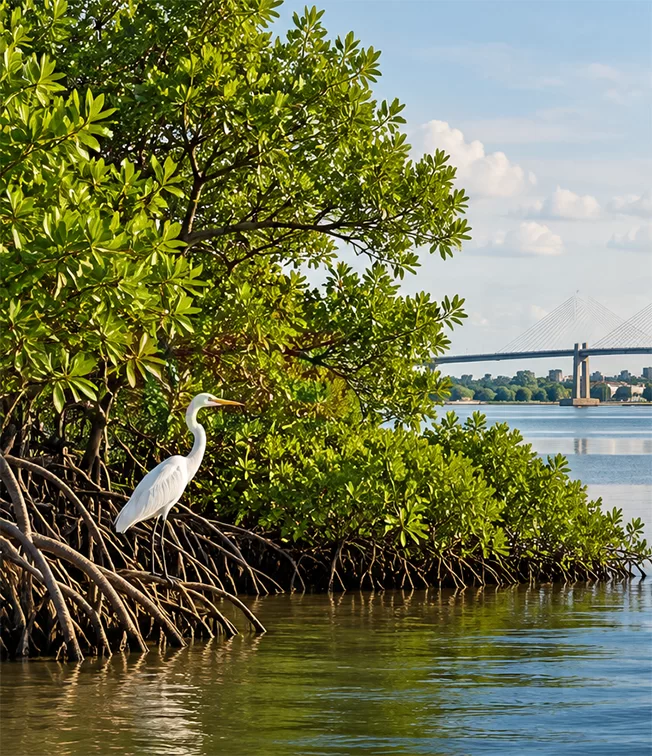
Suriname has launched a series of interconnected environmental and spatial planning initiatives designed to strike a critical balance between economic progress and the preservation of natural ecosystems and biodiversity, starting with a targeted marine conservation project along the banks of the Suriname River.
The 6-year project, named Greening Transportation Infrastructure Development, broke ground in March this year and is scheduled to run through 2029. It receives funding from the eighth funding cycle of the Global Environment Facility, with WWF-US appointed as the international lead implementing partner for the initiative. The project’s core mandate is to integrate sustainable environmental practices into regional development along the Suriname River’s marine corridor, aligning with Suriname’s broader national policy goals for spatial planning and infrastructure investment.
In a parallel development, Suriname kicked off the first phase of a new National Spatial Planning Framework in 2026, which will create legally binding guidelines for all levels of the national government. This initial phase focuses on establishing a national land use blueprint, with targeted attention given to eight priority zones, including both urban development areas and marine ecosystems. A second phase will see the development of customized structural plans for districts, regional jurisdictions, and larger aggregated geographic areas. Additionally, the framework outlines the creation of binding zoning plans that, following formal legislative approval, will apply to both government bodies and private citizens across the country.
Suriname’s 2027 Financial Year Plan identifies the absence of a codified national spatial planning law and approved structural and zoning plans as one of the most pressing current challenges to sustainable development. The new framework is built around several core guiding principles: promoting more compact urban development to reduce sprawl, curbing linear ribbon development along major transportation routes, expanding urban park networks and green public spaces, and protecting Suriname’s unique status as a carbon-negative nation. These initiatives mark a significant step forward for Suriname’s commitment to sustainable development, demonstrating that economic growth and environmental stewardship do not have to be mutually exclusive goals.