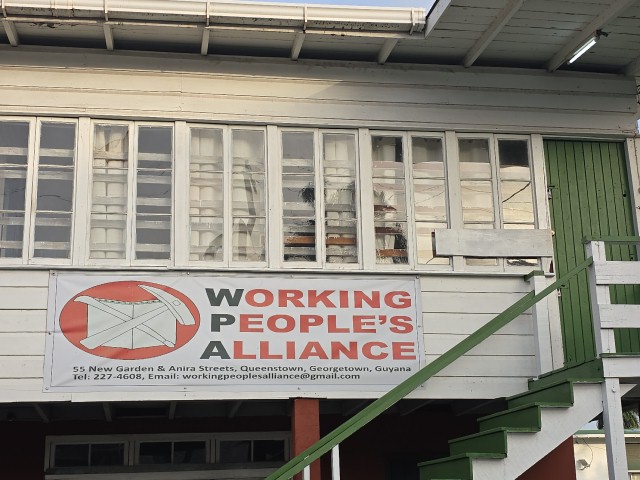
On Sunday, October 4 2026, Guyana’s political landscape entered a period of national mourning following the death of 78-year-old Robert Corbin, former leader of the People’s National Congress Reform (PNCR), at a Georgetown city hospital. In a formal statement released hours after his passing, the Working People’s Alliance (WPA) — a historic Guyanese political party with deep roots in the movement against 1970s and 1980s PNC authoritarian rule — offered an unexpectedly nuanced tribute to the leader who once broke decades of partisan enmity to build a cross-party coalition.
The WPA’s relationship with the PNC has been defined by bitter conflict for generations. The party’s co-founder, renowned historian and anti-dictatorship activist Dr Walter Rodney, was assassinated in June 1980 via a bomb hidden in a walkie-talkie, at the peak of WPA-led civil resistance to PNC rule. A Guyana Defence Force electronics expert named Gregory Smith carried out the attack, before being secretly evacuated to French Guiana just days later. There, he lived and worked under the assumed name Cyril Johnson until his own death. During the widespread political unrest of that era, WPA members were also falsely accused of burning down the original PNC headquarters on Georgetown’s Camp Street. Today, the WPA no longer releases annual public statements marking Rodney’s assassination, a quiet shift in the party’s decades-long commemoration of his killing.
Against this backdrop of long-standing hostility, Corbin’s decision to open negotiations with the WPA represented a moment of extraordinary political courage, the party affirmed. As one of the founding architects of A Partnership for National Unity (APNU), Corbin led PNCR delegations in the sensitive talks that ultimately united the WPA, PNCR and smaller opposition groups into a broad electoral coalition that won national power in Guyana’s 2015 general election, as the APNU+Alliance For Change (APNU+AFC) bloc.
“Robert Corbin demonstrated immense political bravery when he chose to engage the WPA, at that time the PNC’s greatest political rival,” the WPA statement read. “We have since confirmed that this move grew from a genuine commitment to power sharing, national unity, and pragmatic politics. At a critical turning point in Guyana’s history, he put national progress and the collective good above narrow partisan interests — that makes him an enduringly impactful leader.”
The WPA further noted that Corbin, a shrewd and formidable negotiator, never treated smaller coalition partners with the condescension common in Guyanese party politics. “If he ever held the Big Party-Small Party bias that plagues our politics, he never showed it,” the statement added. “The fact that APNU was expanded to welcome other so-called small parties stands as clear proof of his commitment to inclusion as a real practice, not just a political slogan.”
The tribute, however, was not without criticism. The WPA expressed clear disappointment that the 2015-2020 APNU+AFC administration, led by then-president David Granger, failed to leverage Corbin’s decades of political expertise and strategic skill. “His immense political talents were never properly utilized by the governing coalition,” the party emphasized.
In closing, the WPA joined the nation in mourning Corbin’s passing, noting that he was the PNCR leader with whom the WPA built the closest working relationship. The party called for Corbin’s legacy of cross-party cooperation and inclusive politics to be permanently embedded in Guyana’s national political culture — a particularly urgent call at a moment when, the WPA argued, modern Guyanese politics has lost the public civility that defined Corbin’s leadership during the coalition building process. The once-influential third party, which historically drew broad support across Guyana’s divided Afro-Guyanese and Indo-Guyanese communities, highlighted the current lack of the collaborative spirit that Corbin championed.