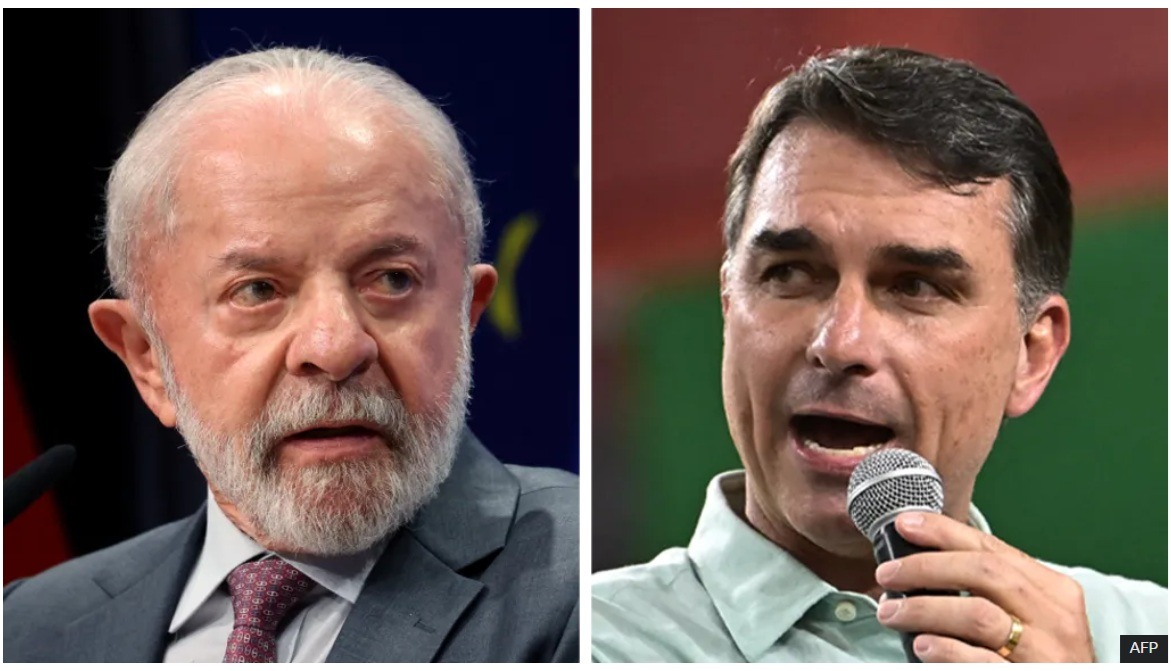
On Sunday, Brazil’s 2026 presidential election delivered a dramatic first-round outcome that has shaken the nation’s political landscape: right-wing candidate Flávio Bolsonaro, eldest son of imprisoned former president Jair Bolsonaro, secured a narrow lead over incumbent left-wing President Luiz Inácio Lula da Silva, pushing the race to a decisive run-off vote on October 25.
With 98.81% of all ballots counted, official results put Flávio Bolsonaro at 47.24% of the vote, compared to Lula’s 44.91% — a surprise finish that defied pre-election polling which had consistently showed the incumbent holding a small lead throughout the campaign. Neither candidate crossed the 50% vote threshold required to win an outright victory in the first round, triggering the two-person runoff that will decide the future of Latin America’s largest economy and most populous nation.
Flávio Bolsonaro’s political ascent is deeply tied to his father’s polarizing legacy. Jair Bolsonaro, the former right-wing president, is currently serving a 27-year prison sentence after being convicted of orchestrating a failed coup attempt following his narrow loss to Lula in the 2022 presidential election. Banned from running for office himself, the elder Bolsonaro endorsed his son’s candidacy, and the campaign has centered on advancing the hardline conservative agenda Jair Bolsonaro championed during his tenure. In a parallel political win for the Bolsonaro family on Sunday, Michelle Bolsonaro, Jair’s wife, won election to Brazil’s federal Senate. If elected in October, Flávio Bolsonaro has pledged to grant amnesty to his father and to the hundreds of pro-Bolsonaro rioters who stormed and vandalized Brazilian government buildings on January 8, 2023, in the wake of Jair Bolsonaro’s 2022 defeat.
The result marks a major upset for Lula, 80, who is running for an unprecedented fourth term after winning three previous elections in 2002, 2006, and 2022. Ahead of the first round, the incumbent had been favored to hold his position, but his narrow deficit has shifted momentum sharply toward Flávio Bolsonaro heading into the run-off. Political analysts note that most of the minor candidates eliminated in the first round are right-wing, leaving their supporters likely to consolidate behind Bolsonaro in the second round. After casting his ballot on Sunday, Lula framed the election as a stark choice between democratic governance and what he called “barbarism”, warning voters of the threat to Brazil’s democratic institutions posed by the Bolsonaro camp. For his part, Flávio Bolsonaro, 45, struck a populist tone, saying his campaign seeks to “free the Brazilian people” from what he frames as failed progressive governance.
The election has already deeply polarized Brazil, a divide reflected in the top issues driving voter turnout: national sovereignty, public safety, economic performance, and corruption have dominated the campaign discourse. The race also carries significant geopolitical weight, as a majority of Latin American nations have already elected right-wing leaders aligned with the second Trump administration, and a Bolsonaro victory would extend this ideological shift across the region.
Tensions over the United States’ role in Brazil’s election have been a persistent flashpoint throughout the campaign. Lula has made national sovereignty a core pillar of his re-election bid, repeatedly accusing Washington of seeking to interfere in the vote to tip the scale in Bolsonaro’s favor. Last year, Donald Trump imposed new tariffs on Brazilian goods and sanctioned top Brazilian officials and judges following Jair Bolsonaro’s coup conviction, a move that deepened friction between the two countries. Earlier this year, Brazil rejected visa applications from two U.S. State Department officials after Brazilian authorities accused the pair of attempting to undermine public confidence in the country’s electoral system — a step that came after Flávio Bolsonaro falsely claimed Brazil’s voting machines share the same flawed system used in Venezuela. Flávio Bolsonaro, for his part, successfully lobbied the Trump administration to designate Brazil’s two largest criminal gangs as terrorist organizations earlier this year. If elected, he has pledged to bring Brazil into the U.S.-led “Shield of the Americas” coalition countering narcotics trafficking, aligning Brazil’s foreign policy firmly with Washington. Despite this pro-U.S. tilt, he has stated he will maintain an “economically pragmatic” trade relationship with China, which overtook the U.S. decades ago to become Brazil’s largest trading partner and the top buyer of Brazil’s key soy and beef exports.
Corruption emerged as a top campaign controversy this year after a massive financial fraud scandal linked to jailed banker Daniel Vorcaro, who orchestrated one of the largest fraud schemes in Brazilian history, dragged in senior figures from across the political spectrum. Voice recordings released during the campaign confirmed Flávio Bolsonaro requested 134 million reais ($25.9 million) from Vorcaro to fund a biographical film about his father. Lula has also been indirectly linked to the scandal: Brazilian police have said Vorcaro attempted to pressure Supreme Court Justice Alexandre de Moraes — widely seen as an ally to Lula, who presided over Jair Bolsonaro’s coup trial — to avoid arrest. Moraes has denied any wrongdoing, and he was not appointed by Lula. On Sunday, Brazil’s Supreme Electoral Court confirmed it found no evidence of foreign interference in the first round of voting, a statement designed to ease pre-election unrest fears.
Public safety and insecurity also rank high among voter priorities. While Brazil’s national homicide rate has declined under Lula’s second term, visible street crime such as petty theft and robberies has risen, and drug trafficking and gang violence remain persistent systemic challenges. Flávio Bolsonaro has run on a hardline anti-crime platform, pledging to extend his father’s loosening of gun ownership laws, classify all major Brazilian gangs as terrorist organizations, and build a network of maximum-security prisons modeled after the facilities used in El Salvador’s crackdown on gangs. Lula has criticized the U.S. terrorist designation of Brazilian gangs as unnecessary geopolitical posturing, but has advanced his own anti-crime agenda, rolling out reforms to target criminal organizations’ financial networks, improve homicide investigations, and invest in prison reform.
Economic policy has been another central dividing line in the campaign. Brazil currently struggles with high levels of household debt and slowing economic growth, putting economic management at the top of many voters’ agendas. Lula’s political legacy is built on his signature social welfare program Bolsa Família, which provides conditional cash transfers to low-income families to keep children in school and ensure they access essential healthcare such as vaccinations. The program is widely credited with lifting more than 20 million Brazilians out of poverty during his earlier terms, and Lula has expanded it since returning to office in 2023. On economic development, Lula has pushed for state-led investment in Brazil’s abundant rare earth mineral reserves and growing data center sector, to ensure Brazilian businesses and workers capture the full benefit of the country’s natural resources. He has also drawn both praise and criticism for his environmental policies: he approved new oil drilling exploration near the mouth of the Amazon River, a move that angered environmental activists, but has presided over a steep drop in Amazon deforestation after rates surged during Jair Bolsonaro’s presidency.
Flávio Bolsonaro, by contrast, has run on a orthodox economic platform, pledging to implement a binding public debt ceiling, cut federal government spending, and revise Lula’s popular social welfare programs to reduce public costs. Like Lula, he has also pledged to expand development of Brazil’s critical minerals sector to meet global demand for energy transition inputs.
As Brazil heads into four weeks of intense campaigning before the October 25 run-off, the outcome remains uncertain, but the result will shape not just Brazil’s domestic future, but the geopolitical and economic trajectory of all of Latin America for years to come.