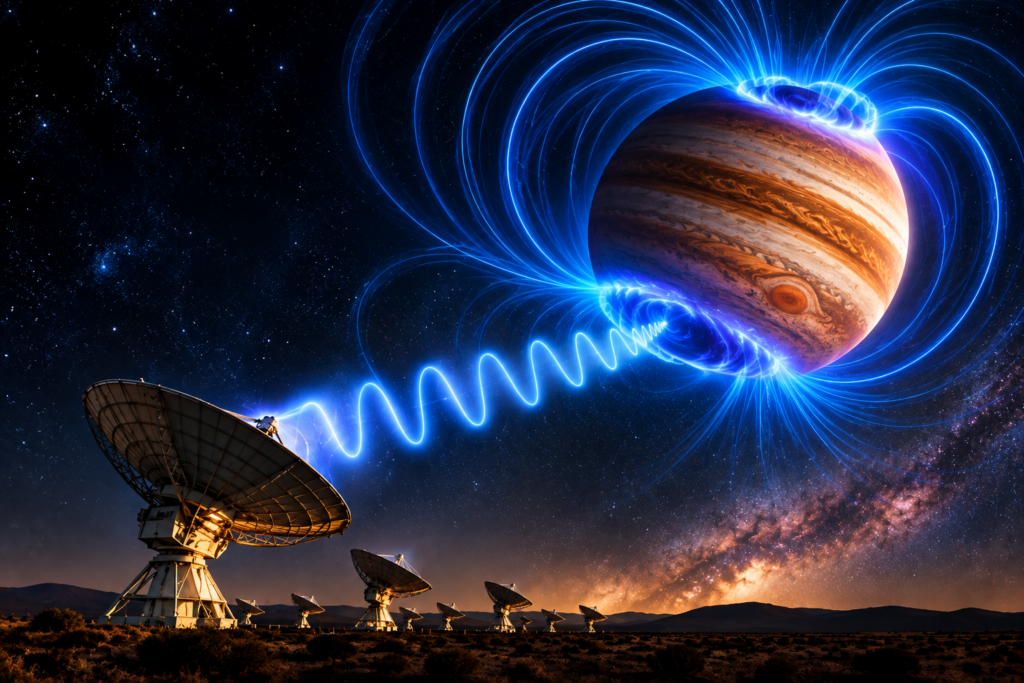
For the first time in the history of astronomical research, scientists have captured radio signals originating directly from an exoplanet — a planet orbiting a star outside our solar system. This groundbreaking achievement opens an entirely new frontier for the study of distant worlds, offering researchers an unprecedented tool to unlock the hidden characteristics of planets light-years away from Earth.
The detected radio emission traces back to Beta Pictoris b, a colossal gas giant situated approximately 63 light-years from our home planet. Researchers were quick to clarify a critical point: these radio waves do not signal the presence of intelligent alien life. Instead, the signals are tied to intense auroral activity driven by the planet’s exceptionally powerful magnetic field, a phenomenon that follows the same fundamental physical rules as auroras seen in our own solar system.
The detection was made possible by the MeerKAT radio telescope array, a cutting-edge facility located in South Africa. The team observed that the signals from Beta Pictoris b are rapid, repeat in regular patterns, and carry a high degree of polarization. Prior research had hinted at possible radio emissions coming from other exoplanetary systems, but those earlier efforts could not definitively separate planetary signals from interference caused by the system’s host star. This breakthrough marks the first time astronomers have been able to confidently trace a radio signal directly to an exoplanet itself.
According to the research team, the radio waves are generated by the same process that creates auroras on Earth, Jupiter, and other solar system planets. When charged particles interact with a planet’s magnetic field, they trigger both the visible light of auroras and the accompanying radio emissions. Analysis of the captured signal allowed astronomers to calculate that Beta Pictoris b has a magnetic field with a minimum strength of 1.25 kilogauss — thousands of times more powerful than the magnetic field that surrounds Earth. This measurement also represents another historic milestone: the first direct calculation of an exoplanet’s magnetic field strength ever conducted.
Beta Pictoris b is far more massive than Jupiter, the largest planet in our solar system, and orbits the young star Beta Pictoris. The entire Beta Pictoris system is estimated to be only 23 million years old, a fraction of the 4.6-billion-year age of our own solar system. This young age gives scientists a rare opportunity to study the early formation and evolution of giant gas planets, a key missing piece in current models of planetary system development.
Astronomers emphasize that this new ability to detect radio emissions from exoplanets creates a transformative research pathway. Moving forward, this method will allow scientists to investigate exoplanets’ magnetic fields, internal structure, and atmospheric conditions in far greater detail, as well as better understand the dynamic interactions between exoplanets and their host stars.
The team’s full findings are currently available on the arXiv preprint server, a public platform for sharing early research results. The study has not yet completed the formal peer review process that confirms the validity and accuracy of scientific work.