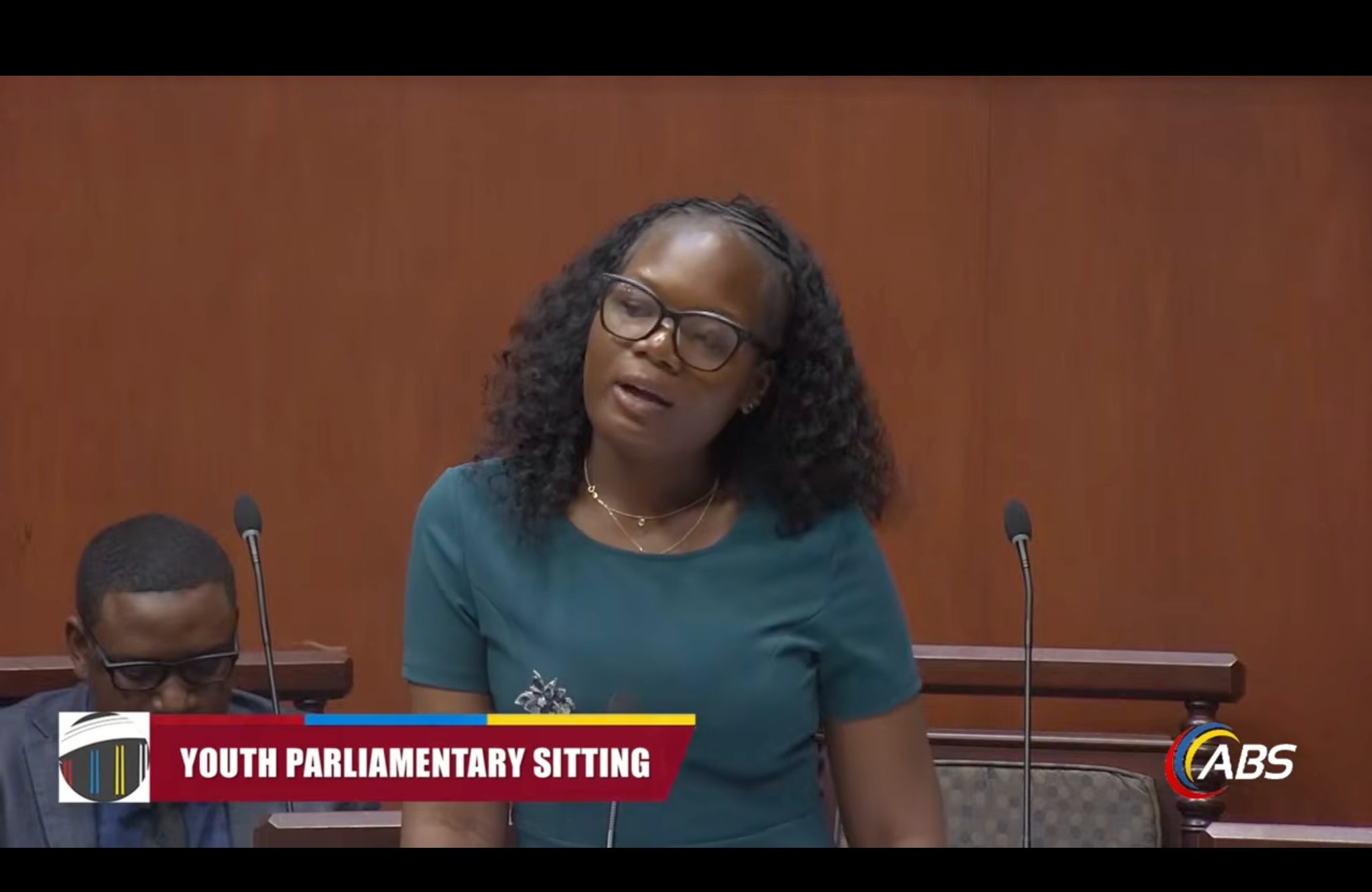
During a plenary sitting of the National Youth Parliament held Friday, Cyniya Ireland, the body’s Deputy Prime Minister and lead for national security, justice and legal affairs portfolios, has put forward two targeted policy proposals aimed at strengthening youth safety, boosting long-term development and curbing youth crime: mandatory camera installation on all public and private school buses, and an increase in the compulsory education age from 16 to 18. The proposals form part of Ireland’s formal backing for the 2026 Education Equity, Youth Development and Protection Resolution, a framework that positions youth-focused policy as a core pillar of broader national security strategy.
Ireland opened her address by reframing education as more than a pathway to academic credentials, arguing it is a critical foundation for national stability. She noted that the current 16-year age cap for compulsory education, set out in Section 27 of the national Education Act, can be adjusted via parliamentary affirmative resolution, clearing a path for the proposed change. Questioning whether 16 remains a developmentally appropriate age for young people to exit the formal education system entirely, Ireland shared a personal anecdote to illustrate the long-term impacts of early school leaving: a former third-form classmate who had long planned to leave school as soon as she hit 16 recently told Ireland she now struggles to secure stable, well-paying work and deeply regrets her decision to leave early.
“When I say I’m raising the age of compulsory education, I’m not simply telling young people to stay in school, but I’m telling them to stay connected,” Ireland explained, pushing back against assumptions that extended compulsory education would force all young people onto a rigid academic track. She clarified that approved pathways for the extended requirement could include technical vocational training, agricultural apprenticeships and other skills-focused programs, recognizing that young people have diverse career and learning goals.
Ireland also tied the proposal to growing concerns about youth involvement in serious crime, referencing frequent public reports of teenagers facing charges for violent offenses including murder and armed robbery. Citing 2023 data from the International Labour Organization, which shows 17.9% of young people globally are classified as NEET — not in employment, education or training — Ireland emphasized that this figure, equal to nearly one in five young people, represents a critical public policy challenge that cannot be ignored. She acknowledged that raising the compulsory education age alone will not resolve the systemic issue of youth disengagement from education and work, but stressed it is a necessary first step to draw sustained policy attention to the crisis.
Shifting her focus to student safety beyond school campus boundaries, Ireland argued that the state’s responsibility to protect students does not end when they step through the school gate or after the final bell rings for dismissal. She highlighted student travel to and from school as an often-overlooked vulnerable zone, calling for mandatory surveillance cameras to be installed on every school bus operating across the country. To address valid privacy concerns, Ireland added that policymakers must also establish clear, binding privacy regulations and procedural protocols that govern who can access camera footage and under what circumstances.
Ireland emphasized that on-board cameras are not just a tool for post-incident investigation to support police responses when harm occurs; instead, they serve as a proactive preventive measure that aligns with core public safety priorities. “Our responsibility does not end when the school bell rings,” she said, noting that students deserve consistent protection throughout their entire school day, including their commute to campus and trip home each afternoon.
Closing her address, Ireland framed the broader education resolution as far more than a set of changes to classroom policy. “National security cannot only begin when there’s a crisis,” she argued. “Sometimes national security begins in the classroom, on the school bus or simply on the playing fields.” Reaffirming her commitment to equitable youth opportunity, Ireland added: “Not every child may need the same pathway, but every child needs a pathway.” She closed by urging fellow members of the National Youth Parliament to back the resolution, centering the goal not just of keeping young people enrolled in school, but of ensuring all young people remain connected to opportunity, prepared for adulthood and protected from harm.