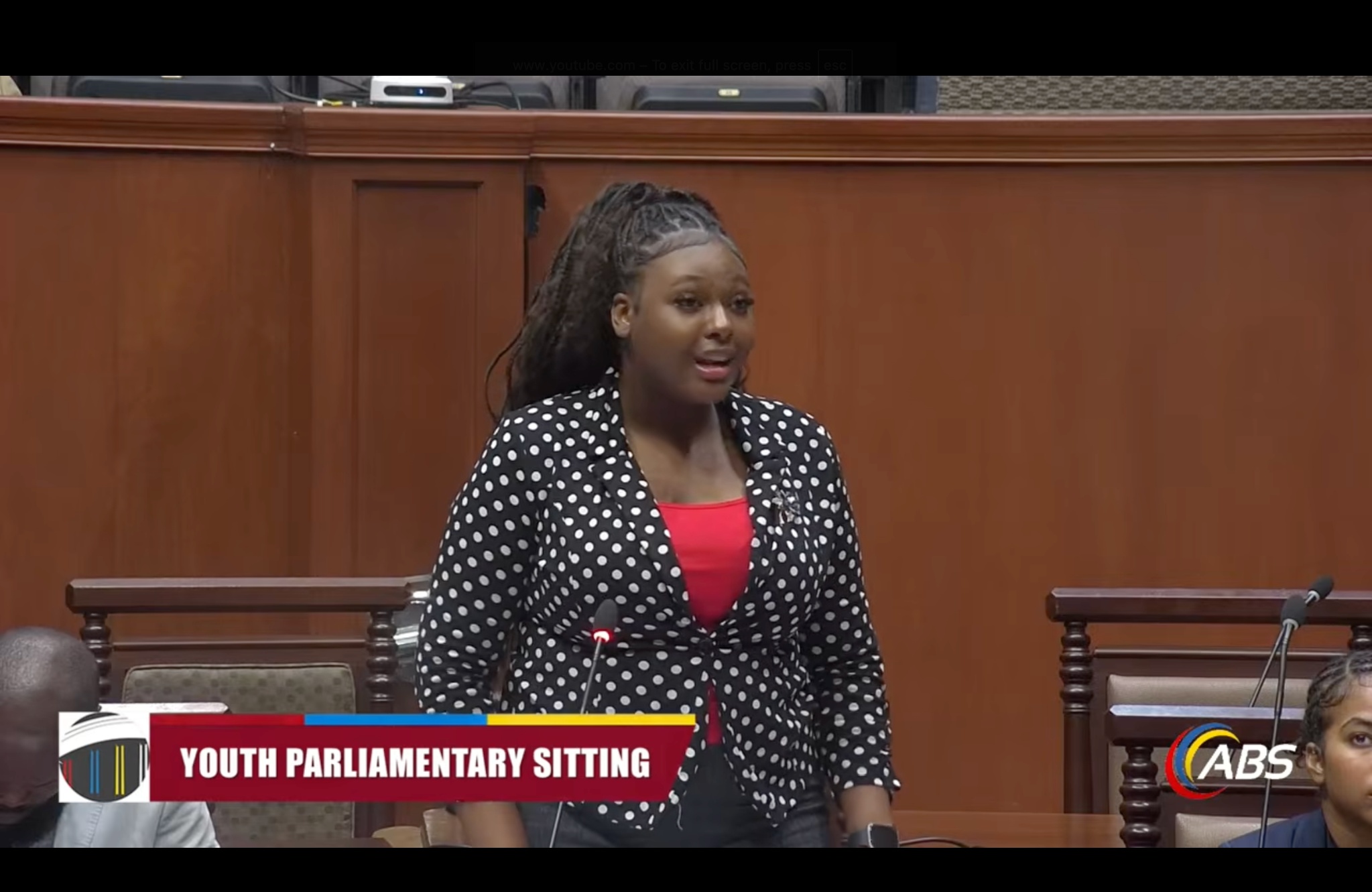
At a recent sitting of Antigua and Barbuda’s National Youth Parliament, a leading youth official has laid out a compelling vision for holistic education reform, centering the often-overlooked needs of student mental and emotional well-being alongside traditional academic goals.
Chantae Thompson, the National Youth Parliament Minister of Health, Social Transformation and Youth Affairs, laid out her proposal while speaking in support of the landmark Education Equity, Youth Development and Protection Resolution 2026. Her argument pushes back against the narrow framing of education access that stops at ensuring students have a physical desk in a classroom, arguing that true educational opportunity requires addressing the full scope of young people’s needs.
Thompson pointed out that many students grapple with unaddressed struggles that impact their academic performance: from underlying mental health distress to disability-related barriers and behavioral challenges that often stem from difficult circumstances outside of school. She posed a pressing question to fellow parliamentarians: “What does educational opportunity really mean if a child is physically sitting in a classroom but emotionally and intellectually unreached?”
Central to Thompson’s proposal is a call to embed formal mental health infrastructure into every school across the nation. She argues that the existing legal framework for education already supports this shift: Section 3 of Antigua and Barbuda’s 2008 Education Act lists physical development, personal health and fitness as core objectives of the national education system. Thompson says this principle must be explicitly extended to include psychological and emotional well-being.
Under her plan, all schools would offer students consistent access to qualified, trained mental health counselors and private, confidential support services for any student in need. “If [the] Education Act calls us to care for the personal health of our students, then that responsibility must not include just the body, but the mind,” she said.
Beyond mental health, Thompson also called for stronger cross-stakeholder coordination to support student needs, including clear, standardized referral protocols in every school to connect students requiring additional support with appropriate services. This focus on streamlined access extends to students with disabilities, learning differences, and developmental needs, Thompson emphasized, noting that the issue is not just whether support programs exist on paper, but whether they actually reach the young people who need them most.
Thompson also highlighted ongoing work to elevate student voice in education decision-making, arguing that young people are not passive recipients of education policy, but core stakeholders who have direct insight into what works in classrooms. She pointed to the National Student Council of Antigua and Barbuda as a key platform for student representation, noting that all schools are currently receiving updated constitutions, regulatory frameworks, and training manuals to strengthen student leadership capacity across the country. “If we want to know what is working, we must listen to the people that are actually sitting in the classrooms,” she noted.
The minister also referenced existing public health initiatives integrated into schools that align with her vision of holistic education, including universal eye screenings for primary and secondary students and updated nutrition standards for food sold and served on campus. These efforts, she said, prove that integrating health into education is already a proven, actionable priority—now it is time to extend that model to mental health.
Thompson’s address was part of a broader debate in the National Youth Parliament focused on modernizing Antigua and Barbuda’s entire education system. The comprehensive resolution under discussion covers a range of interconnected priorities, from special education access and early intervention services to safeguarding protocols and career guidance, all rooted in the goal of advancing education equity for all young people across the twin-island nation.