As the high-stakes election challenge trial over dual citizenship continued at the Kingstown High Court this week, two connected legal disputes brought by defeated opposition candidates have wrapped up their evidentiary phase, setting the stage for a critical next phase of judicial proceedings that could carry lasting implications for electoral law across the Caribbean.
The two linked petitions stem from the November 2025 general election in St. Vincent and the Grenadines, where the New Democratic Party (NDP) secured a landslide victory, claiming 14 of the 15 available parliamentary seats. The challenges are led by Luke Browne, a candidate from the Unity Labour Party (ULP) who lost his fourth consecutive bid for the East Kingstown parliamentary seat, and Agustus Carlos Williams, the ULP candidate who failed to unseat Prime Minister Godwin Friday in the Northern Grenadines constituency.
Both petitioners argue that Prime Minister Friday and East Kingstown MP Dwight Fitzgerald Bramble — the respondents in the cases — are ineligible to hold parliamentary office because they hold dual citizenship of St. Vincent and Grenadines and Canada. They are also challenging the actions of returning officers, the national Supervisor of Elections, and the attorney general, who is named as a respondent in line with standard procedure for electoral disputes of this kind.
On Thursday, the final day of the evidentiary phase, several NDP supporters from East Kingstown took the stand for cross-examination. Questioning centered on the witnesses’ partisan affiliations, their personal connections to petitioner Browne and respondent Bramble, and how much prior knowledge they had of the dual citizenship status held by both Bramble and Prime Minister Friday. In total, the legal team representing the respondents called 21 witnesses over the course of the evidence-gathering phase, which concluded the same day.
Following the close of proceedings, Justice Gertel Thom issued a clear timeline for the next steps: all legal teams must submit formal written legal submissions to the court by November 4, with oral arguments scheduled to be heard before the court on November 10. The justice also ordered both sides to prepare separate documents outlining agreed-upon facts and disputed facts, to streamline her judicial review.
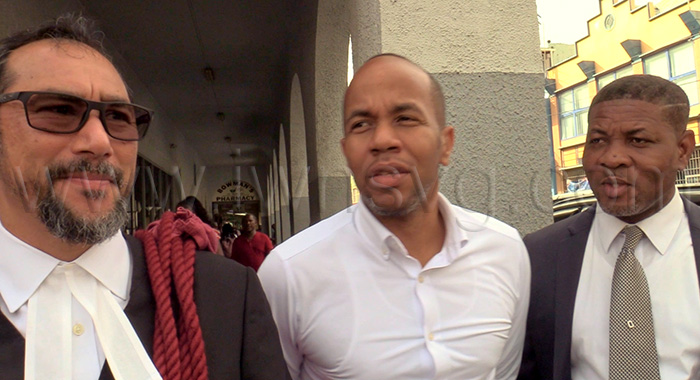
Speaking to reporters outside the courthouse after Thursday’s adjournment, Browne pushed back against widespread social media speculation that the ULP would never have pursued this legal challenge if the NDP had lost the general election. He argued that claims of partisan double standards are unfair, noting that the ULP launched a comprehensive public awareness campaign about the dual citizenship issue long before election day.
Browne also addressed public observations that he and Williams appeared to smile during cross-examination of the respondents’ witnesses, clarifying that the expression was not a sign of amusement. He emphasized that the legal team views the case as a deeply serious constitutional matter, and their calm demeanor reflects confidence in their legal position, not disregard for the proceedings.
Browne stressed that the case carries ramifications far beyond St. Vincent and the Grenadines, noting that it will bring critical clarity to electoral law that will shape political practice across the Caribbean and beyond. He described the week of court proceedings as successful, saying, “We have had a well-organised case from the earliest sitting, and we are looking forward to the next phase of this consequential process.”
Responding to questions about what would have happened if the NDP had lost the election, Browne noted that any counterfactual is purely speculative. He added that if he had personally won the East Kingstown seat, the challenge to Bramble’s nomination would be moot, but that does not mean the ULP would have dropped broader legal action over dual citizenship eligibility.
Stuart Young, the lead senior counsel for the petitioners, echoed Browne’s confidence in the case. While he declined to elaborate on specific details of new evidence that emerged during cross-examination or speculate on potential post-ruling consequences, Young described the week’s cross-examination of respondents’ witnesses as near-perfect from the petitioners’ perspective. “From the petitioner’s point of view, we could not have asked for a better week with our cross-examination… We feel very, very confident from an evidence point of view,” he told reporters, adding that any rulings on consequences of a successful petitioner challenge would be left entirely to Justice Thom.
NDP and government officials have rejected the challenges outright, framing them as baseless partisan attacks. Prime Minister Friday dismissed the petitions as nothing more than “sour grapes and sore losers” from a defeated opposition. Anand Ramlogan, the lead senior counsel for the respondents, backed up the prime minister’s remarks, characterizing the ULP’s legal action as disingenuous and anti-democratic.
Friday and Bramble have long maintained that their dual citizenship is fully permitted under the Constitution of St. Vincent and the Grenadines, and they have rejected claims of ineligibility. Friday has served as a Member of Parliament since 2001, while Bramble won his first term in East Kingstown in 2020 and was re-elected for a second five-year term in the 2025 vote. In the election, Friday secured 2,185 votes to Williams’ 332, with 11 rejected ballots, resulting in Williams losing his electoral deposit. Bramble won re-election with 2,728 votes to Browne’s 1,727, with 19 rejected ballots.