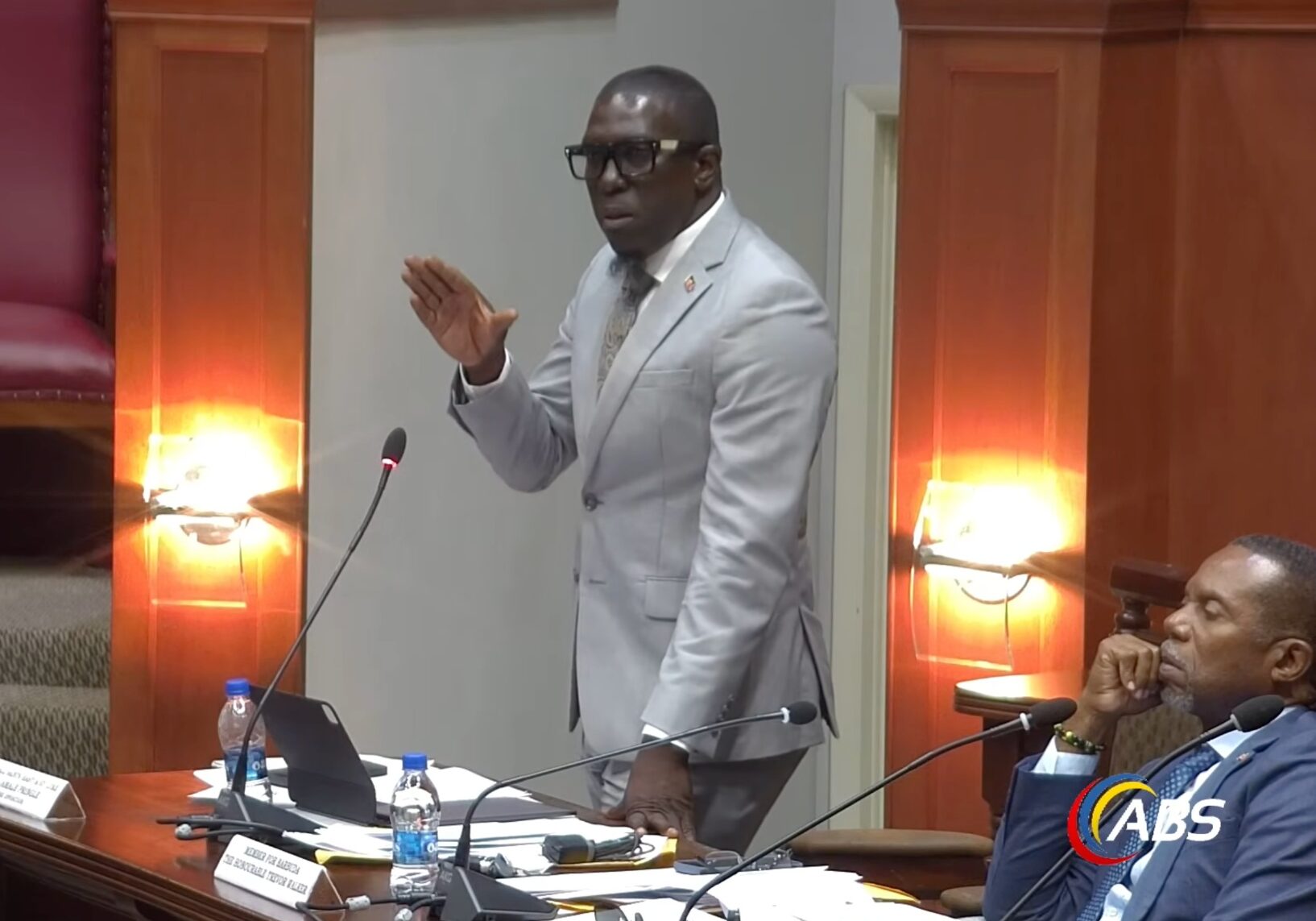
As parliamentary debate opened this week on the landmark Firearms (Amendment) Bill 2026, Antigua and Barbuda’s opposition leader Jamale Pringle has delivered a nuanced call for a holistic, multi-pronged response to the nation’s growing gun violence crisis, arguing that harsher prison sentences alone cannot reverse rising criminal activity.
Pringle opened his address to the House of Representatives on Monday affirming his backing for stringent punishment for individuals who commit serious violent offenses using illegal firearms. “There’s no doubt that persons who commit serious crimes with firearms should face the full extent of the law,” he told lawmakers. But he immediately pushed back against framing the sentencing reforms in the bill as a standalone “saving grace” for the country’s security challenges, warning that deep-rooted social and systemic drivers of crime cannot be addressed through punishment alone.
One of the most alarming trends Pringle highlighted is the steadily declining age of individuals involved in serious gun-related crime, a shift he said points to a much broader, unaddressed social crisis. “The age group is getting younger and younger,” he noted, arguing that this trend demands proactive intervention rather than only reactive punishment after crimes are committed.
While Parliament moves to extend sentences to keep convicted firearm offenders behind bars for longer periods, Pringle argued that equal priority must be given to cutting off the supply of illegal guns at the source and preventing at-risk youth from entering criminal activity in the first place. He raised pointed questions about the effectiveness of past government commitments to boost policing, border surveillance, and forensic investigative capabilities, specifically calling out gaps in the nation’s forensic infrastructure. Pringle asked whether Antigua and Barbuda’s national forensic laboratory is fully operational, or if critical evidence still must be shipped overseas for analysis — a delay that can undermine successful prosecutions.
He also drew attention to a major gap in post-seizure investigation: after law enforcement seizes illegal weapons, little public information is provided about efforts to trace the guns back to their smuggling networks. Pringle emphasized that tracing every recovered firearm is a critical step to “plug the holes” in border security and dismantle the transnational trafficking rings that supply illegal guns to Antigua and Barbuda. To address this gap, he called for the establishment of a dedicated firearm tracing unit within the Royal Police Force of Antigua and Barbuda, if one does not already exist, with a mandate to trace every seized weapon from the person caught in possession back through the entire supply chain to the original manufacturer. He also urged deeper collaboration with regional and international law enforcement agencies to target these transnational networks, and called for investment in stronger detection capabilities at Customs to stop illegal guns from entering the country in the first place.
Beyond investigative and border enforcement reforms, Pringle stressed that even the strongest legislation is useless if law enforcement agencies lack the resources to catch and prosecute offenders. “If you cannot catch the criminal, this bill serves no purpose,” he said, referencing longstanding complaints from police about resource shortages and arguing that sustained, adequate investment in enforcement agencies is non-negotiable for any gun crime strategy to work. Echoing the government’s own public position that border security is a core pillar of countering gun crime — which recently led the Cabinet to approve the purchase of specialized detection dogs for the country’s ports — Pringle noted that the effectiveness of new sentencing rules depends entirely on the resources allocated to enforce them. “If we’re just going to pass this to deal with the people who we catch with firearms and there’s no effort in going after the persons who are importing these firearms into Antigua and Barbuda, we’re wasting time in here,” he said. “The ultimate goal must be to ensure that firearms are not imported into Antigua and Barbuda.”
To address the social roots of rising youth involvement in crime, Pringle called for major new investment in community infrastructure that gives young people positive alternatives to loitering on street corners, where they are far more likely to be exposed to criminal recruitment and activity. He argued that reducing gun violence requires tackling the underlying social conditions that push people into crime, rather than only responding after offenses have been committed. He also called for comprehensive reform of the country’s prison system, noting that current facilities often leave incarcerated people worse off than when they entered, with little focus on rehabilitation that can reduce recidivism. Additionally, he raised urgent concerns about rising hard drug use among young people and its damaging impacts on mental health, calling for systemic investigation into the root causes of the crisis.
In closing, Pringle emphasized that the Firearms (Amendment) Bill should be treated as one component of a broad national strategy, not a complete solution to the country’s gun crime problem. Notably, his position overlaps with key parts of the governing administration’s stated approach: the Cabinet has previously acknowledged that enforcement alone cannot address the social conditions driving youth violence, and has identified families, schools, faith institutions, community groups, and social service agencies as key partners in prevention efforts. The Firearms (Amendment) Bill is just one part of a wider package of government measures to respond to rising gun violence, with the administration saying the legislation will strengthen sentencing rules while being paired with increased investment in policing, investigative, and forensic capabilities.