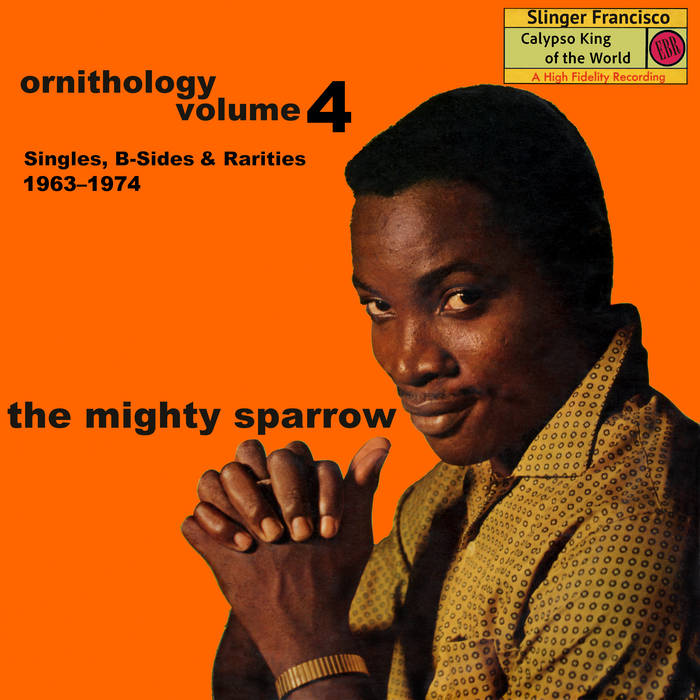
When news broke of Mighty Sparrow’s passing at around 4 p.m. on Sunday, September 27, I paused before accepting it. After all, this was not the first time rumors of the legendary calypsonian’s death had circulated – and he had turned those false reports into art decades earlier. Back in 1969, Sparrow recorded the iconic calypso *Sparrow Dead*, a sharp, playful rebuke that mocked the false gossip about his failing health and turned death hoaxes into one of his most memorable tracks.
Growing up in St. Vincent, Sparrow’s music was a constant backdrop to my childhood, streaming from every radio and woven into the fabric of daily community life. His tracks were more than songs – they were our collective anthems. From *Capitalism Gone Mad* to *Where the Lizard*, *Education*, *Dan is Man*, *Wanted Man* and dozens more, his work was the soundtrack of our youth. Even my deeply religious relatives could not resist singing along to his line “all saltfish sweet” – a joke that only a West Indian can fully appreciate. I still recall celebrating with Chrys Ralph when he returned home and took the road march title with *Don’t Back Back on me*, and to this day, the sharp, cutting wit of *Lying Excuses Parts 1 and 2* remains unmatched in calypso.
I have never had a trained ear for music, which is why I always gravitated toward Sparrow’s brilliant lyrics. He had an unmatched gift for wrapping complex social and political issues in witty, catchy, accessible verse that resonated with everyday people. As I grew older and entered academia, I came to a clear conclusion: Sparrow was one of the sharpest social analysts the Caribbean region has ever produced. He was far more effective at communicating hard truths to the public than any trained academic, because he shared his analysis in public spaces, in the everyday language of Caribbean people, backed by a infectious chorus that stuck in your head for days.
I studied economics in lecture halls across the Caribbean, the United States, and the United Kingdom, but some of my earliest and most lasting lessons in political economy came from this Grenada-born, Trinidad-raised calypsonian, whose music reached every corner of the world where West Indians gathered with a radio. His 1956 breakout hit *Jean and Dinah*, which launched his legendary career, is still the greatest calypso ever written in my view. On the surface, it is a humorous story about American soldiers withdrawing from the Chaguaramas military base, leaving Port of Spain’s sex workers without their main source of income. But beneath the lighthearted tone, it offers a searing analysis of national sovereignty reclamation and the economic impact of losing the foreign spending that a dependent local economy has come to rely on.
Three years after that breakout hit, he released *Simpson* to push back against early death hoaxes, a pattern that would repeat through his career. As the West Indies Federation teetered and collapsed in 1962, Sparrow released *Federation!*, his diagnosis of the union’s failure. He called out the toxic combination of small states with oversized egos, and the collective failure to recognize that the region was far stronger united than divided. That analysis remains just as accurate 64 years later, as Caribbean nations still grapple with the same question of regional integration.
For those of us who were students in the mid-20th century, *Dan is the Man* remains endlessly relatable. It follows a working-class young man who systematically dismantles the absurdity of the colonial education curriculum, line by line. Today, as many call for the Caribbean Examinations Council (CXC) to be scrapped entirely, Sparrow’s song holds a key lesson: while CXC must be held accountable for its shortcomings, destroying the institution entirely is not the answer.
In the 1980s, when Trinidad and Tobago – long the Caribbean’s oil-rich economic powerhouse – went from a crippling oil boom to a devastating bust and was forced into an IMF restructuring program, Sparrow released *Capitalism Gone Mad*. You will not find a clearer, more accessible explanation of import cost-push inflation anywhere in academic textbooks, and it is set to one of the catchiest melodies Sparrow ever wrote.
Legendary Caribbean thinker CLR James once described Sparrow as a genuinely West Indian artist: rooted in working people, unapologetically speaking for their experiences and concerns. University of the West Indies scholar Gordon Rohlehr spent decades documenting this truth in his academic work, and titled his collection of essays on Sparrow *My Whole Life is Calypso* – a phrase that perfectly sums up the singer’s life and legacy. In 1987, UWI awarded Sparrow an honorary Doctor of Letters, a decision that remains one of the wisest the institution has ever made.
Even today, the Caribbean too often waits for outside validation, funding, and salvation from foreign powers. In that context, Sparrow’s decades-long career is a critical case study for what the region needs to thrive in the new global order. Sparrow built his excellence locally, owned his work locally, and exported it to the world with unshakable confidence.
Sparrow was no saint, and he never pretended to be. A Vincentian calypsonian once told me that Sparrow sang too much raunchy material, and it is true: his songs were just as often racy as they were profound. He would have laughed at any tribute that tried to sanitize his legacy or smooth over his rough edges. A core part of his genius was that he refused to be forced into a false choice between being respectable and being real – he gave us both, often in the same verse.
I still remember the shock and joy when, at an age when most performers have long retired, Sparrow came back to win the calypso crown in 1992 with *Both of Them* and *Survival*. For all his insight and impact, Sparrow was a public intellectual who never held an endowed academic chair at a university.
As a friend of mine wrote after his passing: “Well boys, Kitch gone, Melody gone and now the Birdie gone too. They have left us with a wonderful legacy.” Now, the great Birdie’s lecture has come to an end, but the lessons he left us will never fade. Rest well, Mighty Sparrow.