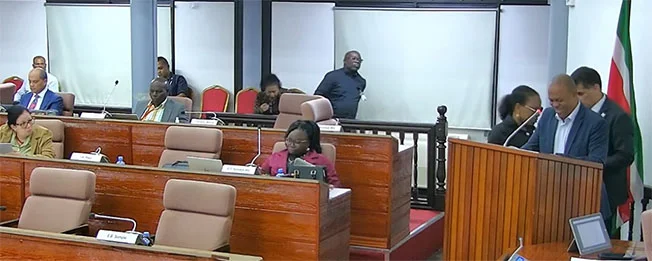
In a parliamentary session held on November 14, members of Suriname’s National Assembly raised concerns that the country’s current fragile financial standing may necessitate deferring its accession to the Latin American and Caribbean Space Agency (ALCE) to a date no earlier than 2028. The deliberations revealed that the Ministry of Public Works and Spatial Planning has already flagged significant misgivings about the timing of the proposed membership, joining legislators in demanding full transparency on all associated costs before any binding commitments are made. During the debate, lawmakers referenced preliminary government feasibility findings that acknowledged the strategic value of joining the regional space body, even as senior ministry officials noted that widespread fiscal constraints make a pre-2028 accession timeline unfeasible at this stage. Ronny Asabina, chair of the parliamentary committee overseeing the matter and representative of the BEP party, formally submitted a request to the executive branch for full details on ALCE’s annual membership fee structure, the methodology used to calculate Suriname’s required contribution, and all potential hidden supplementary costs. Asabina confirmed that the Ministry of Foreign Affairs, International Trade and Cooperation has already sent an official inquiry regarding fee schedules to ALCE’s headquarters, but no substantive response had been received in time for the parliamentary debate. Legislators emphasized that membership costs extend far beyond base annual dues, with additional projected expenditures covering travel to regional agency meetings, specialized technical training for local staff, participation in cross-national working groups, and the establishment of a dedicated national institutional framework to process and apply satellite data. Multiple parliamentarians highlighted that Suriname has already faced persistent challenges in meeting its existing financial obligations to other international intergovernmental bodies, and stressed that no new binding commitments should be entered into without a complete, verified breakdown of long-term fiscal impacts. Lawmakers also posed critical questions about whether Suriname currently possesses the required technical expertise and physical infrastructure to effectively leverage the satellite data and resources that ALCE membership would provide. Importantly, the widespread skepticism over the proposed timeline does not reflect a rejection of the core value of regional space cooperation across the National Assembly. Multiple speakers underscored that ALCE satellite data would deliver tangible public benefits for Suriname, including real-time deforestation monitoring, more accurate natural disaster early warning systems, optimized agricultural production planning, and improved detection of illegal mining and unauthorized resource extraction in the country’s remote interior regions. The central unresolved question guiding the ongoing policy review remains whether the long-term socioeconomic benefits of ALCE membership will outweigh the total associated costs, and whether Suriname has completed sufficient operational preparation to participate meaningfully in the agency’s activities. The National Assembly has formally requested the executive branch to provide a full, detailed response that clarifies the full financial feasibility of accession and identifies the most appropriate, fiscally responsible timeline for Suriname to join the regional space partnership.