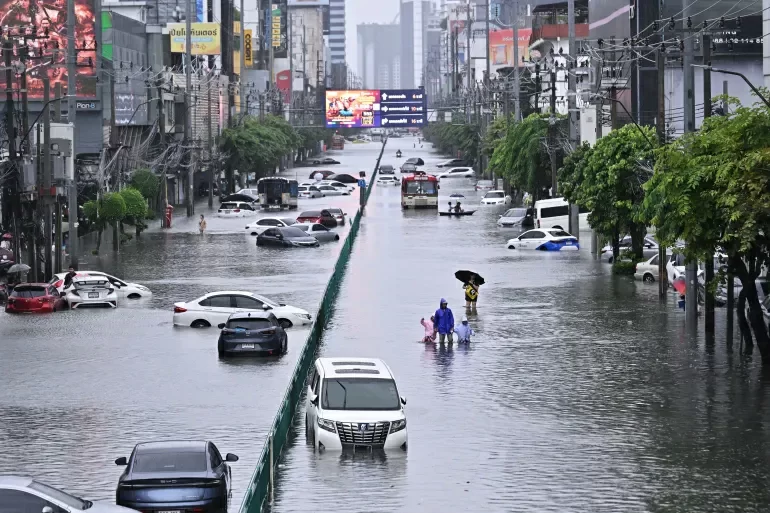
On September 26, 2026, days of relentless, unprecedented rainfall pushed Thailand’s capital Bangkok to a breaking point, prompting authorities to formally declare all 50 of its administrative districts official flood disaster zones on Saturday.
The extreme weather event began Thursday afternoon, when non-stop heavy downpours began drenching the city. By Saturday, some parts of Bangkok had recorded nearly 300 millimeters of cumulative rainfall, with the city’s eastern districts bearing the brunt of the impact. Min Buri and Khlong Sam Wa districts alone saw more than 270 millimeters of rain in just over 48 hours. The unprecedented volume of water overwhelmed the city’s network of canals and urban drainage system, pushing both to their maximum operational capacity. Low-lying neighborhoods flooded, forcing mass evacuations of local residents, and major thoroughfares across the capital were left submerged.
Bangkok Governor Chadchart Sittipunt announced the expansion of the disaster zone declaration from the initial three hard-hit districts to all 50 on Saturday. The official disaster status unlocks expanded authority and resources for national government agencies and local authorities, enabling faster, coordinated disaster response and flood mitigation efforts.
As of Saturday afternoon, Governor Chadchart reported that flood conditions are beginning to stabilize. If no additional heavy rainfall occurs, he projected that most floodwaters could drain out of the city within two to three days, with the city deploying all available pumping capacity and drainage infrastructure at full operation to speed water removal. However, the threat of further disaster has not passed. Thailand’s meteorological department warns that heavy rain will continue across most of the country through Sunday. A low-pressure system over central Thailand combined with an amplified southwest monsoon increases the risk of additional flooding, sudden flash floods, mudslides, and river overtopping across the region.
The ongoing flooding has severely disrupted transportation across large swathes of Bangkok. Multiple major roads are partially or fully submerged, leaving dozens of motorists stranded and forced to abandon their vehicles along inundated corridors. The Bangkok Metropolitan Administration (BMA) has advised residents to stay home unless travel is absolutely essential, and has identified Ramkhamhaeng Road, New Phetchaburi Road, Ekkamai Road, Sena Nikhom 1 Road, Lat Krabang Road, and sections of Vibhavadi Rangsit Road as high-risk, impassable zones. To help residents move their vehicles to higher ground, public transit authorities have temporarily opened free park-and-ride lots at MRT stations, a program currently scheduled to run through October 2.
Across affected areas, authorities have set up temporary evacuation shelters in dry, elevated public facilities including schools and government buildings. All BMA-run public schools will be closed on Monday, and non-essential government employees have been directed to work from home to reduce traffic congestion on already strained, flooded road networks.
The impact of the flooding extends far beyond Bangkok’s city limits. As of Saturday, more than 84,000 people across 21 Thai provinces have been affected by flood-related disruptions. In canal-side communities across the capital, floodwater has breached residential properties, with emergency response teams prioritizing support for residents in low-lying areas and those dependent on powered medical equipment. Authorities have issued warnings for canal-side communities to remain on high alert, noting that most canals are already operating at full capacity, meaning any new rainfall will quickly trigger additional flooding. Bedridden patients relying on life-support equipment have been advised to relocate to hospitals temporarily if conditions worsen.
While Bangkok regularly experiences seasonal heavy rain and temporary flooding during the annual monsoon, what makes this event unusual is the uninterrupted duration of rainfall. Unlike typical monsoon downpours that last a few hours, this event has brought near-constant rain since Thursday, leaving drainage systems no time to clear water between storms. A 67-year-old shopkeeper living near a canal told AFP that floodwaters reached her waist, forcing her to close her business for two full days, and compared the conditions to the devastating 2011 Thai floods. Context is key, however: the 2011 disaster was a months-long, nationwide catastrophe that killed over 500 people and damaged millions of homes. While current conditions in Bangkok are severe, they have not yet reached the scale of the 2011 event.
At the national level, authorities have mobilized to respond to the crisis. Thai Prime Minister Anutin Charnvirakul has cut short an official visit to London to return to Thailand to oversee the flood response. Authorities have stressed that the next 24 to 48 hours will be critical to determining the trajectory of the disaster. If rainfall eases as forecast, floodwaters will gradually recede, but new heavy downpours would once again overwhelm drainage capacity. Until conditions improve, officials are urging residents in hard-hit areas to stay home unless travel is essential, move vehicles to higher ground, and closely follow official emergency warnings.