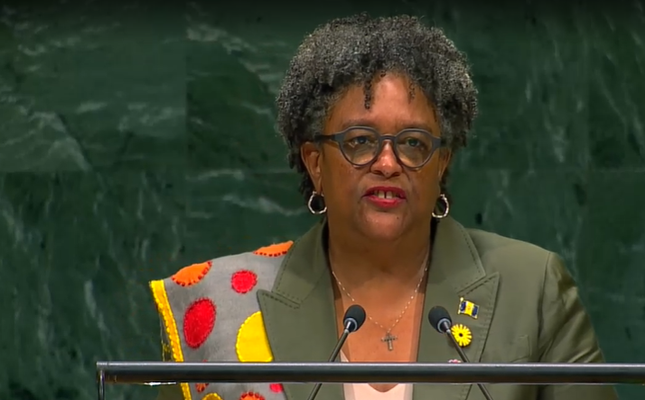
As world leaders gather for the United Nations General Assembly (UNGA) General Debate in Manhattan, New York, just weeks ahead of the 31st Conference of the Parties (COP31) climate summit, Barbados Prime Minister Mia Mottley is pushing the international community to shift from symbolic goal-setting to tangible, urgent implementation of climate action for climate-vulnerable developing states.
Against a backdrop of accelerating global climate disruption, marked by record-breaking heatwaves across Europe and growing forecasts of a devastating super El Niño event, Mottley used her UNGA platform to confront developed nations over their unmet commitments to vulnerable economies. As the current president of the Climate Vulnerable Forum (CVF), she emphasized that while reducing carbon dioxide emissions remains the cornerstone of a global energy transition, progress has been far too slow to avoid catastrophic warming. That is why the CVF, backed by 74 member countries, has prioritized methane reduction as a core action item for COP31 — a focus that Mottley argues is particularly critical for small island developing states that face existential threats from sea-level rise and extreme weather.
Mottley told the assembled audience that during April’s G20 Ministerial Dialogue, finance ministers from participating nations recognized methane cuts are not just an environmental imperative, but also a catalyst for economic growth, fiscal stability, and improved public health outcomes. Where the conversation breaks from past rhetoric, however, is on the issue of climate financing — a gap that Mottley quantifies in stark terms. By 2030, vulnerable countries need approximately $490 billion in annual climate financing to adapt to and mitigate the effects of climate change, but current annual inflows only reach roughly $90 billion. Mottley summed up the disparity with a relatable quip: “As young people in Barbados would say, ‘the math simply ain’t math.’”
Beyond the overall financing gap, Mottley also drew attention to the unfair disadvantage climate-vulnerable nations face in global borrowing markets. She noted that these countries pay an average of 1.2 percentage points more in borrowing costs than advanced economies, a discrepancy that adds up to more than $62 billion in excess annual interest payments. “This cannot be fair,” she declared, pointing out that these unnecessary costs crowd out critical public investments in climate resilience, healthcare, education, and infrastructure.
Mottley stressed that vulnerable nations are not waiting for the international community to act; they are already forging solutions through collaborative initiatives laid out in the Bridgetown Initiative, a framework spearheaded by Barbados to reform global climate finance. One key outcome of this work is the Vulnerability to Viability Compact, a partnership between the CVF, G20 nations, and the OPEC Fund for International Development that unites 74 countries and 16 development finance institutions. The compact’s goal is to expand access to low-cost, long-term capital for projects in education, healthcare, and water infrastructure. A second initiative, the Lifeline Fund, was established by CVF-coordinated central bank governors and will soon be operational to provide rapid liquidity support when climate shocks trigger balance-of-payments pressures for vulnerable economies.
“So we are moving to help ourselves,” Mottley said, explaining that short-term lending cycles of 10 to 15 years make it impossible for vulnerable nations to build critical climate-resilient infrastructure, as high borrowing costs and quick repayment schedules crowd out essential investments. While Mottley celebrated the progress these homegrown initiatives have achieved, she warned that they cannot fix the deep-rooted flaws in the existing international financial architecture on their own.
For nearly five years, the Bridgetown Initiative has argued that climate resilience, debt sustainability, and access to affordable finance cannot be addressed as separate issues, Mottley reminded delegates. For most vulnerable countries, the core challenge is not just a lack of available capital, but a lack of fiscal space to borrow and invest at reasonable terms that support long-term development and climate action.