In his September 2026 address to the United Nations General Assembly, Belizean Prime Minister John Briceño laid out clear, uncompromising positions on a series of pressing global and regional crises, calling for collective international action to address long-standing injustices and emerging conflicts.
Briceño began by focusing on regional instability in the Caribbean, starting with the ongoing crisis in Haiti. He emphasized that Haiti’s instability is a shared concern for all Caribbean nations, noting that while upcoming December elections offer a glimmer of hope, a sharp rise in gang violence threatens to derail the democratic process. Echoing the position of the CARICOM Eminent Persons Group, Briceño called for the immediate full deployment of an international gang suppression force to create the secure political environment required for a Haitian-led, Haitian-owned transitional government to succeed. “Haiti’s crisis is our crisis. Haiti is the Caribbean,” Briceño stated, affirming Belize’s unwavering solidarity with the Haitian people and alignment with CARICOM’s demands.
Turning to Cuba, Briceño reiterated Belize’s long-standing condemnation of the United States’ decades-long economic embargo against the island nation. He explained that the blockade, exacerbated by strict fuel restrictions, has inflicted severe, unnecessary damage on Cuba’s economy, calling the ongoing policy unjustified and inhumane. Briceño renewed Belize’s call for the full lifting of the embargo, as well as the removal of Cuba from the U.S. list of state sponsors of terrorism.
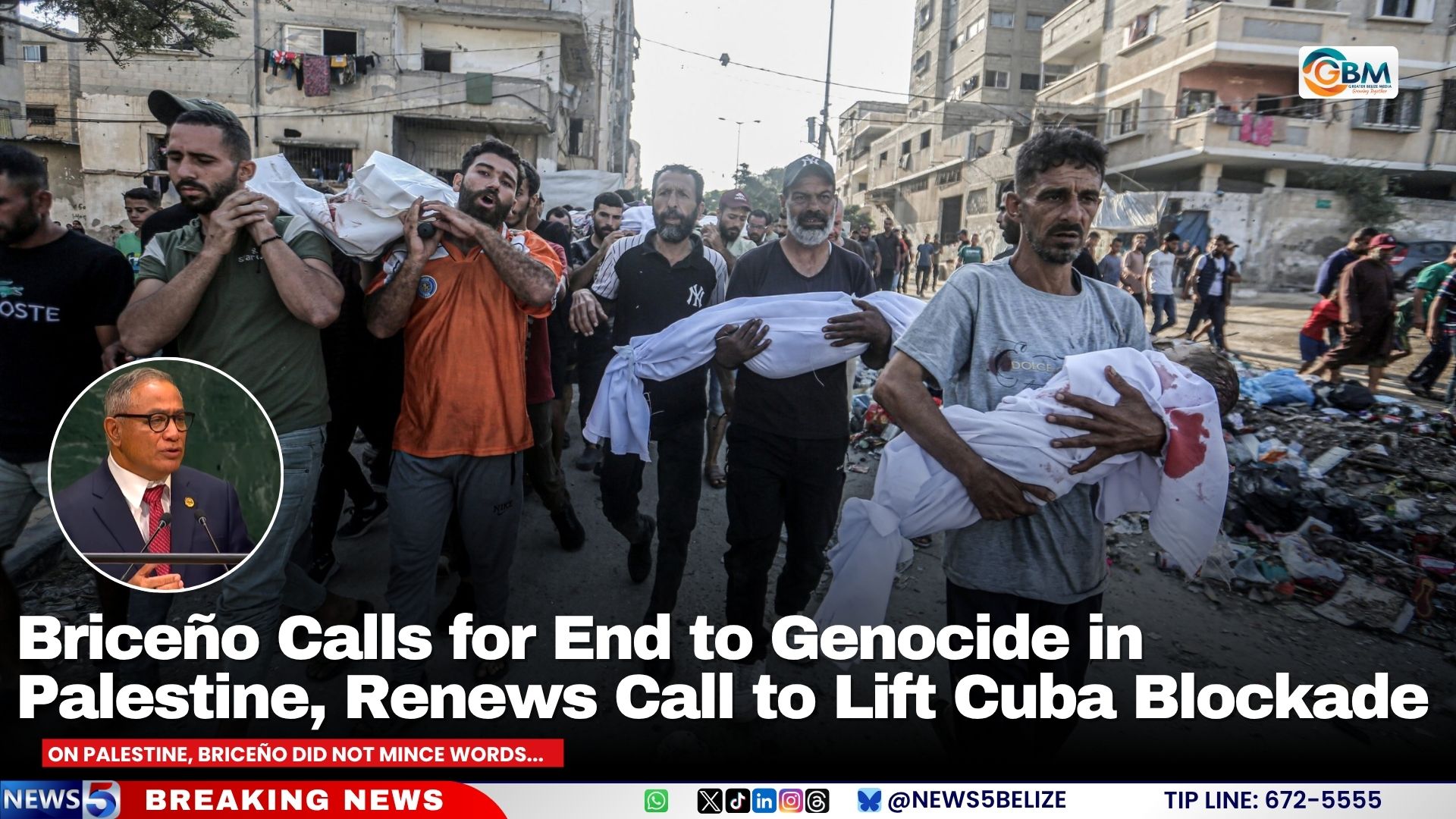
On the conflict in Palestine, Briceño spoke with unfiltered clarity, condemning Israel’s military actions in Gaza and calling for an immediate end to what he labeled as genocide and apartheid. He argued that the international community has failed for decades to secure Palestinian self-determination, calling out the global body for allowing what he described as a settler colonial project to continue unchallenged. “It is an affront to this assembly and to humanity to be forced to listen to a man justify apartheid and genocide when he is wanted by the International Criminal Court for war crimes and crimes against humanity,” Briceño said. “The genocide must end. The apartheid must stop. End the occupation and decolonize Palestine.”
Briceño also addressed the full-scale Russian invasion of Ukraine, framing the conflict as a critical test of the existing international order. He stressed that any violation of a UN member state’s sovereignty and territorial integrity threatens the foundation of global peace, noting that if borders can be redrawn through force, every border across the globe becomes unstable. “Our actions must extend to every conflict and to every person displaced, destitute, or in despair,” he added.
Closing his address, Briceño turned to the question of Taiwan’s inclusion in the UN system, reaffirming Belize’s decades-long diplomatic relationship with the island. He highlighted that 23 million Taiwanese people are currently denied representation and a voice in the UN General Assembly, a situation Briceño called a global security concern. Briceño emphasized that Taiwan has been a reliable development partner to Belize for more than 30 years, contributing directly to progress in climate resilience, agricultural technical capacity, and public infrastructure development. Beyond Belize’s bilateral partnership, Briceño noted that Taiwan occupies a central role in global tech supply chains, producing the world’s most advanced semiconductors and leading innovation in artificial intelligence, with the island standing ready to share its technological expertise with the entire international community. For these reasons, Briceño once again called for Taiwan’s meaningful participation in the United Nations system.