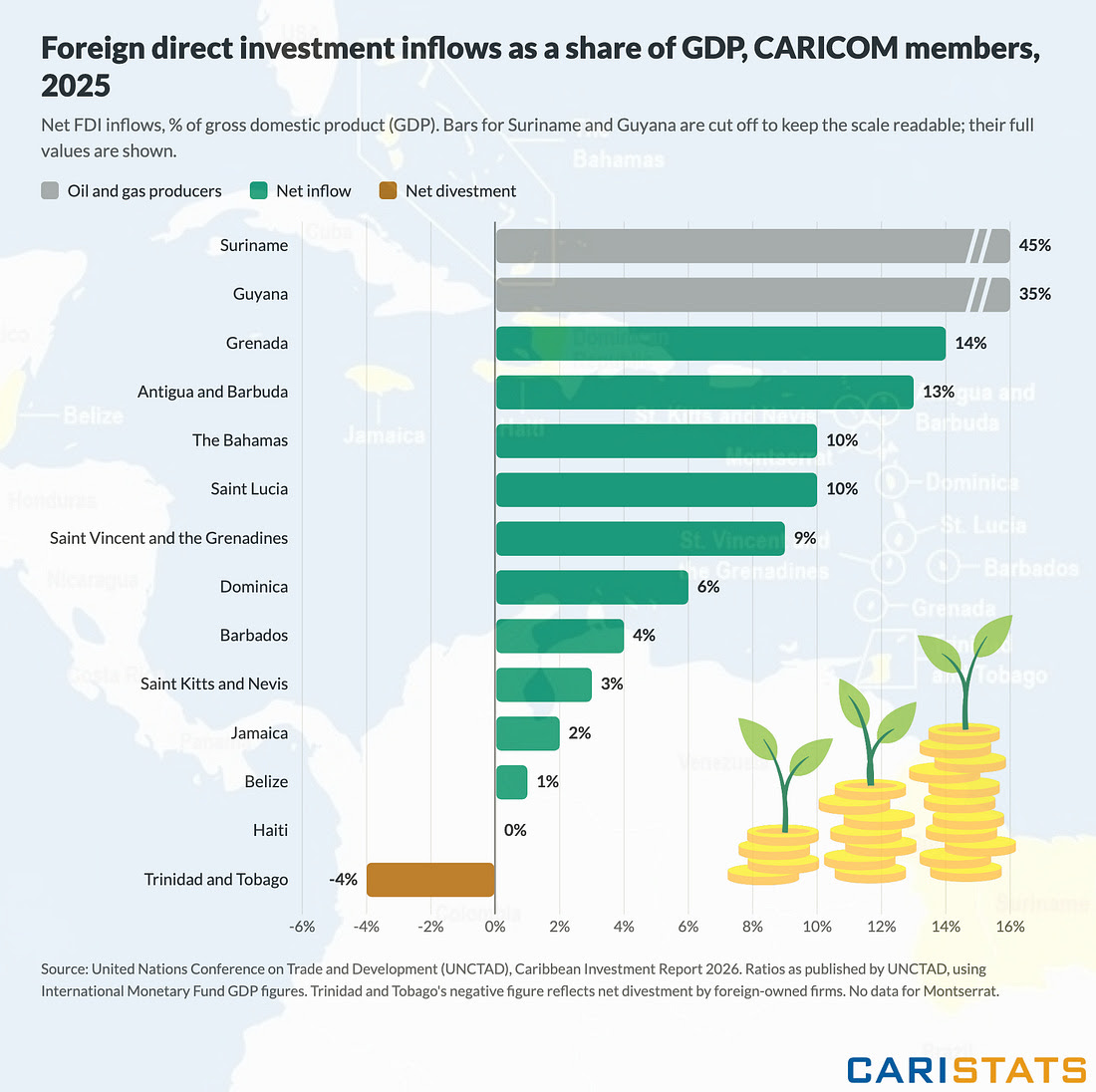
Conventional assessments of foreign direct investment (FDI) that rely exclusively on absolute U.S. dollar totals inherently skew outcomes to prioritize the world’s largest economic powers, masking critical nuances in how cross-border capital flows relative to the actual scale of local economies. Newly released data from the United Nations Conference on Trade and Development (UNCTAD) 2026 Caribbean Investment Report, which calculates FDI inflows as a proportion of national gross domestic product using verified IMF GDP metrics, paints a far more granular portrait of capital distribution across the Caribbean region for 2025. The data shows four small island nations leading the regional rankings: Grenada posted the highest FDI-to-GDP ratio at 14%, driven by $207 million in total inbound investment, followed by Antigua and Barbuda at 13%, with The Bahamas and Saint Lucia tied at a 10% share. Notably, small geographic and economic size alone does not predetermine elevated FDI performance, the report clarifies. Dominica and Saint Kitts and Nevis, both with smaller overall economic footprints than Grenada, recorded far lower FDI-to-GDP ratios of 6% and 3% respectively, while The Bahamas, an economy vastly larger than Saint Lucia, matched the latter’s 10% ratio, dispelling any linear correlation between national scale and proportional FDI intake. Two South American Caribbean-bordering nations stand out as outliers by a wide margin: Suriname logged an extraordinary 45% FDI-to-GDP share and Guyana 35%, a divergence the report attributes almost entirely to surging investment in their booming oil and gas extraction sectors. The data also exposes significant year-over-year volatility in regional FDI trends. Belize saw its FDI-to-GDP ratio plummet from 5% in 2024 to just 1% in 2025, while Saint Kitts and Nevis’ share dropped from 6% to 3%, though UNCTAD notes both declines followed historically unusual peak investment years that made a statistical pullback inevitable. Most notably, Trinidad and Tobago recorded net FDI divestment equal to 4% of its total GDP, a shift driven by foreign-operated firms in the country paying out more in capital outflows than they generated in new earnings, or registering net operating losses. The report underscores that for any economy where FDI makes up 10% or more of total GDP, even minor fluctuations in inbound capital can trigger cascading ripple effects across local construction activity, formal employment levels, and the stability of national foreign currency reserves.
Antigua and Barbuda Among Caribbean’s Top Countries for Foreign Investment in 2025