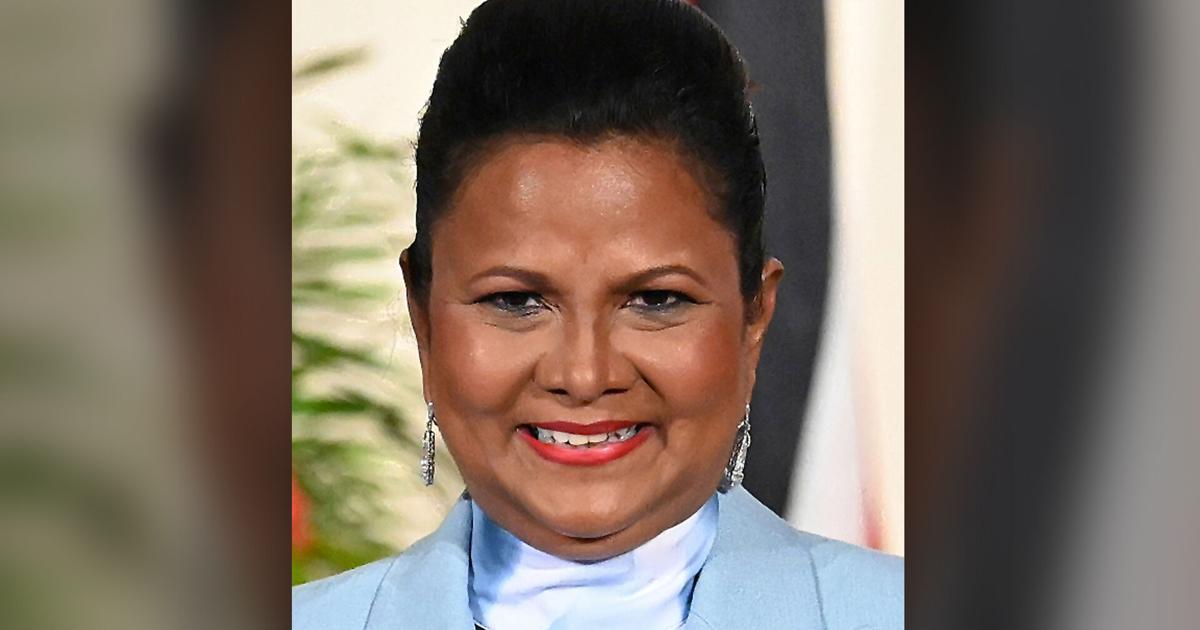
As Trinidad and Tobago marks 50 years since it became a republic, President Christine Kangaloo has delivered a landmark national address urging the country to prioritize the protection of civil liberties even as it confronts a devastating national crime wave. In her official Republic Day message, Kangaloo warned that widespread public fear over rising violent crime must not be allowed to erode the fundamental rights that form the backbone of the nation’s constitutional democracy.
Acknowledging the deep harm crime has inflicted across communities, leaving countless households gripped by grief and constant anxiety, Kangaloo reaffirmed the state’s non-negotiable obligation to protect human life, uphold public order, and guarantee all citizens the right to live free from fear. But she emphasized that a truly mature republic must advance both collective security and individual freedom simultaneously, arguing that any public safety measures adopted must meet strict legal standards: they must be necessary, proportionate, transparent, and fully accountable to the rule of law.
“Exceptional emergency powers must remain truly exceptional,” Kangaloo stressed. She cautioned that fear can insidiously shift public opinion over time, leading communities to mistakenly view freedom as a barrier to public safety. “Rights surrendered in anxious times are not always easily recovered,” she added, noting that the strength of a constitutional democracy is not measured by its ability to wield unchecked power, but by its capacity to govern effectively while upholding the inherent dignity and freedom of every citizen it serves.
Against the backdrop of the 50th republic anniversary, Kangaloo framed the milestone not as an occasion for empty celebration alone, but as a critical moment for national reflection. The anniversary, she argued, demands that the nation answer pressing questions: have we only preserved the formal institutions of the republic, or have we upheld its core democratic values? Does public power get exercised with intentional restraint? Is political disagreement conducted with mutual respect? Does every citizen hold equal standing under the law? Are both liberty and security equally protected for all?
She also addressed the declining standards of political and civic discourse in the diverse nation, warning that the republic is weakened when respectful debate gives way to mockery, when simplistic labels replace substantive argument, and when inflammatory provocation is misinterpreted as strength. “Courtesy is not weakness, and restraint is not timidity,” Kangaloo said. “They are disciplines of democratic leadership, especially in a society as varied and closely woven as ours.”
Looking back to the nation’s 1976 transition to a republic, Kangaloo recalled that the historic decision was rooted in national self-confidence. It was a public declaration that while Trinidad and Tobago would remain open to global engagement, it would not copy the political divisions, anger, or culture of contempt seen in other nations. The country can learn from global partners without adopting their most harmful divisions, she argued, allowing it to engage the world confidently while retaining its distinct national identity.
Out of the nation’s overlapping, diverse histories, cultures, and faiths, Kangaloo noted that Trinidad and Tobago has built a rare, inclusive national identity spacious enough to welcome every community. This unique inheritance carries a core obligation: no citizen should ever be reduced to a simplistic identity label, and no group should ever be made to feel their place in the republic is conditional. Equal citizenship means the republic belongs fully and equally to every person — not as a granted permission, not tied to ancestry, and not dependent on political convenience.
Beyond the responsibilities of elected leaders, Kangaloo emphasized that ordinary citizens also hold a critical role in sustaining the nation’s democracy. Civic duty does not end at casting a vote or supporting aligned political actors, she explained. It also requires holding public power to account, defending the rights of others with the same care one defends their own, rejecting divisive language that erodes national communal life, and demanding that public institutions serve the entire nation, not just narrow interests.
The long-term health of the republic, she added, depends not only on the standards leaders choose to uphold, but also on the standards citizens demand from those who govern them. Fifty years after becoming a republic, the core question facing the nation is no longer whether Trinidadians and Tobagonians are capable of governing themselves — it is whether they will choose to govern themselves well: with courage, but without cruelty; with vigilance against threats, but without being ruled by fear; with pride in national identity, but without hostility toward those who are different.
Finally, Kangaloo reminded citizens that the republic is far more than the 1976 constitutional framework that established it. It is a daily, deliberate choice: to live as one united people under the rule of law, to preserve both public order and individual freedom, and to hold space for every citizen equally within the national community. “If we make that choice deliberately and consistently, we will not simply commemorate the promise of the Republic. We will renew it,” she concluded.