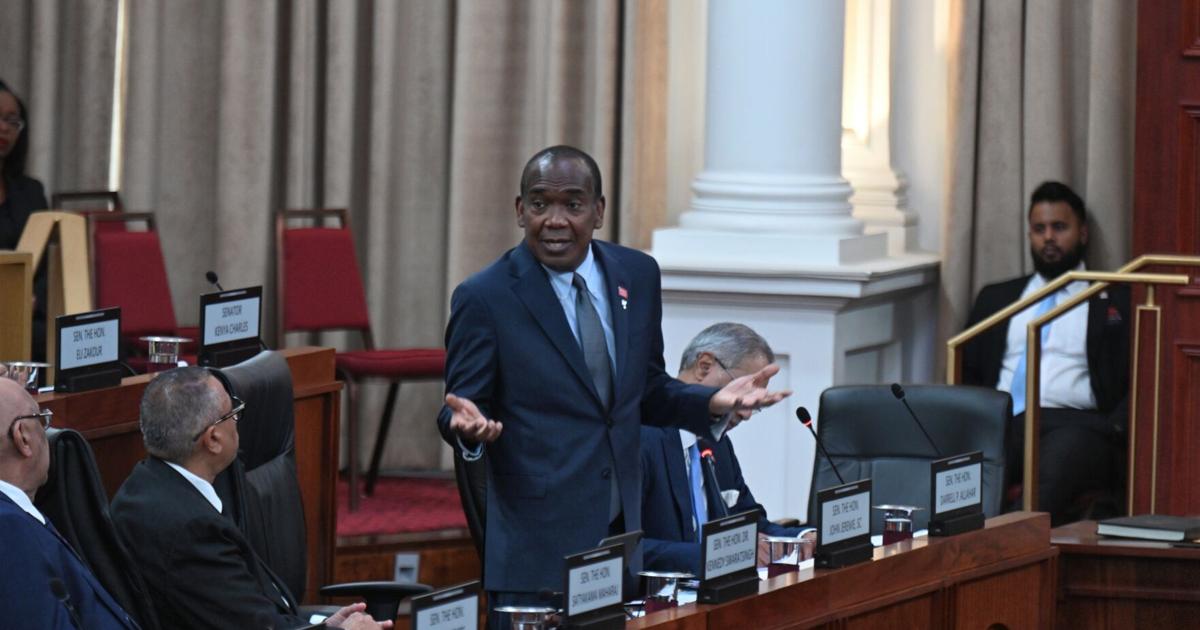
A fiery Senate debate over the 2026 Special Operations Bill has put Trinidad and Tobago’s government and opposition at odds, as the administration pushes forward with a sweeping new crackdown on transnational drug trafficking, gang violence and organized crime.
Opening the debate in defense of the legislation, Attorney General John Jeremie delivered an uncompromising message to drug traffickers who have long relied on political connections and state protection to operate: exit the trade now, before the new law brings severe consequences. “If you are involved in the trafficking of narcotics, if you think that you have the in with the State that you have enjoyed for a decade, the message is simple. I am asking you to quit while you are ahead,” Jeremie told the upper chamber.
Jeremie emphasized that the government has no intention of backing down from its offensive against criminal networks, noting that all Trinidad and Tobago citizens hold a fundamental right to live free from pervasive fear. For him, true public peace means residents can walk their neighborhoods, commute to work, and return home each day with full confidence that their lives and personal freedoms are protected. He added that a functional, orderly society cannot exist without respect for the rule of law, acknowledging that while not every new policy will win universal popularity, democratic governance requires all laws to be followed consistently by all members of society.
The Special Operations Bill lays out a framework for dividing Trinidad and Tobago into dedicated policing districts, authorizing law enforcement to carry out targeted anti-crime operations in high-risk areas, with the option to call on support from the national Defence Force. It also requires monthly public reports on the scope and outcomes of these operations to be submitted to the Prime Minister and relevant cabinet ministers.
Much of the debate centered on fierce pushback from Jeremie against opposition criticism that framed the bill as racially discriminatory and comparable to apartheid-era South African policy. Jeremie forcefully rejected these claims, tracing the opposition’s racial rhetoric to the harmful racial hierarchy imposed during the transatlantic slave trade, where lighter-skinned enslaved people often internalized white supremacist tropes to demean darker-skinned enslaved people. He noted that the current opposition’s racial attacks are targeted at two senior government figures: a woman of color and a Black man, making the rhetoric particularly insidious.
Calling the comparison to apartheid deeply objectionable, Jeremie reminded senators that apartheid was a formal system of state-enforced racial segregation that allowed a white minority to systematically oppress and dehumanize a Black majority. He argued that invoking this violent history in a debate over legislation designed explicitly to protect the right to safety of Black communities across Trinidad and Tobago is far more than accidental overstatement.
“To invoke that history here while our black children are being slaughtered in the streets of their own communities is not careless rhetoric. It demands that we examine the assumptions beneath it,” he said. “What is particularly shameful is that some who have enjoyed extraordinary privilege and accumulated extraordinary wealth would lecture us on oppression while the blood of young people of colour, many of whom will never see their 20th birthday, runs through our streets.” Jeremie closed his rebuttal by urging all senators to reject the opposition’s racially charged line of criticism.
For his part, Opposition Senator Faris Al-Rawi laid out a series of procedural and constitutional concerns about the legislation, arguing that the selective implementation of special operations outlined by the government would only displace criminal activity rather than eliminate it. Al-Rawi warned that if the government only applies the new hardline measures in non-government held districts, drug traffickers and gang members would simply relocate to areas where the rules are less strict, leaving the overall problem of violence unchanged.
Al-Rawi also questioned the bill’s provisions allowing the Prime Minister to access detailed law enforcement information on criminal cases, noting the legislation includes no explicit limits on what information can be requested or how it can be used. He raised alarms that this framework could open the door to political interference in prosecutorial decisions, charging and targeting of individuals under the law. He tied these concerns to recent public comments from opposition leader Kamla Persad-Bissessar, who noted the government has already signaled it will not impose special operations in ruling PNM-controlled districts where local representatives and residents oppose the measures.
Under Trinidad and Tobago’s Constitution, all national legislation must be enacted for the peace, order and good governance of the entire country. Al-Rawi argued that the proposed selective application of the bill makes it inherently unconstitutional, because it targets specific groups and regions rather than applying uniformly across the nation. He confirmed the opposition remains united in its position that the law is unconstitutional and cannot withstand legal challenge.
Despite the opposition’s widespread criticism, the bill was widely expected to pass the Senate on the night of the debate, backed by the government’s governing majority.