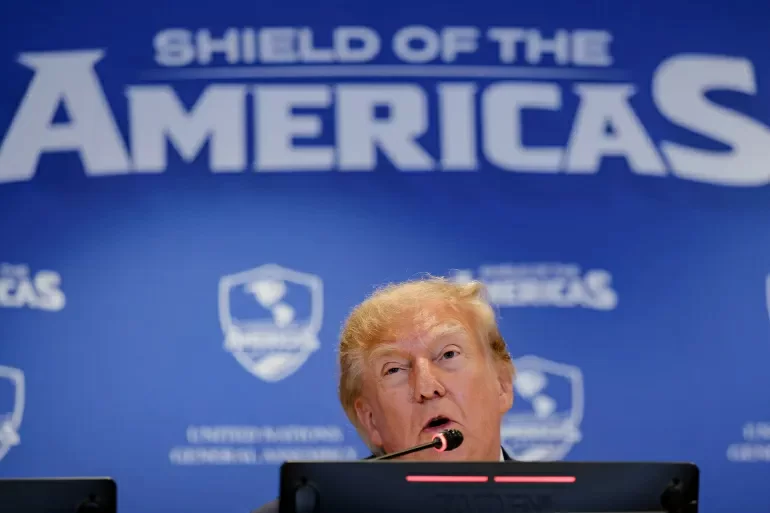
On the margins of the 81st United Nations General Assembly in New York, the United States advanced a new push to coordinate regional action against transnational criminal networks and drug cartels on September 22, 2026. Speaking at a gathering of the Washington-led ‘Shield of the Americas’ coalition, U.S. President Donald Trump called on participating nations to collectively designate 24 violent criminal groups as shared threats to regional security.
Following Trump’s address, the 15 member countries of the coalition released a joint declaration announcing plans to implement coordinated countermeasures, asset freezes, visa restrictions, and criminal prosecutions targeting group members, financiers, and facilitators who knowingly provide material or logistical support to the designated organizations. While the agreement marks a tangible expansion of cross-border security cooperation, it does not mandate immediate uniform sanctions across all participating states, as most nations require domestic legislative or judicial adjustments to align national law with the new commitments.
The newly released designation list includes two groups already labeled as terrorist organizations by the U.S.: Mara Salvatrucha (MS-13) and Tren de Aragua. It also encompasses major Mexican drug cartels, Colombia’s National Liberation Army (ELN) guerrilla movement, Brazil’s two largest criminal syndicates Primeiro Comando da Capital (PCC) and Comando Vermelho, and Peru’s Shining Path insurgency. Long framing these groups as more than traditional criminal enterprises, Trump compared the cartels to the Islamic State, referring to them as ‘narco-terrorists’ that demand a unified security response. He reaffirmed that the U.S. maintains ‘unprecedented military power’ to address threats across the Western Hemisphere, framing the war on drug trafficking as a core regional security issue rather than a narrow law enforcement matter.
The 15 signatory governments include the U.S., Argentina, Bolivia, Chile, Colombia, Costa Rica, the Dominican Republic, Ecuador, El Salvador, Guyana, Honduras, Panama, Paraguay, Peru, and Trinidad and Tobago. Notably absent are Latin America’s two largest economies: Mexico and Brazil. Colombia’s participation marks a significant shift, as the country had declined to join previous similar coalition statements, though it still needs to pass new domestic legislation to implement the agreed sanctions. Al Jazeera correspondent Alessandro Rampietti noted that the declaration is, for now, primarily a symbolic political step, with operationalization dependent on national-level legal processes.
The new diplomatic agreement comes as the U.S. has already dramatically escalated its own unilateral military campaign against alleged drug smuggling operations. Since September 2025, the U.S. military has carried out dozens of airstrikes and raids on vessels in the Caribbean Sea and eastern Pacific Ocean, claiming all targeted boats were involved in drug trafficking. However, the campaign has drawn sharp international condemnation: United Nations special rapporteur Ben Saul has concluded the operations may violate international law and could amount to crimes against humanity. Saul’s analysis records at least 223 deaths across 68 attacks between September 2025 and August 2026, with a further four killed in a new strike carried out over the preceding weekend, pushing the total confirmed death toll above 230. Washington has defended the operations as part of an armed conflict against drug cartels, arguing they are necessary to stop illicit drug flows into the U.S. Critics counter that the Trump administration has released little public evidence confirming the identity or smuggling activities of those killed on the targeted vessels.
Beyond counter-narcotics cooperation, the Shield of the Americas initiative carries broader geopolitical meaning. The Trump administration has spent recent months aggressively pushing for a greater U.S. role in the Western Hemisphere, with officials discussing a renewed interpretation of the 19th-century Monroe Doctrine – the principle that originally sought to block European interference in the Americas and later became associated with U.S. regional dominance. The current administration has tied security cooperation to trade, energy policy, border control, and access to strategic critical minerals. Bilateral talks between U.S. and Ecuadorian officials this week covered not only anti-cartel action but also oil, natural gas, and critical mineral access, though no formal agreement on resources has been made public. This expanded U.S. push has sparked widespread concerns across Latin America over national sovereignty and growing American interference in regional affairs.
Brazil, which remains outside the coalition, has openly pushed back against the initiative. In his address to the UN General Assembly, Brazilian President Luiz Inácio Lula da Silva issued a clear rebuke without naming the U.S. directly, warning against ‘renewed hegemonic temptations’ in Latin America and the Caribbean. ‘Brazil does not fit into anyone’s backyard,’ he stated. Lula emphasized that countering transnational organized crime requires global cooperation, but Brazil’s approach diverges sharply from Washington’s: it prioritizes national sovereignty, multilateral diplomacy, and inclusive regional cooperation, in contrast to the Trump administration’s reliance on U.S. military power and unilateral security tools. Mexico has also declined to join the coalition.
The joint sanctions declaration is both a concrete security measure and a high-stakes diplomatic signal. For participating countries, closer collaboration under the framework could streamline intelligence sharing and disrupt cross-border criminal networks that operate across multiple jurisdictions. Yet the actual scope of operational cooperation remains uncertain: the declaration does not legally bind the 15 nations to identical measures, and most proposed sanctions still face lengthy domestic legal hurdles. Over the coming months, the initiative will face a critical test: whether it evolves into a fully functional operational partnership or remains primarily a political signaling platform. The U.S.’s unilateral military campaign remains the most contentious sticking point, as Washington seeks regional backing for harder action against cartels while global debate grows over the legal limits of using lethal military force against suspected drug traffickers. The New York gathering has opened a new chapter in U.S. counter-narcotics strategy – one that brings deeper regional coordination, but also new, unresolved questions over sovereignty, evidence standards, and compliance with international law.