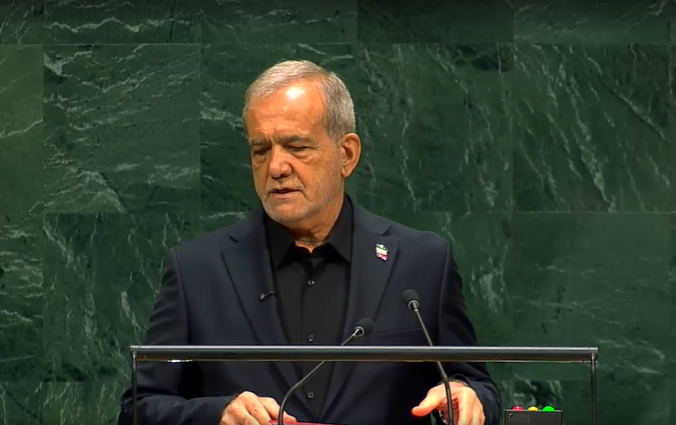
Amid spiraling regional tensions that have put the global community on high alert, Iranian President Masoud Pezeshkian delivered a firm rejection of escalating threats from the United States during his address to the United Nations General Assembly in Manhattan on September 23, pushing back hard against Washington’s designation of Iran as a terrorist state while vowing unwavering defense of his nation’s sovereignty and security.
Pezeshkian’s speech came just 24 hours after former U.S. President Donald Trump used his own UN platform to issue a harsh warning to Iranian leadership and repeat the controversial terrorist labeling, marking the latest escalation in a years-long standoff between the two countries. Speaking to assembled global delegates, the Iranian leader centered much of his address on the devastating human toll of sustained attacks targeting his country, laying out a litany of alleged unlawful actions by the U.S. and Israel against Iranian civilian infrastructure and innocent people.
“I come from an Iran where, in truth, they bombed a school. You see these children? These children perished under bombs, with weapons used by the United States and Israel. They were innocent, had committed no crimes,” Pezeshkian told the assembly. He went on to accuse U.S. and Israeli forces of striking a civilian sports hall full of children in the Iranian city of Lamerd using multi-warhead weapons, adding that countless unarmed Iranian civilians – including top scientists, women and children – have been targeted in unlawful assassinations and attacks.
“They martyred, assassinated, our scientists, our men, women, and children. Innocent children who, in truth, had committed no crimes, no sins,” he said.
Rejecting the U.S. characterization of Iran as a state sponsor of terrorism outright, Pezeshkian argued that the label is a cynical projection by the actors that actually support and harbor violent groups. He emphasized that all of Tehran’s actions have been rooted in self-defense, not aggression. “Those who are terrorists and train and protect terrorists describe us as such. We have only defended ourselves. We are not terrorists,” he added.
Pezeshhkian acknowledged that Iran has faced relentless cross-border attacks and targeted assaults in recent years, but stressed that his country has never surrendered to external pressure. “Yes, they did hit us, but we did not bend the knee. We did not bow our head. We responded, but we did not hit civilian populations,” he said. He further accused the U.S. and Israel of intentionally targeting Iranian civilian infrastructure – including universities, hospitals, schools, and healthcare centers – actions that he said flagrantly violate core tenets of international law.
The Iranian leader also referenced the high-profile assassination of Hamas political leader Ismail Haniyeh, which took place on Iranian soil just as he was taking office as president, as a fresh example of external aggression against his nation. Turning to the broader Middle East conflict, Pezeshkian condemned what he called Israeli genocide in the Gaza Strip, noting that more than 80,000 Palestinian civilians have been killed and hundreds of thousands displaced by the ongoing military campaign.
Pushing back against widespread international narratives that frame Iran as a primary source of regional instability, Pezeshkian clarified that Tehran only seeks full national independence and the inherent right to defend its territory. He explained that Iran’s pursuit of military strength is purely a deterrent measure designed to prevent future attacks, not a tool for expansion or aggression. “Iran must be powerful so as to avoid being threatened, to avoid its future being threatened,” he said. “We do not seek power in order to attack or commit aggression. We seek energy for progress, not to threaten societies with weapons.”
He stressed that Iran would never ask permission from foreign powers to exercise its right to self-defense, a direct rebuke to U.S. and European demands for limits on Iran’s military and nuclear activities. On the topic of Iran’s nuclear program, Pezeshkian defended Tehran’s sovereign right to develop peaceful nuclear technology for civilian energy and medical purposes, rejecting decades of international sanctions and diplomatic pressure as unlawful overreach.
Pezeshkian’s remarks come at a time of sustained heightened tension between Tehran and Washington, with the escalating regional confrontation drawing widespread global concern over its catastrophic humanitarian and cross-border security implications. In closing, the Iranian president reaffirmed that his country’s military capabilities are solely intended to ensure that any attack on Iranian civilians does not go unanswered, and emphasized that Iran does not build its own national security on the insecurity of other nations in the region.