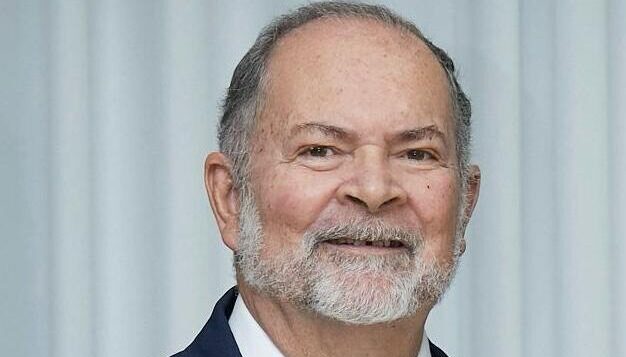
Some lives transcend mere personal biography, becoming living windows through which we can observe the unfolding of national and regional history. Henry Volney, a legendary Dominican educator born in 1952 in Montserrat at the end of British colonial rule in the Caribbean, is exactly such a figure. His life story tracks the full arc of Dominica’s transformation from a stratified British colonial territory to an independent, self-determining Caribbean nation, with his 50-year career in education placing him at the center of that transition.
Volney was born into a well-connected regional Caribbean family. His father, Cyril Frederick Louis Volney, was a St. Lucian engineer working for Cable & Wireless, a role that required the family to relocate constantly across Eastern Caribbean islands. His mother, Rosalind Nicholls-Volney, came from one of Dominica’s oldest established colonial families, a lineage that includes prominent political activist and Dominica Labour Party co-founder Phyllis Shand Allfrey. Raised moving between schools in Montserrat, Dominica, Barbados, Antigua, and St. Kitts as one of nine children, Volney developed a uniquely integrated regional outlook decades before official Caribbean integration initiatives such as CARICOM became a common policy priority. Like many Caribbean families of his generation, his siblings scattered across the region, Britain, and North America, entering professions ranging from banking to medicine, with his brother Herbert Volney going on to become a prominent jurist and public figure in Trinidad and Tobago.
In 1961, at age nine, Volney passed the entrance exam for St. Mary’s Academy (SMA) in Dominica’s capital Roseau, where his education was shaped profoundly by the Congregation of Christian Brothers, a Catholic teaching order that ran the school from 1956 through the turbulent early 1970s. For Volney, the Christian Brothers’ legacy extended far beyond religious instruction: they brought structured academic culture, a wide range of extracurricular activities from sports to the Glee Club, and a key inclusive innovation that transformed outcomes for low-income students: evening study sessions. For boys from homes with no or unreliable electricity, the lit school campus allowed them to study after dark, removing poverty as a barrier to academic progress. The school’s lively extracurricular culture even drew future cultural icons, including Cadence-Lypso pioneer Gordon Henderson, who competed in student boxing matches on the SMA yard. Volney himself was both a scholar and athlete, competing in cricket, football, and basketball throughout his student years.
By the late 1960s and early 1970s, the shifting global tides of Black Power, African independence, and civil rights reached SMA, challenging the colonial-era norms that structured school life. Young Caribbean activists drew inspiration from radical thinkers including Frantz Fanon, C.L.R. James, Walter Rodney, and Malcolm X, questioning why European standards of identity, dress, and behavior remained unchallenged in a majority Black society approaching independence. A 1972 confrontation over a student’s Afro hairstyle erupted into a student strike and broader racial reckoning that disrupted the Christian Brothers’ mission. Though Volney had already graduated by that point, the changing political climate shaped the rest of his career as an educator: when he returned to teaching, he encountered a generation of students that no longer accepted inherited colonial authority without question.
Volney was among the small number of Dominicans of his generation to earn a university education, studying History and Economics at the University of the West Indies Cave Hill Campus in Barbados. At a time when a university degree marked membership in an emerging Caribbean intellectual class, the study of history carried unique weight: it allowed a new generation of Caribbean scholars to confront the region’s hidden histories of slavery, resistance, anti-colonial struggle, and African civilization. Returning to Dominica, Volney took up his life’s work as an educator, first at his alma mater St. Mary’s Academy, where he earned a reputation as a demanding but knowledgeable history teacher who upheld the school’s high academic standards.
He later moved to Dominica’s Sixth Form College, known affectionately to generations of students as SiFoCol, which emerged in the mid-1970s as the key bridge between secondary school and university for Dominican students, centralizing advanced-level instruction that had previously been scattered across multiple institutions. Before mass access to overseas universities, SiFoCol provided an affordable path to higher study for talented students from all backgrounds, and its graduates went on to fill the professional and public institutions of the newly independent Dominican state. Volney became one of the college’s defining educators: in 1990, after Rupert Sorhaindo left academia to enter government, Volney was appointed Director of the Academic Studies Division, the successor to SiFoCol, a role he held until 1998, with encouragement from his wife Carmen Yvonne Severin Volney, whom he married that same year. The couple had one daughter, Giselle, who went on to become a physician. After stepping down from administration, Volney continued to coordinate the A-Level programme at the newly consolidated Dominica State College, remaining active in the role as recently as 2015, closing out a nearly 50-year career in Dominican education.
In reflections on modern Dominican society, Volney raises provocative, challenging questions about contemporary education and youth outcomes. He expresses particular concern over a decades-long trend he has observed: declining academic ambition among Dominican boys, with women now outnumbering men by ratios as high as 7 or 8 to 2 or 3 in advanced academic programmes. Volney attributes this gap in part to differing family discipline norms: he argues that girls are often held to stricter standards and closer supervision during the critical adolescent years between 13 and 18, while boys are given excessive freedom that allows them to drift away from formal study. For too many young men, he laments, ambition has shrunk to little more than acquiring a motorcycle, a metaphor for a cultural shift that prioritizes immediate consumption and display over long-term investment in education, profession, and public service.
Volney also speaks candidly from decades of classroom experience about the impact of adolescent marijuana use. He argues that the normalization of casual marijuana use among teenagers has disproportionately harmed young men, with drug use and peer pressure displacing academic study for vulnerable adolescents. For Volney, the core question is developmental: how does drug use affect a teenager’s ability to build self-discipline, prioritize study, and delay gratification? He warns that when family supervision breaks down, marijuana use can be a first step toward broader disengagement from education and exposure to more harmful substances and criminal activity, a conclusion drawn from 50 years of firsthand observation of Dominican students.
Beyond academic outcomes, Volney worries about declining standards of deportment and linguistic range among young Dominicans. He recalls an educational culture that expected young people to master the social skills of greeting elders, communicating clearly, and code-switching between Dominican Creole for everyday life and Standard English for professional, academic, and international settings. He argues that reduced reading habits have shrunk vocabulary and weakened the capacity for clear, nuanced thought, since the ability to distinguish between ideas is tied directly to the language available to express them. His concern with manners, he argues, goes beyond etiquette: courtesy is a form of social discipline, and a society that cannot extend basic respect or disagree without abuse loses the habits needed for healthy collective life.
Crucially, Volney’s nostalgia for the discipline and standards of the past is not a call to return to colonial rule. He acknowledges openly that colonial Caribbean society was defined by profound injustice: rigid racial hierarchy, restricted political power, class barriers, and limited educational access for the majority of the population. His argument is not that Dominica should recreate colonial society, but that independent Dominica should retain the useful elements of that educational inheritance—discipline, high academic standards, and a focus on responsibility—while discarding its oppressive structures. A nation, he argues, reaches maturity when it can distinguish between the useful parts of its history and the injustices of its past.
Volney also offers a sharp critique of the direction of modern Dominican education, arguing that current schooling is insufficiently aligned with the country’s economic needs. He calls for expanded practical and technical education to train Dominicans for key sectors including agriculture, tourism, construction, hospitality, engineering, the marine economy, technology, and entrepreneurship, warning that the current system too often acts as an assembly line that pushes talented young Dominicans to pursue conventional university degrees only to leave the country for work abroad. Access to education, he argues, is not enough: education must serve the specific needs of the Dominican nation. SiFoCol, which Volney helped lead, now forms part of the foundation of Dominica State College, which consolidated all of the island’s post-secondary education institutions in 2002.
Outside the classroom, Volney is an accomplished competitive bridge player, having represented Dominica in regional competitions for decades, including a second-place finish in the 2013 OECS Open Pairs championship. He continues to organize and promote the game in Dominica in retirement, a pursuit that aligns perfectly with his lifelong focus on sharpening critical thinking and strategic thought.
The value of Volney’s testimony does not lie in expecting every reader to accept all of his arguments without question. Instead, its power comes from the perspective it preserves: that of a man who lived through every stage of Dominica’s transition from colony to independent nation. Born into colonialism, from a family tied to the old colonial professional establishment, shaped by the Christian Brothers school system, present for the Black Power upheavals that challenged colonial authority, one of the first Caribbean-trained university graduates to return home to teach, and a mentor to the generation of independence-era scholars who now preserve Dominican history, Volney has a unique vantage point.
As an elder, he asks the uncomfortable questions that deserve to be heard, even when we disagree with his answers: Why are so many boys falling behind academically? What has happened to collective ambition? What role do families play in supporting adolescent achievement? How does reading and language shape the capacity for thought? What kind of education does an independent Dominica actually need to prosper? The world Volney describes, of scarce university places, night study under electric lights, student strikes challenging colonial authority, and education that could transform an entire family’s trajectory, has passed. But the lessons he draws from that world, and the questions he poses, remain as relevant as ever for modern Dominica. His story is not just the biography of a distinguished educator: it is the story of a nation crossing the bridge from colony to independent state, and the teacher who stood in the classroom as history unfolded around him.