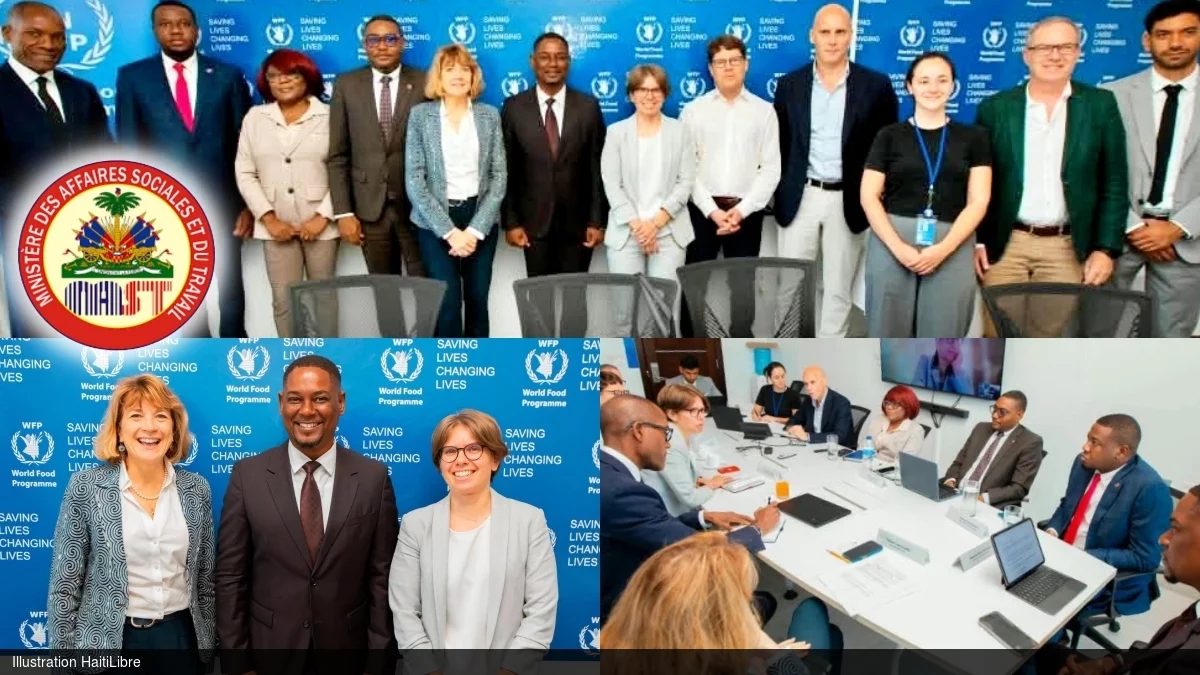
Haiti’s Ministry of Social Affairs and Labor (MAST) is moving forward with an ambitious plan to consolidate and expand national social protection systems, as senior officials met this week with key international partners to map out the transition of the Adaptive Social Protection for Increased Resilience program, widely known as Klere Chimen, to full government leadership. MAST Minister Marc-Elie Nelson led the discussions, with representatives from the World Food Programme (WFP), World Bank, and Swiss Cooperation in attendance, alongside MAST’s own technical team from the Program Studies Unit. The gathering comes at a critical juncture for the partnership, as stakeholders work to shift direct implementation responsibility from international bodies to the Haitian government.
Core topics on the meeting agenda included consolidating existing program gains, outlining a phased handover of responsibilities to MAST, strengthening national institutional capacities, and laying the groundwork to expand Klere Chimen coverage to all 10 of Haiti’s administrative departments. Minister Nelson opened the discussion by praising the sustained commitment of the three international partners, highlighting the complementary nature of their financial and technical support. Specifically, he noted that Swiss Cooperation’s contribution augments World Bank financing for the PSARA initiative, creating a collaborative model that demonstrates the value of national leadership in international development partnerships.
Nelson emphasized that the impact of Klere Chimen extends far beyond the success of a single targeted project. Instead, he framed the program as a foundational lever to strengthen Haiti’s entire national social protection system, with priority areas including institutional capacity building, upgrading MAST’s internal information system (SIMAST), improving beneficiary payment mechanisms, streamlining beneficiary management, and better coordinating cross-sector social protection interventions. While the minister expressed enthusiasm for the transition to national implementation, he stressed that the handover process must be gradual, well-structured, and risk-mitigated. “Transferring responsibilities without transferring capacities undermines the sustainability of public action,” Nelson noted, arguing that capacity building must go hand-in-hand with the devolution of program ownership.
To date, the Klere Chimen program has already yielded actionable operational infrastructure in key areas including cash transfer distribution, beneficiary targeting, payment processing, case management, grievance resolution, and program monitoring and evaluation. These existing systems create a solid foundation for program expansion, but the minister stressed that the transition must not disrupt support for vulnerable households. To guarantee continuous service delivery and benefit access, MAST has called for the development of a joint coordinated roadmap that clearly outlines transferred responsibilities, capacity building priorities, technical assistance requirements, implementation timelines, and accountability and monitoring frameworks.
Beyond the Klere Chimen transition, meeting participants also agreed on the need to move away from a model of disconnected, standalone projects toward a unified, coherent, and sustainable national social protection ecosystem. Minister Nelson noted that Haiti’s existing National Policy for Social Protection and Promotion (PNPPS) is the appropriate strategic framework to align and harmonize disparate interventions across the sector. He proposed that the ongoing drafting of national policy implementation plans draw directly from the Klere Chimen experience and its successful model of complementary partnership between the Haitian government, World Bank, Swiss Cooperation, and WFP. “Partner funding must gradually contribute to a unified national architecture,” Nelson stated, explaining that this approach will prevent the growth of uncoordinated parallel systems and ensure that international investment directly strengthens Haitian public institutions for long-term sustainability.
A central role in this unified architecture is earmarked for SIMAST, the MAST information system. The Haitian government is advancing legislation to designate SIMAST as the single official social registry for the entire Haitian state, with a draft decree currently in development. A separate proposed order to establish the DTSI-MAST (Directorate of Information Systems and Statistics at MAST) will also strengthen the technical and institutional foundation of the ministry’s information systems. Additionally, plans to adopt innovative alternative data collection methods are expected to rapidly expand SIMAST coverage, even in hard-to-reach rural areas and during emergency response scenarios.
Following the conclusion of the meeting, Minister Nelson reaffirmed his commitment to maintaining open dialogue with the three international partners around a shared five-pillar agenda: expanding Klere Chimen national coverage, formalizing the institutional role of SIMAST, harmonizing beneficiary targeting practices, scaling up adaptive social protection programs, and strengthening national coordination mechanisms. “Every investment made today must contribute to making the national social protection system stronger tomorrow,” Nelson concluded.